
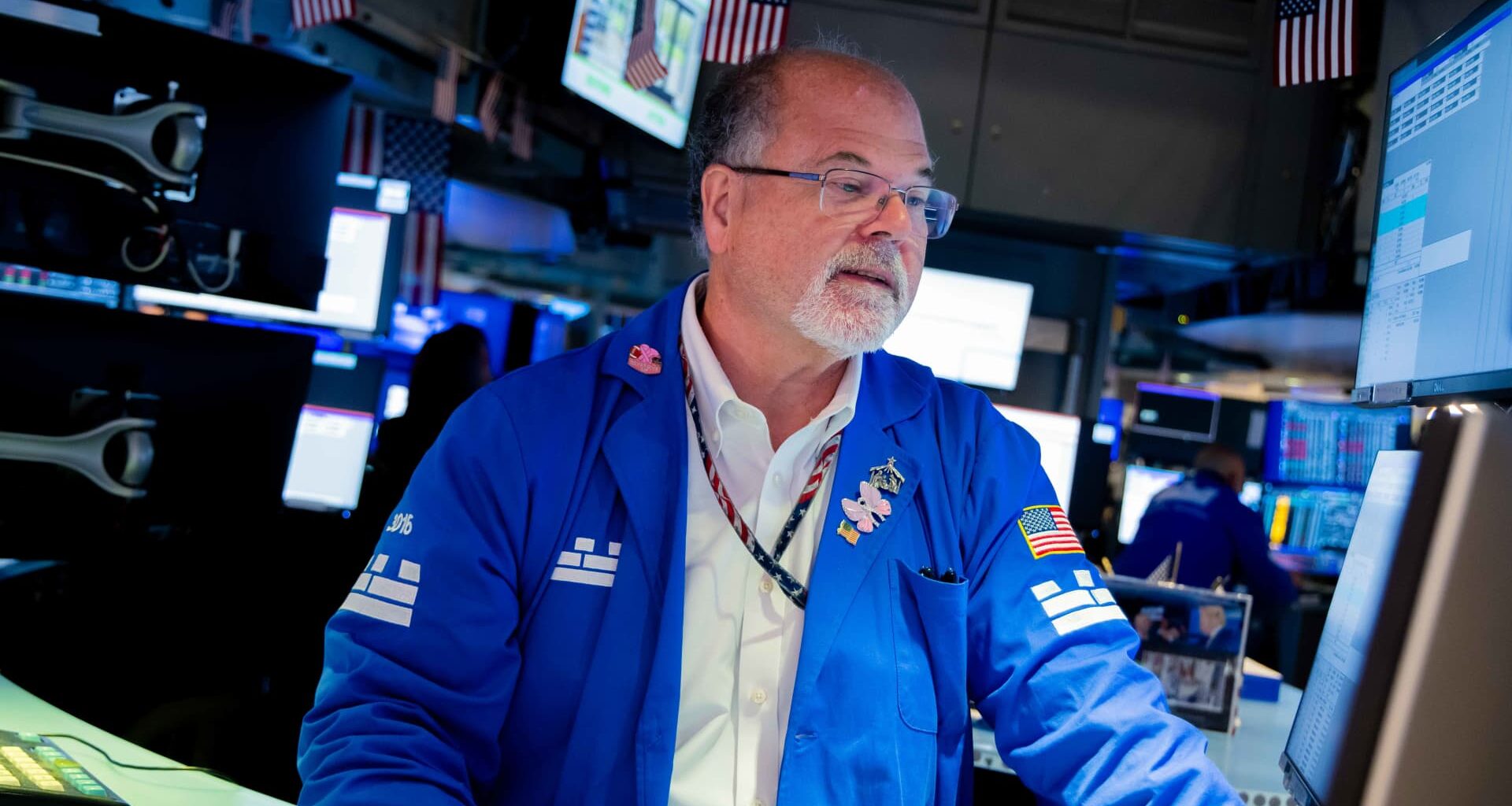
Traders work on the floor of the New York Stock Exchange.
NYSE
Stocks rose Friday, rebounding after four straight days of declines, as oil prices retreated. Traders also looked past growing expectations of a Federal Reserve rate hike following the latest U.S. inflation reading.
The Dow Jones Industrial Average advanced 509.19 points, or 0.98%, to close at 52,573.29. The S&P 500 climbed 0.86% to 7,656.98, while the Nasdaq Composite jumped 0.96% to end at 26,333.04.
The three major averages had fallen for four consecutive sessions. For the Dow, it was the longest daily losing streak since late April. Week to date, the Dow fell 1.6% and the S&P 500 declined 0.8%. The Nasdaq fell about 0.7%, marking its first negative week in three sessions.
Crude prices eased, giving back some of the sharp gains seen this week due to escalating tensions in the Middle East. West Texas Intermediate futures dropped 2.4% to settle at $100.05 per barrel. Brent futures slid 2.8% to $104.61 per barrel.
Still, WTI rallied nearly 10% this week, while Brent popped almost 9%. On top of that, the latest U.S. inflation data shows higher energy prices putting upward pressure on consumer goods.
The consumer price index rose 0.4% in August month over month and 3.4% year over year, matching Dow Jones estimates. Core CPI, which excludes energy and food, climbed 0.3% from the month prior, slightly more than expected.
Yields were mostly steady after the report, though the 2-year Treasury yield topped 4.6% and touched its highest level since July 2024, reflecting increasing expectations of a Federal Reserve rate hike. The CME Group’s FedWatch tool shows a roughly 86% chance of a quarter-point rate hike next week.
“The debate has quickly shifted from whether the Fed will hike to the more important question of how many hikes this cycle will ultimately require,” Seema Shah, chief global strategist at Principal Asset Management, said. “We do not expect the Fed to be one-and-done. This is no longer simply about fine-tuning the economy. After half a decade of above-target inflation, policymakers are likely to conclude that more than one hike will be needed to re-establish price stability.”