
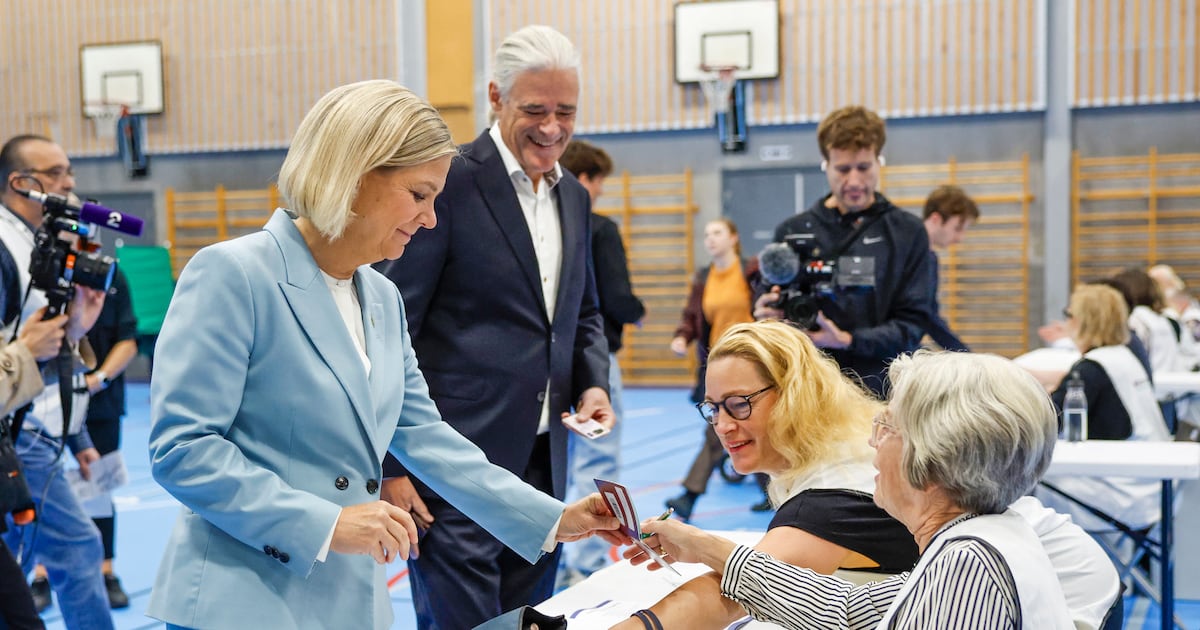
Swedish voters delivered a cliffhanger general election result on Sunday, with early projections showing the outgoing centre-right group of prime minister Ulf Kristersson just one parliamentary seat behind the opposition centre-left camp led by the Social Democrats.
With 10 per cent of districts counted, the opposition Social Democrats led by former prime minster Magdalena Andersson won the election with 27.6 per cent, followed by Ulf Kristersson’s Moderates with 20 per cent.
Taken as part of their traditional blocs, Andersson’s centre-left group would hold 175 votes in the new parliament while the Kristersson-led centre-right group hold 174 seats.
“This is a nail-biting situation, really,” said Prof Henrik Ekengren Oscarsson, political scientist at the University of Gothenburg. “This is a completely unlikely result with a majority of one seat for the opposition, but it could go back and forth all evening,” he said.
The other big news of the evening was an apparent slump in support for the far-right Sweden Democrats, for the first time in its history, to finish on 17.5 per cent support. All large parties lost support on Sunday while Sweden’s smaller parties, key in coalition talks, saw rises in support.
A first projection just before 10pm in Sweden showed a much tighter race than when polls closed at 8pm, with an SVT exit poll indicating a 4.5 point lead for Andersson. Even before polls closed, SVT election analysts urged caution, recalling an exit poll survey four years ago that indicated a Social Democrat victory, only for the result to flip as the night wore on.
Sunday’s election was seen by many analysts as a referendum on whether Swedish voters would support or reject a taboo-shattering plan by Kristersson to bring the Sweden Democrats, a party with with Nazi roots, into power. Kristersson and his centre-right allies promised to maintain their radical correction in migration and asylum policy in Sweden. Once Europe’s most liberal it is now among the most stringent. In addition Kristersson promised to continue its energetic pushback against gangland violence.
Andersson, who served as prime minister for a year until October 2022, vowed to retain tight migration rules and the violent crime pushback, but to introduce addition measures to tackle the roots of that crime. Her Social Democratic Party secretary general, Tobias Baudin, said the positive exit poll for his party, if reflective of the final result, delivered “three pieces of good news. Sweden will get a new government, a new direction and get Magdalena Andersson as prime minister.”
That early lead prompted ABBA legend Benny Andersson to serenade the Social Democratic leader with a rewrite of his hit Mamma Mia: “Magdelena, here we go again”. But Moderates leader Ulf Kristersson was more cautious, retorting that “you don’t sell the bearskin before you have shot the bear”.