IBM and NASA have released an open AI model that can help scientists identify lunar ice, map craters and study volcanic features across the Moon. Those applications make for an easy headline, although they are not the most important part of the project.
The larger achievement sits underneath the model.
For decades, lunar missions have collected enormous amounts of information using instruments built for different purposes, operating at different resolutions and measuring different properties of the Moon. NASA has accumulated petabytes of observations, yet combining them into a form that a modern machine learning system can use has remained difficult.
The new NASA IBM Lunar Foundation Model tackles that problem by creating a shared representation of lunar data. Alongside the model, IBM and NASA assembled an open, machine learning ready dataset containing more than 30 spatially aligned layers from nine instruments across four missions. It combines tens of thousands of images and maps from sources including NASA’s Lunar Reconnaissance Orbiter, the GRAIL mission and Japan’s SELENE Kaguya mission.
That makes the project less interesting as another scientific AI model and more important as a new data layer for lunar exploration.
The Moon already had plenty of data
The central problem was never that scientists lacked observations.
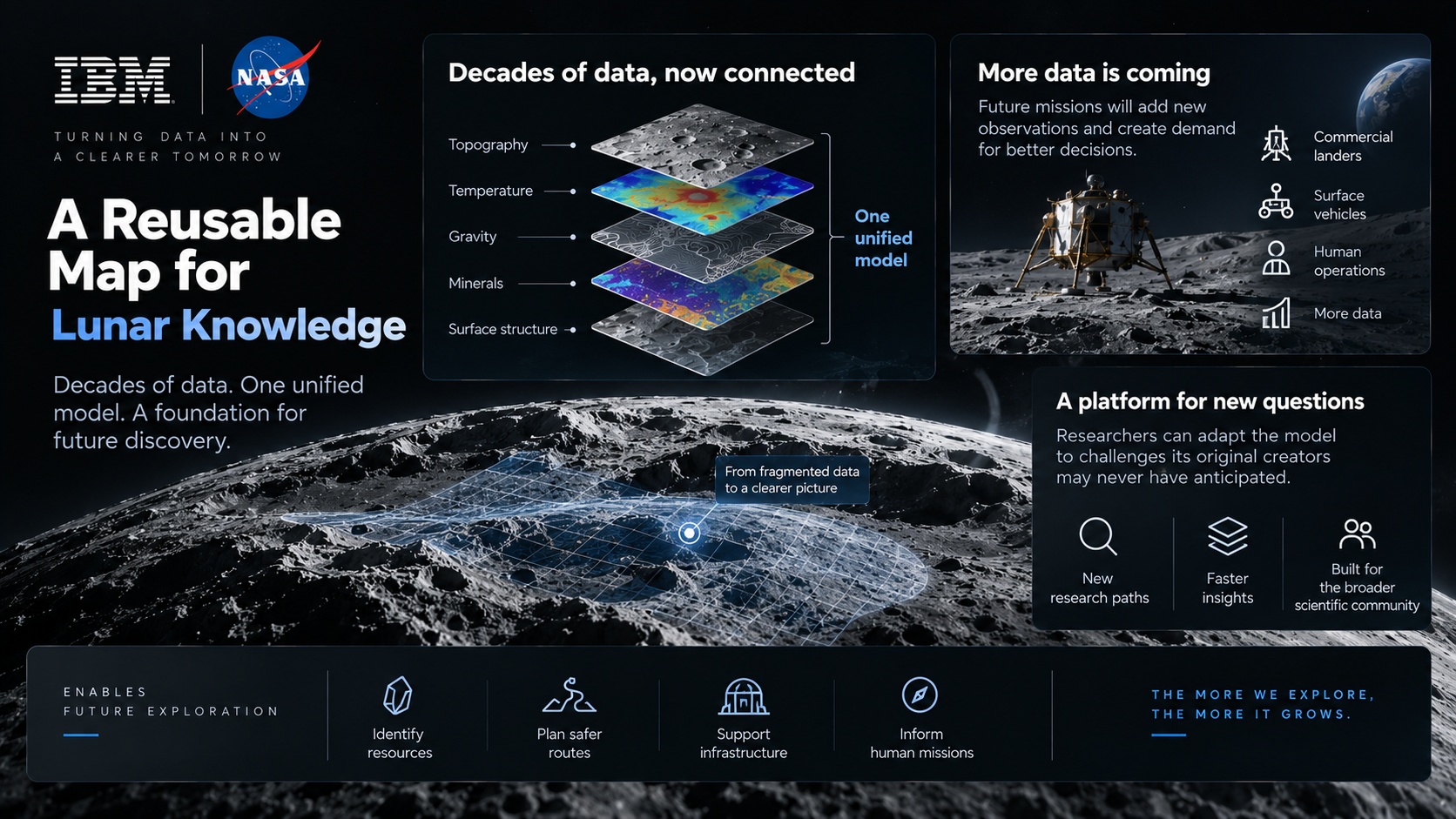
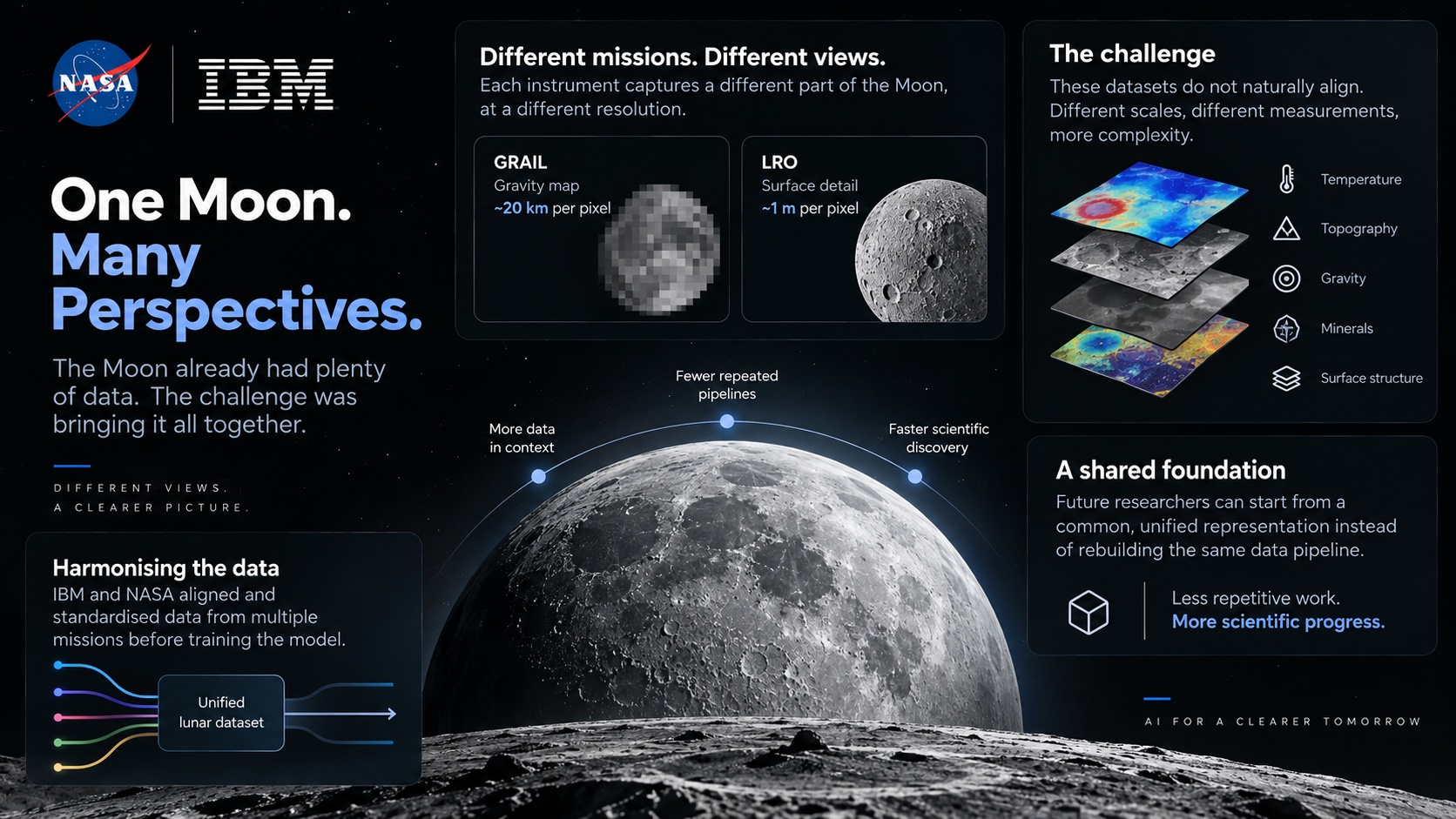
Different missions have spent years mapping the Moon’s temperature, topography, gravity, mineral composition and surface structure. The difficulty is that these instruments do not necessarily see the same place in the same way.
IBM Research gives a useful example. GRAIL mapped the lunar gravitational field at scales around 20 kilometres per pixel, while the Lunar Reconnaissance Orbiter can observe some surface features at roughly one metre per pixel. Combining information separated by that much spatial resolution is more complicated than feeding a collection of images into a conventional computer vision model.
Researchers first have to determine how observations relate to the same physical locations and how measurements representing different physical properties should be interpreted together.
IBM and NASA therefore spent part of the project harmonising data before training the model itself.
That work changes what can happen afterwards. Instead of every research team rebuilding its own pipeline for locating, cleaning and aligning data before addressing a scientific question, future researchers can begin with a common representation that already contains information from several instruments.
The model is consequently valuable because it reduces repeated infrastructure work.
One foundation can support several lunar problems
Traditional machine learning approaches often begin with a specific objective.
A research team that wants to detect craters might create a crater dataset and train a model for that task. Another group interested in lunar ice could repeat much of the process with different data, labels and algorithms.
A foundation model changes that workflow.
IBM and NASA first trained a broader model to learn relationships within lunar observations, then adapted it to individual scientific tasks. The researchers used lightweight LoRA adapters during fine tuning while leaving about 90% of the base model weights unchanged.
The same foundation could therefore be reused rather than replaced whenever the scientific question changed.
Initial results show why that matters. In tests published by IBM and NASA, the model reduced error for potential lunar ice detection by up to 22% compared with a SwinV2 baseline. At a context scale of roughly 100 metres, it outperformed the same comparison architecture on crater detection by nearly 19% while using half as much training data. For mapping irregular volcanic features, the improvement was smaller at around 3%, although the system reached comparable performance with lower adaptation costs.
These results do not mean one AI model has solved lunar mapping. They show something more practical. A common model can be adapted across very different scientific problems without rebuilding the entire machine learning stack each time.
That is the infrastructure argument.
IBM and NASA are applying the same idea across science
The lunar model is also part of a broader strategy rather than an isolated experiment.
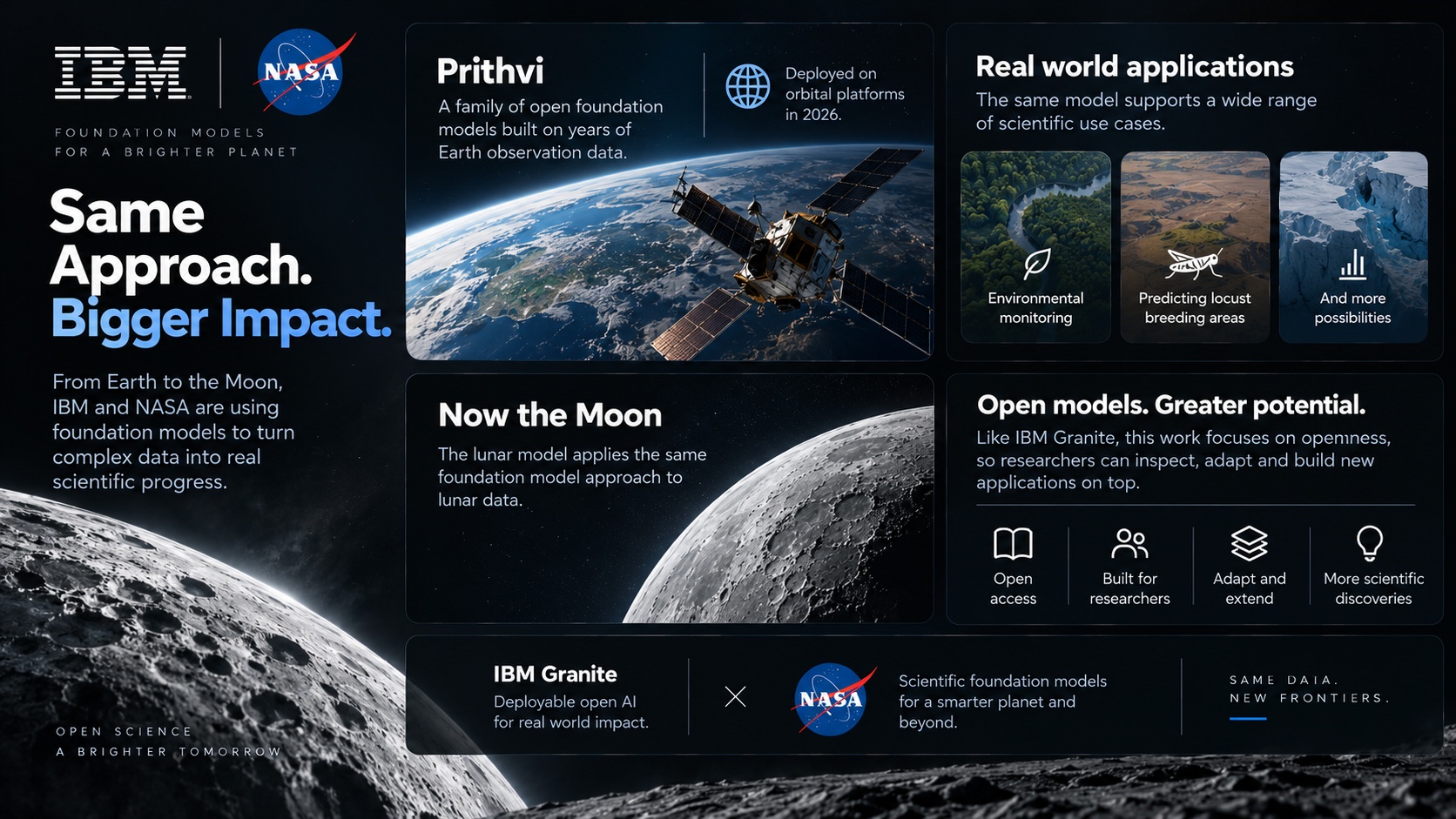
IBM and NASA have already collaborated on Prithvi, a family of open foundation models built around scientific data. A Prithvi geospatial model trained on years of Earth observation data was deployed aboard orbital platforms in 2026, allowing researchers to test foundation model based Earth analysis directly in space.
The model has also been adapted for applications that were not necessarily obvious when the original system was created. NASA has highlighted researchers using Prithvi for tasks ranging from environmental monitoring to predicting potential locust breeding areas.
That reuse is important because scientific instruments are expensive while the questions researchers may eventually ask of their data are difficult to predict in advance.
Instead of developing a new algorithmic foundation whenever a new problem emerges, NASA can increasingly treat large scientific models as common infrastructure and allow researchers to build specialised applications on top.
The Moon is now being added to that approach.
There is a similar philosophy behind IBM’s broader push toward open models. Memeburn recently examined how IBM Granite 4.2 focuses on deployable open AI rather than simply chasing larger models. The lunar project applies the same general principle to scientific computing, where openness matters because universities and research institutions need to inspect, adapt and extend the underlying system rather than depend entirely on a closed service.
Better lunar data matters more as missions become more frequent
This infrastructure becomes increasingly useful as NASA moves from occasional lunar missions toward a more persistent presence.
Through its Commercial Lunar Payload Services initiative, NASA has awarded 17 lunar deliveries to five vendors carrying more than 60 payloads, with contracts supporting a programme worth up to $2.6 billion through November 2028. These missions are designed to gather scientific data, test technology and prepare for longer term human activity on the Moon.
NASA is also developing a Moon Base near the lunar South Pole, where water ice is particularly important. The agency says commercial partners are working toward delivering landers and infrastructure from 2028 as part of plans for sustained robotic and human operations.
Memeburn has covered another part of that architecture through SpaceX Starship V3 and its role in NASA’s future Artemis lunar missions.
Once missions become more frequent, deciding where to send them becomes an increasingly important optimisation problem.
Crater maps can help identify hazards and suitable infrastructure locations. Better estimates of ice distribution can influence where resource prospecting should concentrate. Geological mapping can help scientists decide which regions justify additional instruments before limited payload capacity is committed to another landing.
The AI model will not make those decisions by itself. Instead, it can make the underlying observations easier to combine and interrogate before scientists and mission planners decide where scarce hardware should go.
The real product is a reusable map of lunar knowledge
There is a tendency to judge scientific AI by whether it discovers something immediately.
That standard misses much of what IBM and NASA are building.
The NASA IBM Lunar Foundation Model matters because decades of observations that previously existed across different instruments, resolutions and mission archives can now be represented inside a common computational framework. Once that foundation exists, individual research groups can adapt it to questions that its original developers may never have anticipated.
That pattern has already appeared with Earth observation models, and NASA now wants to extend it across more scientific domains.
For lunar exploration, the timing is particularly relevant. More commercial landers, scientific payloads, surface vehicles and eventually human operations will produce another wave of data while simultaneously creating demand for better decisions about terrain, resources and infrastructure.
Collecting additional observations will remain essential. The harder challenge will increasingly be connecting them.
IBM and NASA’s new Moon AI is therefore more than a model that can find craters or estimate where ice might exist. It is an attempt to turn the Moon’s fragmented scientific record into infrastructure that future missions can repeatedly build on.
The more data humanity collects there, the more valuable that common layer could become.