
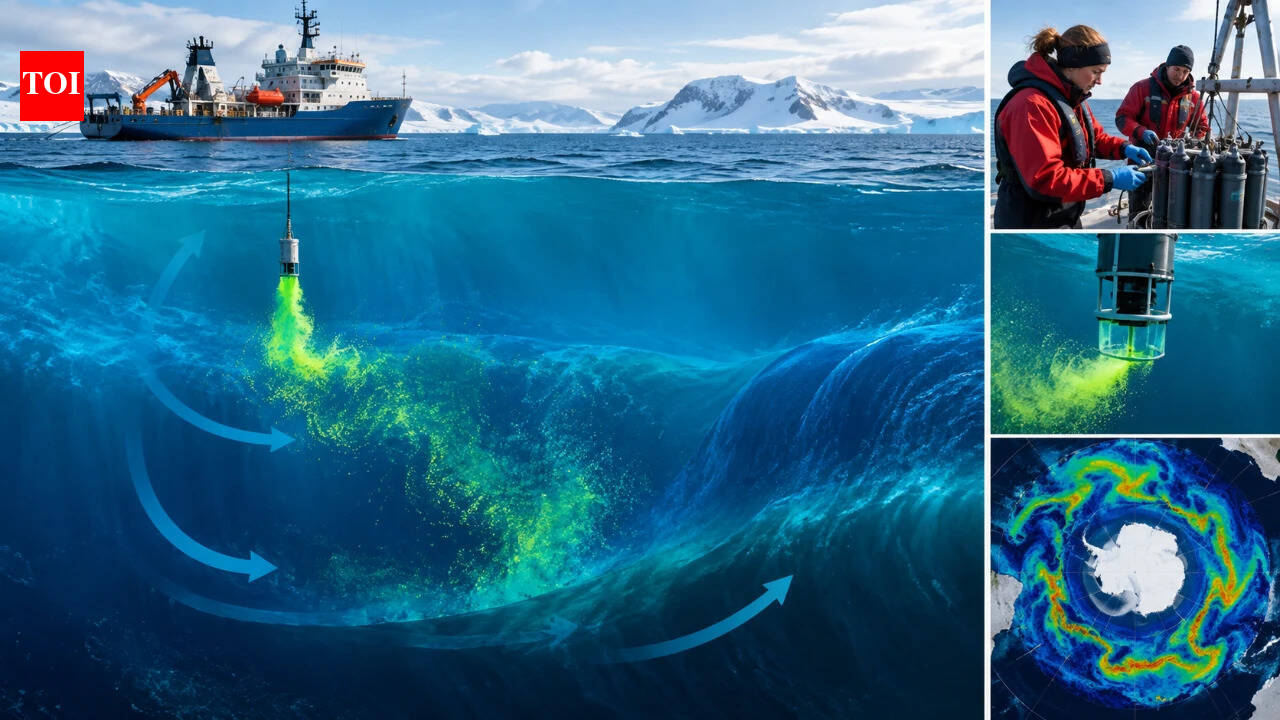
 For decades, scientists have known that the Southern Ocean acts as a giant gateway between the surface and the deep ocean, moving heat, nutrients and carbon between layers and across ocean basins. Yet one of the most difficult questions was surprisingly simple, how quickly does water actually mix across density layers once it sinks below the surface?To answer it, researchers turned the ocean itself into a giant experiment. During the Diapycnal and Isopycnal Mixing Experiment in the Southern Ocean, or DIMES, scientists released a tiny amount of an inert chemical tracer into water about 1,300 metres below the surface and then returned year after year to follow its spread.The tracer was not sulfur hexafluoride, as is sometimes reported. DIMES used trifluoromethyl sulfur pentafluoride, or CF₃SF₅, because SF₆ had increasingly become valuable as a natural atmospheric tracer. The unusual experiment provided a direct way to measure how quickly deep water crosses density surfaces, a process that is crucial to the ocean’s circulation and its ability to store carbon. The eScholarship chapter ‘Mixing in the Southern Ocean,’ by Sarah T. Gille, Katy Sheen, Sebastiaan Swart and Andrew F. Thompson, describes DIMES as an extensive UK-US field programme designed to quantify both cross-density and long-density mixing.
Southern Ocean mixing experiment followed a tracer for years
DIMES was built around a remarkably simple idea. If researchers could place a chemical tracer inside a particular layer of the ocean and then measure how its concentration changed over time, the spreading pattern would reveal how strongly the surrounding water was mixing.The tracer was released in 2009 on a density surface in the southeast Pacific sector of the Antarctic Circumpolar Current. Researchers then conducted annual cruises between 2009 and 2013, following the tracer as it travelled downstream towards Drake Passage and the Scotia Sea. The eScholarship account says the programme measured how the tracer spread both along density surfaces and across them, allowing scientists to calculate the average rate of diapycnal mixing along its journey.That distinction matters because water in the deep ocean does not simply mix like liquid stirred in a glass. Much of its movement follows surfaces of equal density, while crossing those surfaces requires energy from processes such as turbulence and internal waves. DIMES was designed to measure that cross-density movement directly rather than relying only on indirect estimates.The experiment also used more than 200 observations from floats and other instruments, giving researchers a way to connect the tracer’s movement with the complex currents and turbulence of the Southern Ocean.
Rough seafloor can make deep Southern Ocean mixing much stronger
One of the most striking findings was that mixing was not uniform across the Southern Ocean. The tracer encountered very different environments as it moved from the relatively smooth seabed of the southeast Pacific towards the rougher terrain around Drake Passage.The eScholarship chapter notes that DIMES compared these contrasting regions because the southwest Atlantic contains energetic eddies and much rougher topography. Measurements showed stronger cross-density mixing in the Drake Passage and southwest Atlantic than in the southeast Pacific, with particularly enhanced mixing near the bottom.This helped reinforce a broader finding from the DIMES programme, the deep ocean can be relatively weakly mixed across large areas, while isolated regions associated with rough seafloor features can act as powerful mixing hotspots.A 2013 study by Andrew J. Watson, James R. Ledwell, Marie-José Messias and colleagues, based on the tracer experiment, found that mean cross-density diffusivity increased substantially along the pathway through Drake Passage. The researchers concluded that mixing was considerably stronger east of about 70°W, where the water encountered the rougher Drake Passage environment.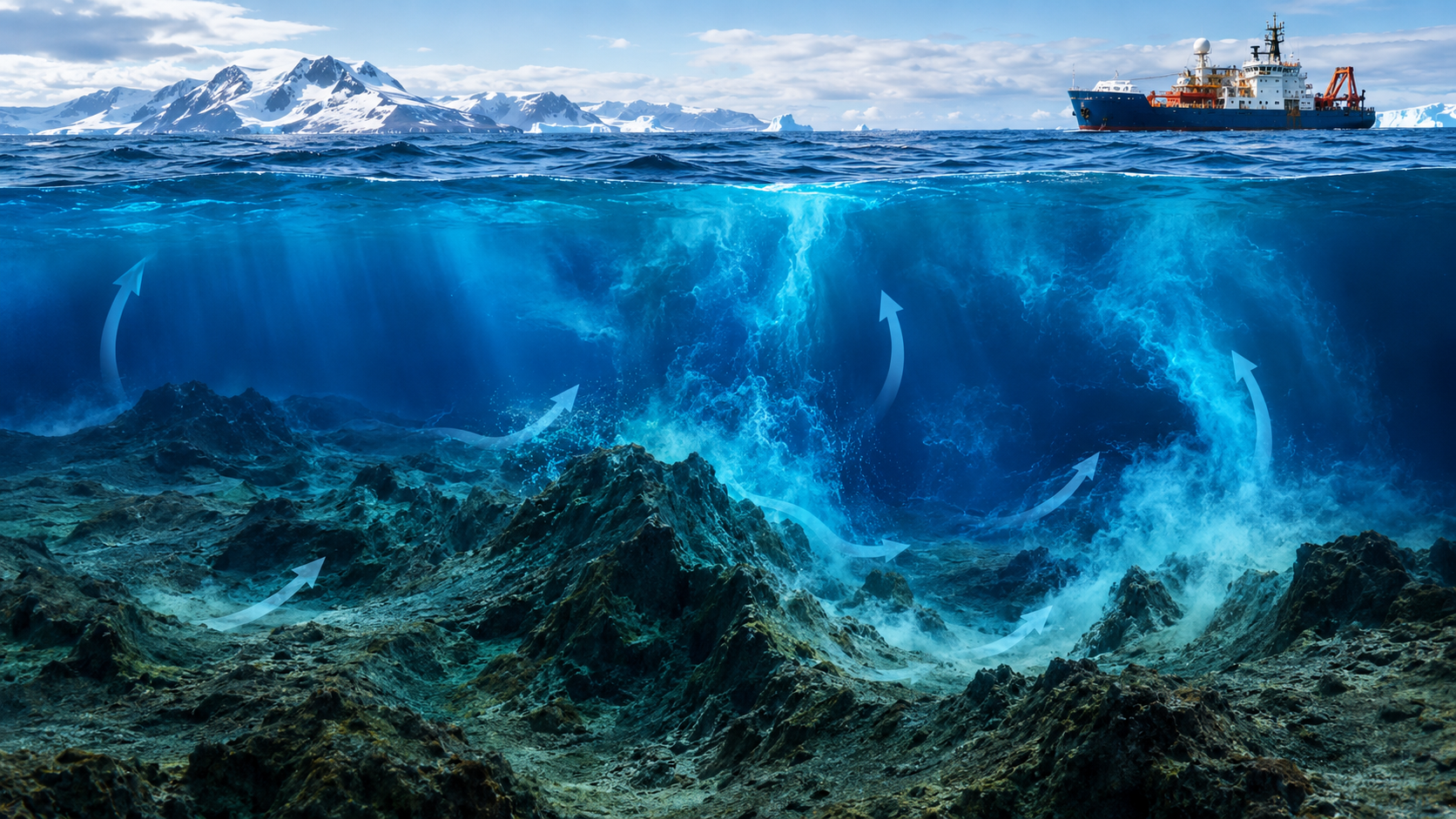
Rough seafloor can make deep Southern Ocean mixing much stronger (Image: AI Generated)
Why the experiment matters for carbon-rich deep water
The Southern Ocean is unusual because it brings old, carbon-rich deep water close to the surface. Winds, currents, eddies and vertical circulation then help exchange that water with the atmosphere before parts of it are carried back into the ocean interior.That makes mixing more than a technical oceanographic measurement. It helps determine how efficiently the ocean can move carbon away from the atmosphere and how long that carbon remains stored at depth.An eScholarship study, ‘Physical controls on Southern Ocean biogeochemistry,’ by Channing Joseph Prend, explains that the Southern Ocean plays an outsized role in global ocean circulation and carbon uptake because it transports mass, heat and tracers between the surface and abyssal ocean. The study also found that carbon outgassing is particularly associated with the entrainment of upwelled, carbon-rich deep water into the mixed layer.Earlier work by Andrew J. Watson and Alberto C. Naveira Garabato likewise showed that the deep Southern Ocean is strongly connected to the global carbon cycle. Their research found that deep waters south of the Polar Front are ventilated through interactions between deep currents and ocean-floor topography, while water between the surface and roughly 2,000 metres is brought upward through the Southern Ocean’s overturning circulation.
Tracing invisible water movement helps explain Earth’s climate
The significance of experiments such as DIMES lies in their ability to turn an otherwise invisible process into something measurable. Oceanographers cannot watch a parcel of deep water move through thousands of metres of ocean, but an inert tracer gives them a chemical signature they can follow.The eScholarship chapter describes DIMES as a foundation for understanding how small-scale mixing processes influence the much larger overturning circulation of the Southern Ocean. Its observations showed that mixing is shaped strongly by eddies, internal waves and rough topography rather than occurring at one uniform rate everywhere.That matters for climate models because the Southern Ocean helps determine how heat and carbon are redistributed through the global ocean. If models overestimate or underestimate the rate at which deep water crosses density layers, they can also misrepresent how quickly carbon moves between the atmosphere, surface ocean and deep sea.The tracer did not make the ocean easier to understand. Instead, it revealed just how uneven and complicated its hidden circulation is, and why measuring that movement directly remains essential to understanding the planet’s long-term climate system.