

Minister for Public Expenditure Jack Chambers has said energy costs for families would be a central issue that Budget 2027 looks to address, with the Government giving “specific consideration” to rises in home heating oil costs.
The price of home heating oil has risen sharply since last September, largely due to global oil instability caused by the US war with Iran.
Speaking at Dublin Castle on Tuesday morning, where he is hosting an EU presidency meeting of cohesion ministers, Chambers said: “We’re very conscious that energy costs are one of the central issues for families right across the country … and particularly the rise in home heating oil has been a specific consideration by Government.”
He also said the Coalition is considering other targeted supports in the budget.
“We’re examining options around that specific issue in the context of Budget 2027 and other targeted supports using our social protection system to support families through the winter period,” the Minister said.
“We made changes last year in the context of fuel allowances in terms of the direct weekly support, but also the broadening in eligibility, and that forms the context for Budget 2027. [This is] in addition to other changes that we want to make, particularly on income tax, where we have a moderate package overall to support workers across the economy.
“And again, budgetary matters are still in their early days with my colleagues across Government, so we haven’t made any decisions at this point.”
He reiterated that home heating oil was being examined in the context of a “specific issue”.
“Home heating oil is being examined in the context of it being a specific issue and home heating oil and its price point has risen significantly,” Chambers said.
“Obviously we’ve made specific changes to excise and other matters … so we are examining options around home heating oil. We don’t want to go into the winter period if there’s a particular price exposure there for families. So we’re considering options on how we can potentially help with that in the context of the budget.”
When asked about the security costs for the recent visit of US president Donald Trump, Chambers said the figure was yet to be finalised with the Department of Justice.
However, he denied it was linked to budget talks, as it was a “one-off” cost.
“The final costs will be finalised over the next number of weeks as part of the ongoing discussions that we have with the Department of Justice. Obviously, security is paramount when it comes to any state visit.”
Elsewhere, the Social Democrats outlined how the party would respond to the fuel crisis caused by the war in Iran, including the introduction of a windfall tax on energy companies, targeted electricity credits for households and more support for the roll-out of solar power.
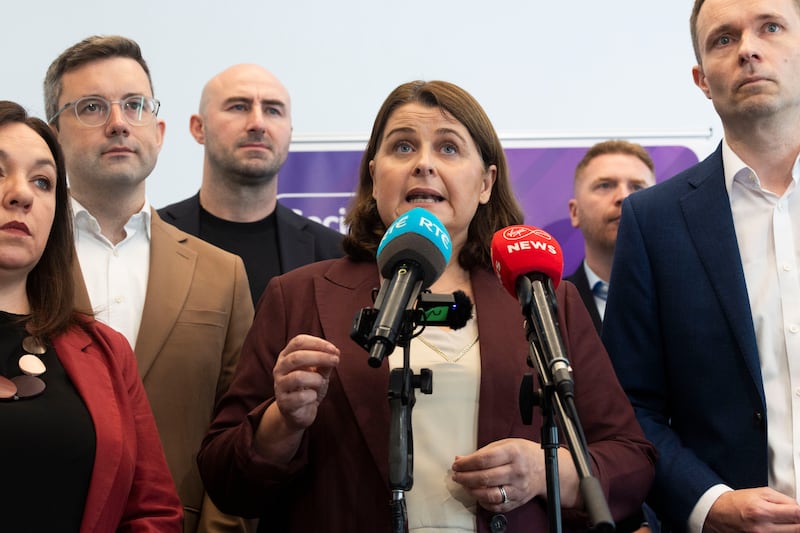 Jennifer Whitmore speaking ahead of the Social Democrats think-in on Tuesday. Photograph: Sam Boal/Collins
Speaking in advance of the party’s pre-Dáil think-in meeting in Dublin, Jennifer Whitmore, the party’s spokeswoman on climate, environment and energy, said 324,000 households are in arrears when it comes to their electricity bills and 188,000 in arrears on gas bills.
She claimed the Government “has a wait-and-see approach to dealing with these repeated energy crises” but also that its responses amounted to “throwing money at the problem, rather than actually trying to resolve it in the long term, rather than trying to ensure that households are resilient to these kind of energy shocks”.
Whitmore said she will be bringing forward proposed legislation for a windfall tax to be placed on the excessive profits of large energy companies, similar to measures previously brought after energy prices rose due to the war in Ukraine. She said such a tax would bring in between €300 million and €350 million.
The Social Democrats also repeated their call for a €400 energy credit for those households earning less than €70,000 euro – a measure it said would cost €459 million.
The party also set out its Solar for All proposals that include a doubling of the solar grants for households; free solar panels for those on the Warmer Homes scheme; the reinstatement of a grant for batteries; and the roll-out plug-in solar for people who are renting and in apartments, and would cost €300 million per year.