
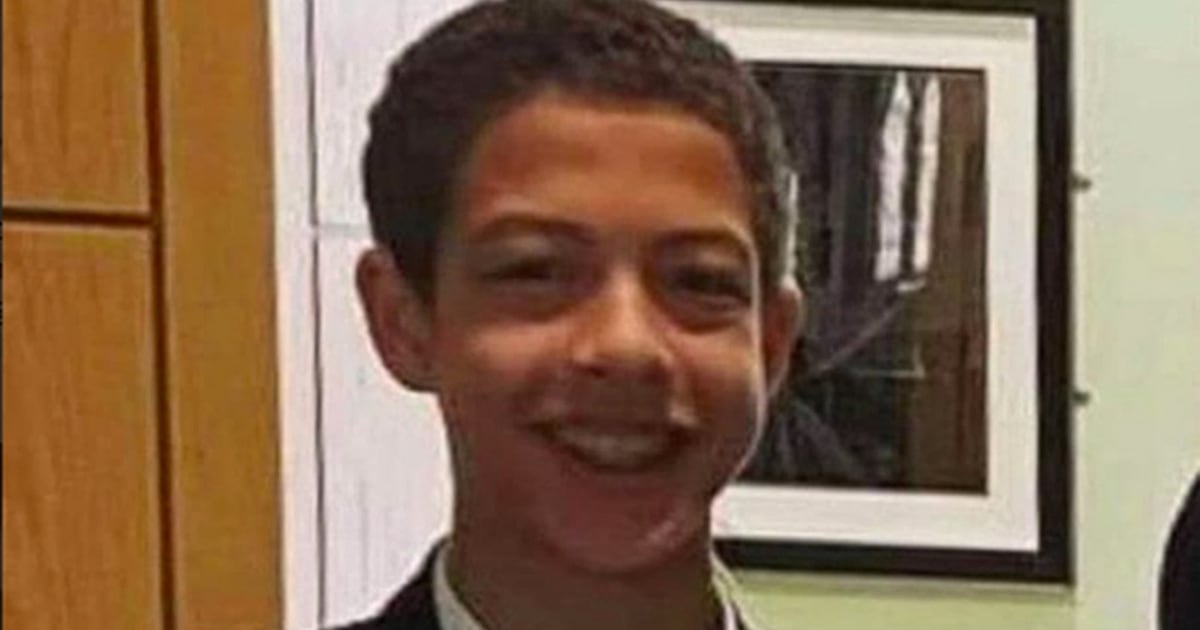
Jurors at the long-running inquest into the death of Belfast teenager Noah Donohoe have found that Stormont’s department for infrastructure “erred” in its management of a tunnel entrance close to where he was last seen alive.
Noah (14) was found dead in an underground water tunnel in north Belfast in June 2020. He had left home six days earlier to meet friends, with his disappearance sparking a major search operation.
On Tuesday, the jury of seven men and two women found there was no warning signs around the entrance to culvert entrance to the tunnel.
The medical cause of death was drowning, jurors agreed.
A decision by the Stormont department to install a debris screen in 2017 meant “as a consequence” he was able to enter the culvert via the screen, they found.
“[The department] erred in not identifying the area around the entrance as a location the public could possibly access”, the foreman of the jury told the court.
While the jury found it was not “probable” that failings by the department contributed to Noah’s death, they did agree that it was “possible”.
The ruling followed five days of deliberations.
Police errors also did not contribute to his death, the jury found.
However, there were 13 criticisms by the jury of the police handling of the investigation.
This included the PSNI’s failure to review contemporaneous CCTV footage; failure to follow up all investigative opportunities, and CCTV strategy and execution “not rigorously applied”.
The jury also found relevant statements had not been taken by police in a reasonable timeframe.
There were also delays in identifying the culvert as a place to search, the jury found.
They also found failings in the speed of that search.The inquest began hearing evidence at Belfast Coroner’s Court in January and was expected to last three months.
It resumed on Monday following an “unprecedented” late night sitting in July, which led to an adjournment over the summer recess.
Noah’s mother, Fiona Donohoe, has led a high-profile campaign for answers backed by supporters calling themselves ‘Noah’s Army’.
She has attended each day of the inquest.
She sat at the back of the court, accompanied by her sister, and wiped tears from her eyes as the jury foreman delivered the findings.
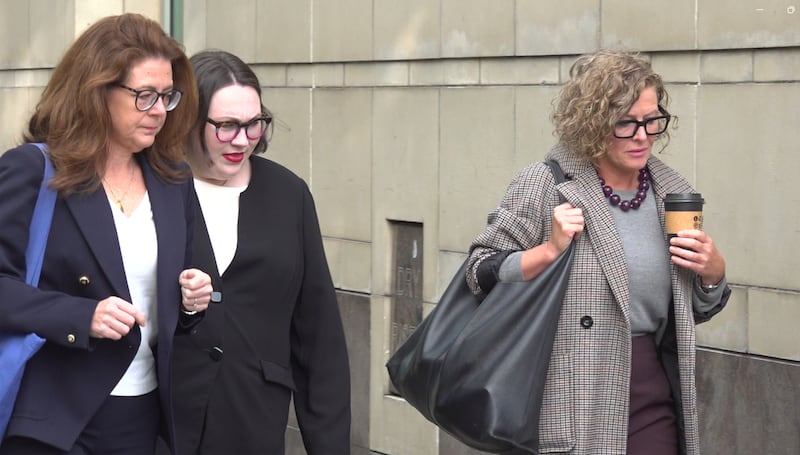 Fiona Donohoe (right) the mother of Noah Donohoe, arriving at Belfast Coroner’s Court with her legal team on Tuesday. Photograph: Rebecca Black/PA Wire
The public gallery of court 13 at Laganside court complex was filled with supporters, some of whom wore the ‘Noah’s Army’ navy and white sweaters.
Ten questions were presented to jurors on which they were asked to reach a unanimous verdict.
Noah, a student at St Malachy’s College, had cycled across the city from his home in south Belfast to the Northwood Road area of north Belfast on Sunday, June 21st, 2020. He abandoned his bicycle on a pavement at Northwood Road close to waste ground where a culvert entrance to an underground water system is located.
His body was found more than 600m downstream in the tunnel. He had previously been seen falling off his bicycle, as well as discarding his clothes and cycling naked.
The jury was also asked to explain why Noah “behaved as he did” after he left the apartment he shared with his mother at 5.40pm.
The foreman of the jury replied on Tuesday: “No, the evidence is insufficient to enable us to reach a conclusion”.
The jury found that Noah died between 7pm and midnight on Sunday, 21st June.
The inquest has heard evidence from 76 witnesses, statements from a further 42 people, as well as maps, video footage, photographs, police logs and expert reports.
In his lengthy summing up of the case earlier this year, coroner Kevin Rooney said that any finding of error against police could only be made in relation to any potential act or omission that took place before Noah died.
Experts have said Noah may have died on the same day he went missing, Sunday, June 21st, 2020, or could potentially have survived until Tuesday.
It was also suggested there was a possibility, though unlikely, that he was still alive on Wednesday, June 24th.
The jury was also asked if there were other factors “which have impacted upon the ability of this inquest to reach a conclusion on any aspect relevant to the circumstances of the deceased’s death?”
In response, the jury foreman listed police failing which included failure to review contemporaneous CCTV footage; failure to follow up all investigative opportunities, and CCTV strategy and execution “not rigorously applied”.
The jury also found relevant statements had not been taken in a reasonable time frame.
There were also delays in identifying the culvert as a place to search, the jury found.
They also found failings in the speed of that search.
In June, the coroner directed jurors to rule out certain outcomes due to insufficient evidence.
Significantly, the jury could not find Noah was assaulted after he went missing or that there was any third-party involvement; they were also not permitted to find he was a victim of child exploitation.
Rooney also said the jury was not permitted to find he was under the influence of drugs, going through a psychotic episode or that he had taken his own life.