
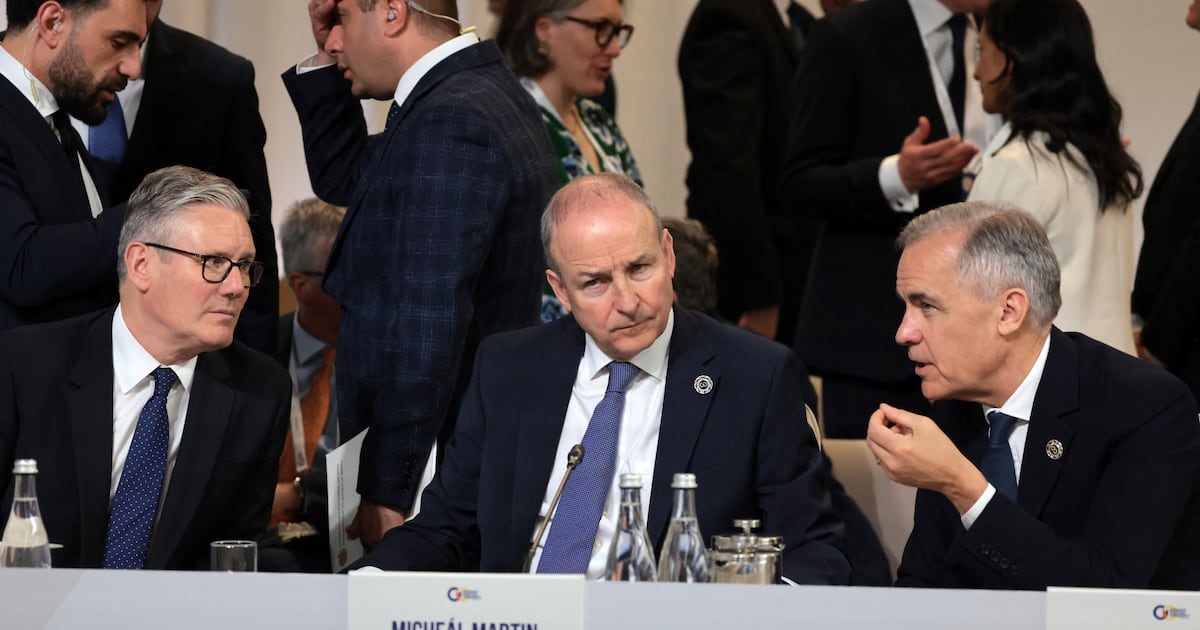
The two countries doing the most to define the European Union this year are two that are not in it. At the outer edges of a fierce battle over who gets to design the new architecture of Europe sits Ukraine to the east, negotiating a European accession amid war, and Canada to the west, constructing a new form of European partnership. Canadian prime minister Mark Carney said this would take the shape of “a unique alliance”, after the Wall Street Journal revealed his desire for Canada to become an “associate member” of the bloc. EU officials are reportedly open to the suggestion.
European integration began as a civilisational and political project to create co-operation and became, after the Cold War, a political-economic bloc that talked endlessly about strategic autonomy – even if it did little to achieve this.
For three decades, the European project existed with the support of the Pentagon’s military power, Silicon Valley’s technology, Russia’s cheap gas and China’s low-cost manufacturing. The notion of strategic autonomy only worked as long as it was not challenged.
What is now emerging is a different Europe that is rapidly drawing up new economic, military, technological and institutional plans for survival. It is being reorganised on a war footing, with its political elite concluding that war will be the organising condition of new European politics.
Kyiv is at the heart of Europe’s structural transformation. Volodymyr Zelenskiy’s influence stretches globally from Washington to Brussels and Ottawa. Ukraine has simultaneously become a beneficiary of this new financing and industrial system, while actively deciding what it looks like – from the outside.
A delicate diplomatic choreography underscores the irony of this. Despite Ukraine not being an EU member, Zelenskiy spoke at the opening of Ireland’s EU presidency after the Taoiseach. Carney will be guest of honour on Wednesday at the European Parliament’s State of the Union and is expected to shed more light on Canada’s EU ambitions.
Ukrainian and Canadian leadership are already having an influence on the new European system, even before their relationship with it is formalised.
Ireland, we are told, will benefit from EU enlargement through a larger single market for our exports and the opportunity to be part of a more secure Continent. Positioning itself as a moral leader of the project, the Irish Government repeats the sentiments offered to Zelenskiy in 2022 by Micheál Martin: “We in Ireland have been transformed by our 50 years’ membership of the European Union and we want the very same transformation for you also.”
Admirable, perhaps. But where do the economic benefits actually accrue from this reordering?
The winners in this new Europe are clear. A more powerful defence role for Poland. Political buy-in for Germany’s otherwise-unjustifiable defence spending. Higher growth for France’s military-industrial base. Serious consideration given to eastern states about a threat they have lived with for decades.
Even those on the outside will be winners: the United Kingdom can sneak back into Europe through defence and intelligence partnerships without admitting Brexit was a defeat. Huge economic and security integration, with eventual reconstruction, for Ukraine. And after decoupling from the United States, and seeing this new emerging market as a destination for its defence, minerals, Arctic capabilities and energy, Canada gets to be on the inside.
So what about Ireland?
The problem is that any theoretical benefits to Ireland belong to an earlier version of Europe. Indeed, these benefits made sense when the EU was a project of co-operative trading, in which enlargement automatically created a bigger market and more prosperity.
But the characteristics of the new European architecture are those of global security and industrial alliance – a European Nato of sorts. In this Europe, “bigger is better” raises questions about who creates, finances and captures this asymmetric growth.
While most other countries debate this change publicly and fiercely, in Ireland this reality goes undiscussed. Have our politicians not yet understood the implications? Or perhaps they have realised that this new reality will be hard to sell domestically, so are choosing not to mention it?
Either way, the political pretence that today’s enlargement is an extension of the European project Ireland joined in 1973, instead of the centralised security-industrial system that the EU is becoming, is worrying.
Ireland’s economic success was a product of a rare combination of sudden EU market access, US investment into a low corporate tax rate and an English-speaking, educated workforce during a time when global supply chains were integrating, not fragmenting.
Although the rising tide of a European defence economy will lift many boats, it may mostly wash past the Irish economy, which has no defence-industrial base of its own – despite Martin doing his best in Brussels to position Ireland differently.
The sad irony is Ireland may prove an outlier when it comes to reaping the benefits, because it prospered by attracting foreign, particularly American, companies and giving them a base from which to enter the European market.
Now Europe is moving towards building strategically important industries and technologies within Europe itself, and Martin is trying to position Ireland to benefit from this new model, and potential opportunities in digital, climate or health industries. But the strategic downsides of the economic model he spent much of his political career defending are becoming clear.
At the EU-level, increased Canadian and Ukrainian partnerships make sense and will be pursued, and Ireland’s role in the EU presidency is to help Europe reach such multilateral deals.
But this does not absolve our politicians from having an urgently needed debate around whether the new industrial architecture of Europe – one that is replacing the economy in which Ireland thrives – will work for Ireland. And what we will do if it does not.