
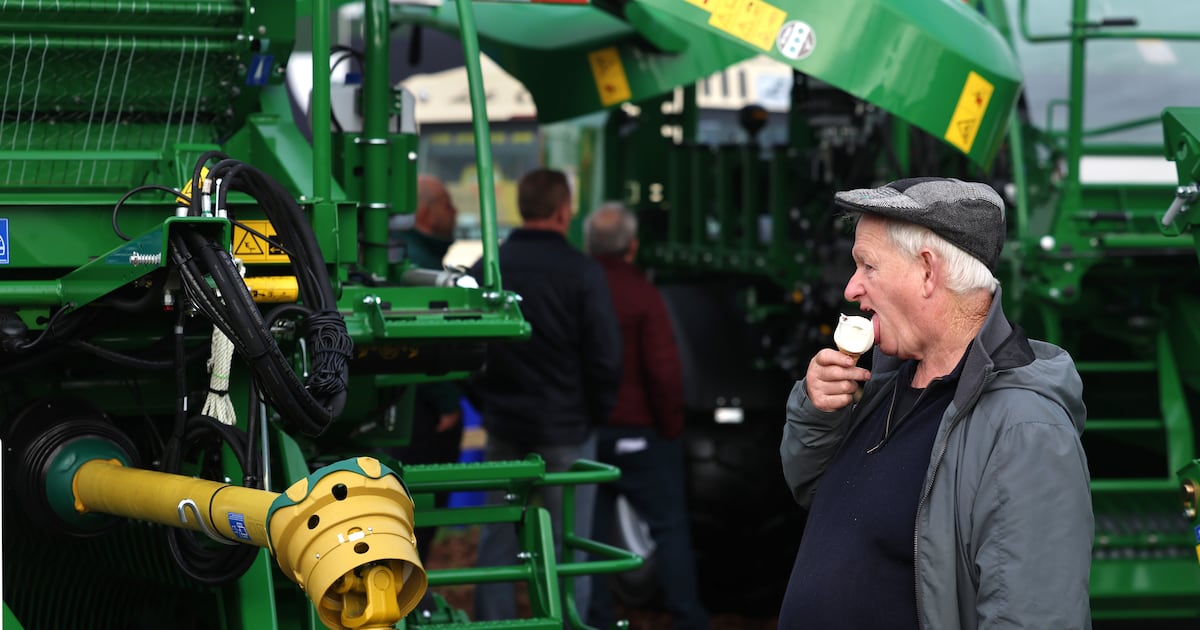
The battle for the title of most desirable merch at the ploughing was unexpectedly fought between sky blue nasal strips and Brat-green tote bags carrying lines of scripture.
The blue strips won it by a nose and while they’re designed to stop snoring, a great many wide-awake people wore them as they wandered the sprawling site checking out a cornucopia of activities that – in any other context – might be considered unhinged.
But in the context of an Irish September, there was nothing out of the ordinary in the welly throwing, the tug of wars, the sheep shearing, the baking and the Christian evangelising.
Stalls were selling everything from farm machinery and wild Irish honey to modular homes and complicated outdoor clothes and one whole tent for 2 Johnnies T-shirts and socks.
Obviously.
All through the morning as an unenthusiastic sun tried to break through stony grey clouds, traffic jams of red double-decker buses ferried people from Tullamore to the sprawling green fields of Screggan.
Brendan Mangan boarded one bus with the aid of a walking stick and sat close to the driver and The Irish Times.
He was, he said, born in Dublin and spent his adult life farming in Mayo before moving to Kildare. He has been to the ploughing “too many times to remember” over many decades.
He was looking forward to meeting people “and to talking to some good politicians and to some of the frauds”.
Once inside, he and around 80,000 others were enveloped by fields of complicated looking farm machinery and a dizzying array of stalls, but it was a simple pull-up bar outside the AIB pavilion that proved to be one of the biggest draws.
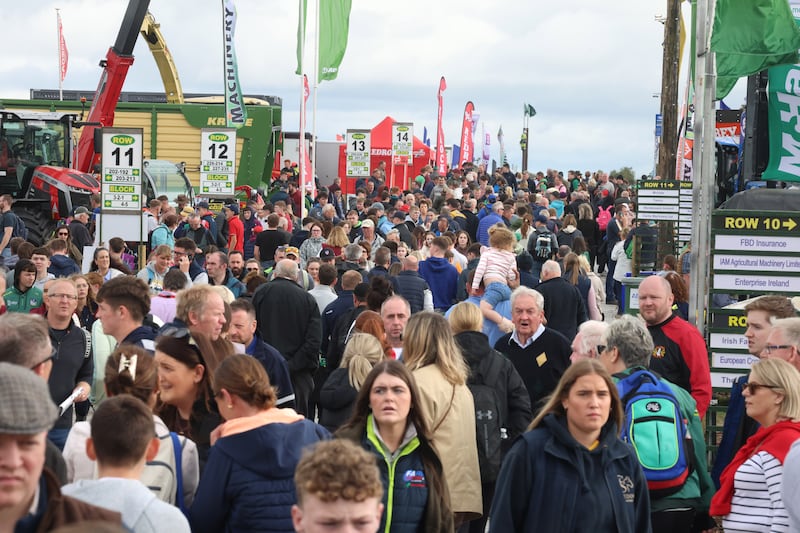 Crowds at the National Ploughing Championships 2026. Photograph: Dara Mac Dónaill / The Irish Times
People were invited to hang from the bar for as long as possible with the winners getting a place on a leader board. Most struggled to hang limply for more than a minute but the record holder – an unidentified 14-year-old girl managed it for just over four minutes.
Jess Kilkenny from Galway was in a long queue waiting to get into the pop-up Inter-Sport Elvery’s shop.
“I’m here because my kids wanted to go in for a look,” she said. “Apart from that I’m more of a taxi driver today than anything else. There are the twin boys, they’re 16 and our smallest is 10. And our 11-year old is there with his friends.”
They were all having the craic. The president of the Irish Farmers’ Association Francie Gorman was enjoying the ploughing too, but he had a serious message to share.
He said the country was facing a difficult winter. “It is not just farmers. Fuel is a huge issue for everybody across the board,” he said, and called on the Government to confirm financial supports sooner rather than later.
He said the spike in the price of fertiliser since the US warn on Iran started last spring was a “huge” issue.
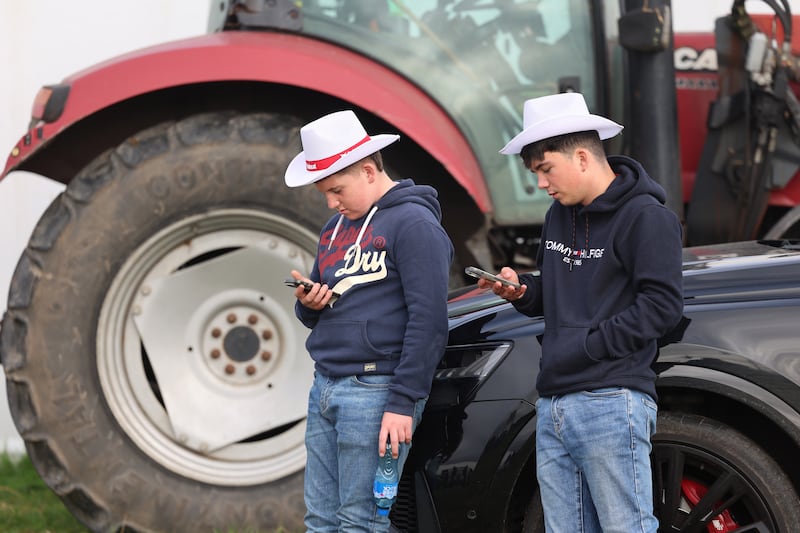 Cathal Batersby and Paddy Muldon, from Skryne, Co Meath at the Ploughing.
Photograph: Dara Mac Dónaill / The Irish Times
“Fertiliser has become so expensive now, farmers are beginning to not spread it and that is impacting the amount of grass we can produce. It impacts everything. You spread less fertiliser, you have lower yields of grass, lower yields of grain, lower yields of maize, of milk and beef, lamb.”
When asked if the IFA would support fuel protests if they happen this winter he said that as an organisation it had held back from protesting in the spring but he said the level of dissatisfaction being felt by farms as we head into winter was comparable to the spring. “It’s a real concern,” he said.
So too is the soaring price of home heating oil, which he said would hit many in rural communities hard in the weeks ahead.
“And there’s a wedge of grass growth there that we lost in the summer. That has never been made up,” he added. Farmers “should be going into the winter with five to six months fodder in the yard. And at the moment, there’s a lot of farmers that don’t have sufficient fodder stocks. If we get a benign autumn and things are not too bad and the spring comes good, it mightn’t be a problem but as someone said to me, “hope is not a strategy,” he said.