
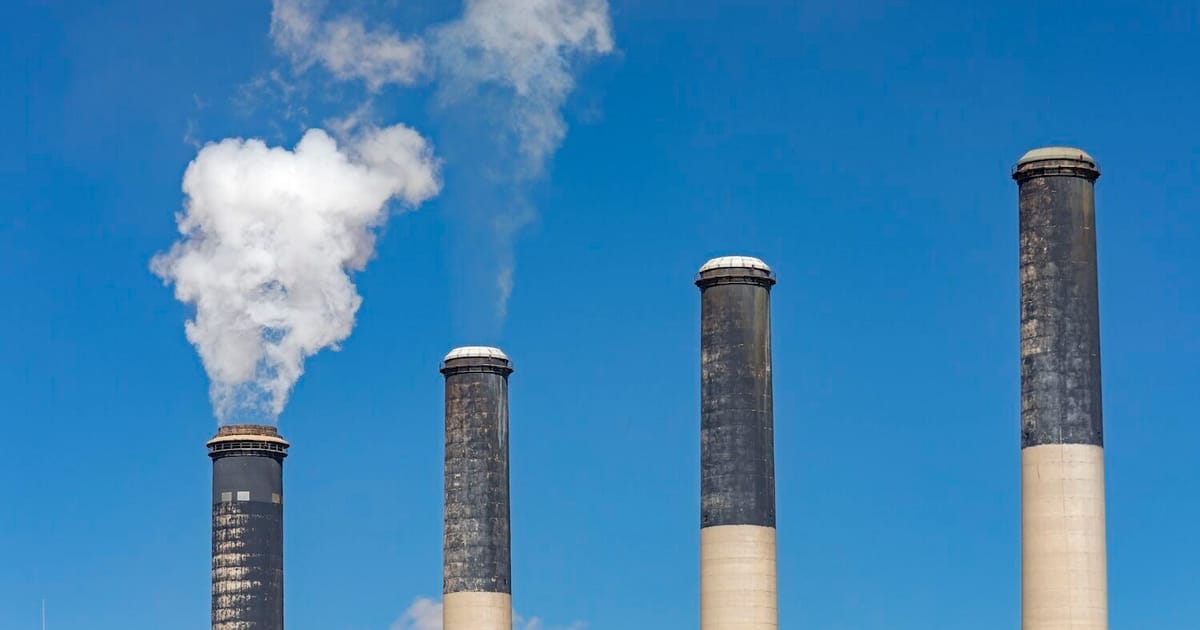
Twenty years ago, a group of Northeastern states signed on to a plan to reduce the greenhouse gases spewing from power plants by making generators pay for the carbon they release. Since then, the region’s power sector emissions have dropped by half, and states have reaped more than $10 billion in revenue to invest in energy programs.
By these numbers, the Regional Greenhouse Gas Initiative, or RGGI, looks like a success. And plenty of clean energy advocates say the program has produced both direct and indirect benefits for the climate and residents’ utility bills.
Two decades in, however, the price power plants pay for each ton of carbon emissions is more than 12 times what it was at the beginning, clean energy development in the region faces daunting challenges, and emissions have started creeping back up. A growing chorus of voices is now questioning whether RGGI is still worth the investment at a time when soaring power prices are straining household budgets.
“I think it’s appropriate to look at RGGI and see to what degree it is amplifying its intended purpose, or if it needs to be pulled back,” said Dan Dolan, president of the New England Power Generators Association, a trade group representing most of the region’s generating capacity.
Globally, carbon cap-and-trade is a common strategy for lowering greenhouse gas emissions. The European Union, China, and South Korea all operate such systems. It’s been slower to catch on in the United States, however. RGGI is the first and only multistate carbon cap-and-trade program in the country; just California, Oregon, and Washington have state-level systems.
RGGI was designed to reduce climate pollution in two ways. First, there’s the cap-and-trade system. Large power generators in participating states are required to buy an allowance for every ton of carbon dioxide they produce, which creates a financial incentive to lower emissions. The cap on total emissions allowed in the region drops every year, generally pushing the price up over time. The price is set through quarterly auctions, though generators can buy and sell allowances on the secondary market, so the actual cost is often higher than that set by the auction. The expense is passed on to consumers.
Each state can then use the revenue collected through these payments to support its own programs for clean energy, energy efficiency, climate adaptation, and bill assistance, potentially leading to even greater reductions in power consumption and associated emissions.
RGGI ran its first auction in 2008 with 10 states: Connecticut, Delaware, Maine, Maryland, Massachusetts, New Hampshire, New Jersey, New York, Rhode Island, and Vermont. The process yielded a price of $3.07 per ton of carbon dioxide.
Today, 11 states participate in the program. New Jersey dropped out in 2012 but rejoined in 2020, and Virginia participated in the auctions from 2021 to 2023, then restarted this year. The most recent auction, held last week, yielded a price of $37.65 per allowance.
During the first decade of RGGI auctions, carbon emissions in the nine consistently participating states fell sharply, from a peak of 117.5 million short tons in 2010 to a low of 61.9 million short tons in 2020. Much of this drop can be attributed to the retirement of coal-fired power plants across the region, particularly in New England and New York. In 2007, coal accounted for 15% of the electricity generation in those seven states; today, no coal plants operate in any of them.
RGGI’s carbon price likely helped drive that decrease, experts say. However, there were other contributing factors, including state climate regulations and the economics of trading coal generation for plants that use lower-priced, cleaner-burning natural gas.
“I don’t think you can realistically attribute it all to one mechanism,” said Paolo Moncada Tamayo, senior policy and data analyst for climate nonprofit Acadia Center and a strong supporter of RGGI.