
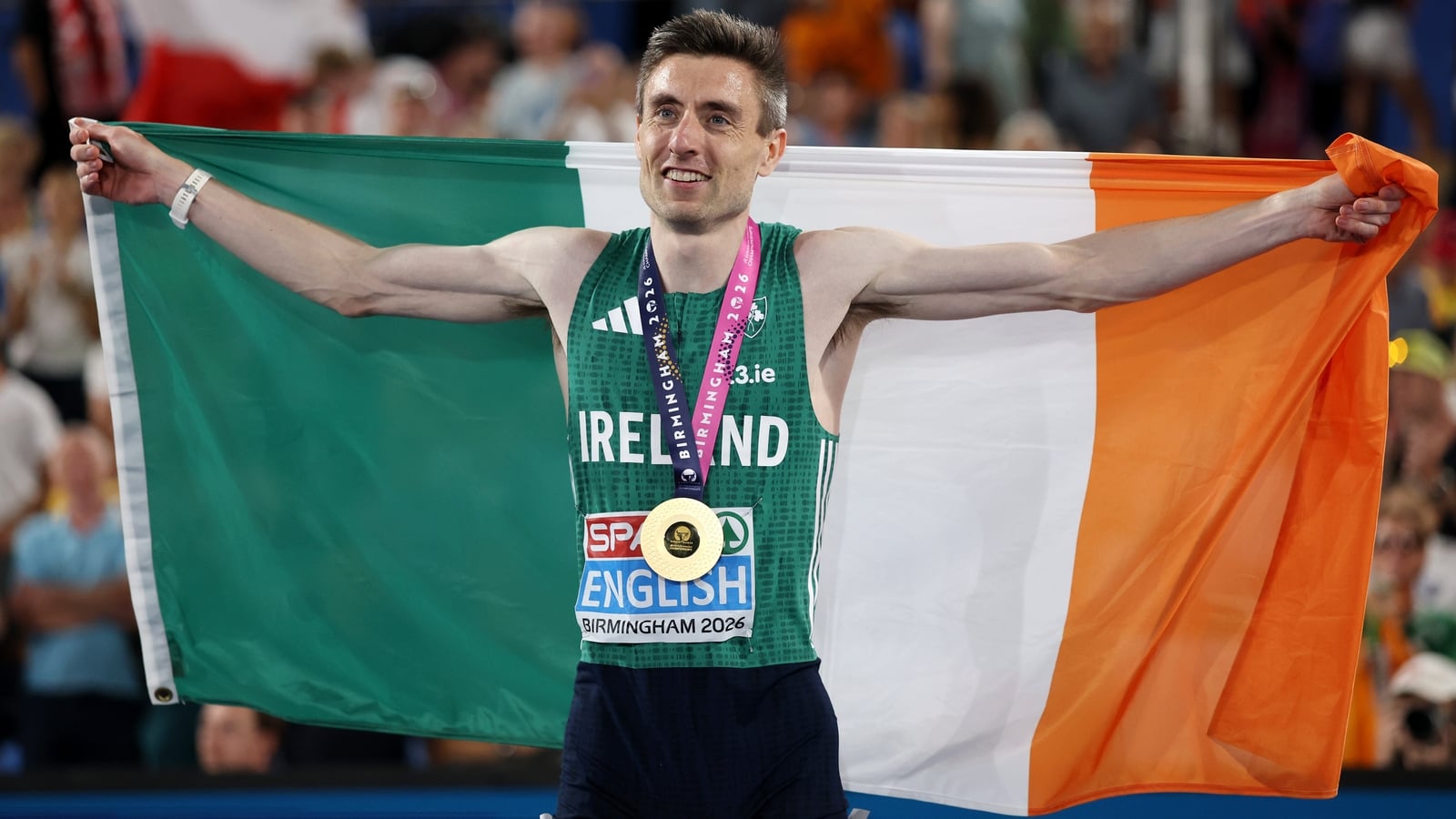
“He’s done it!!! What an extraordinary climax to a career. He knows that this is what he’s been building towards since he was a World Junior fifth-placed finisher 14 years ago. The arc has been jagged in the graph of his progress, but he was always destined to be a champion…” – RTÉ Sport commentator Greg Allen.
It’s been a remarkable year for Irish sport, but Mark English’s European Athletics Championships gold in the men’s 800m will be hard to top when they’re stitching together the 2026 edition of Reeling In The Years.
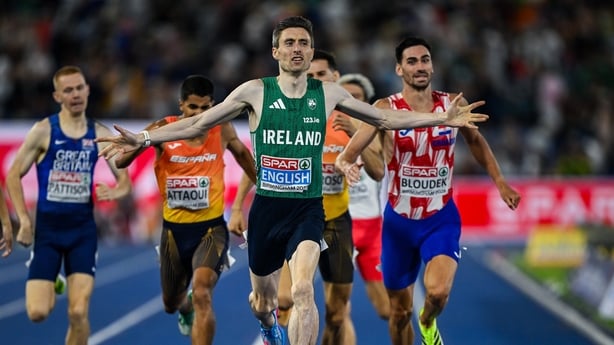
It all came together for the doctor from Donegal as he glided beyond Croatia’s Marino Bloudek and Mohamed Attaqui of Spain to blast over the line, chest out, head raised towards the tricolours in the stands.
English is still tyring to process that magnificent run. On Wednesday, with his season now over, he’ll have an official homecoming reception in the Finn Valley Centre. His people will finally get the chance to welcome their hero home.
English has been on the circuit ever since winning gold, most recently finishing sixth at the inaugural World Athletics Ultimate Championship in Budapest.
Speaking to Greg Allen for RTÉs Saturday Sport programme, he admitted it was hard to comprehend the victory in the moments after he’d sealed it.
“It’s difficult to really say that I felt initially happy because you’re in such an analytical mindset that the initial emotion is just relief,” he said.
“But when everything calmed down a little bit and I took the flag around to the supporters and I got to sign all the autographs for the kids who were waiting outside, that’s when it starts to sink in a little bit in terms of just being happy.
“It’s a strange one because I’ve never experienced it before, obviously, but it was brilliant.”
“That’s a mental advantage that I would have. It all thankfully worked out in the end.”
English turned 33 last March. Years of dedication to his sporting discipline meant he was aware things were clicking at the right time as he headed for the Europeans, and though no athlete is immune to nerves, he harnessed the expectations to nourish positivity.
“I knew I was a gold medal hope, so that carries its own type of pressure,” he said.
“You have to try and look at the positive from the situation of going in as favourite, and one of those for me was that, well, I’m the favourite for a reason, because people think that I’m going to win.
“So with that comes the knowledge that you’re probably in the best physical shape here, so try to take that into the race. That’s a mental advantage that I would have. It all thankfully worked out in the end.”
Linking up with Australian coach Justin Rinaldi two years ago led to English trying new things, leaning into different training techniques in the quest to peak at the right time.
“I would have contacted Justin after the Olympics in 2024. I’ve basically been working with him from the end of that year through to now. Yeah, it’s worked out.
“He’s somebody who’s great at providing tactical advice coming up to a race. To have him in your corner before going into European final, you know there’s not going to be any better help than him.
“That gives you great confidence as an athlete going into the race, knowing that he’s checked over each and every athlete in the race. He knows their weaknesses, he knows their strengths, and tries to maximise the race to your advantage if you’re one of his athletes.
“Justin primarily bases himself out of Melbourne in Australia.
“You mentioned altitude training, that’s something I’ve taken on board a lot. One of the approaches I wanted to take was to increase the amount of time I was spending at altitude. I think in Australia, the highest place that you can train at is a place called Perisher. I think it’s maybe 1800 metres or so to 2000 metres.
“I would have utilised Sierra Nevada in Spain a lot last year, and that’s 2300 metres. So I just wanted to go there. It was close to Ireland. There was no time zone difference, so that just worked better for me. I’ll have conversations with Justin every day on the training and the upcoming races. And it works for me.
“I’m 33 years old, I don’t need to be babysat around the training, but it’s great to have the discussions with him, just in terms of what I need or what I need to change.”
It’s two years until the next Olympics Games in LA.
English will be 35 years old then and is pragmatic enough to resist making any grand declarations about the future.
“There are certain things can happen obviously when you get older in sport – injuries, illness, motivation – are sticking points for a lot of people. But I suppose if you look at the injuries, I have actually had several injuries. Even this year, I’ve had an Achilles issue.
“It’s just about reaching out to people that know more about that topic than you. I guess with the medical background I have, it helps a little bit in terms of seeking out the right people.
“There’s obviously the Olympics in 2028 that a lot of people are talking about. But as I said, I just have to sit down and discuss what’s best going forward with Justin and people close to me and make a decision on it.
“A lot of it comes down to the physical shape that I know I need to be capable of as well. So there’s a couple of things that’ll come into that decision.”