
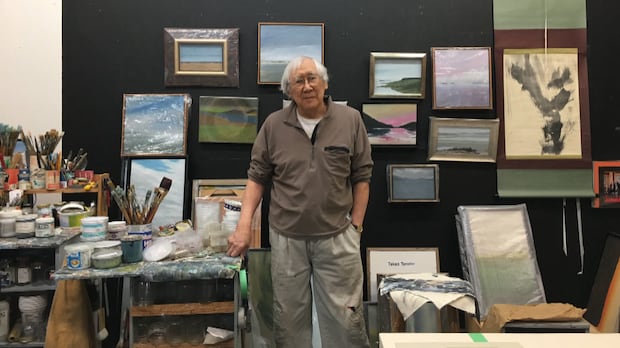
Two decades ago, 79-year-old Takao Tanabe stood in the Vancouver Art Gallery, examining a painting he had done in 1983.
It was part of a series created shortly after he returned to Canada’s West Coast, following a stint producing landscapes of the prairies and foothills near Banff, Alta.
“This series I called Queen Charlotte Summer, but it looks more like winter,” Tanabe mused.
“I love the whole idea of not being able to see things clearly. Indistinct land masses, indistinct water with bits and pieces floating on it.
“It suits my temperament. Being secretive.”
Over a career spanning seven decades, the prolific Prince Rupert, B.C.-born artist has created hundreds of artworks in a wide array of artistic styles, though he is primarily known for his landscapes.
“What I am trying to do is create new forms based on nature so that I see the world in a new way,” he said in a 1981 interview.
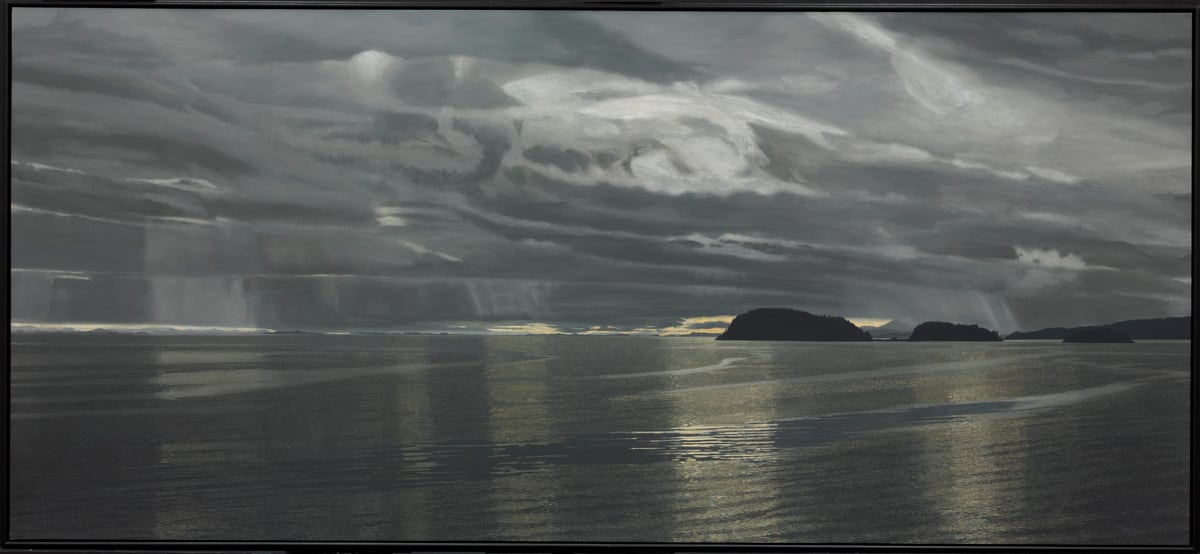 Takao Tanabe’s Dawn, 2003. (Photo: NGC / MBAC)
A retrospective at the Audain Art Museum in Whistler, Takao Tanabe 100: Inside Passage, was created to coincide with Tanabe’s 100th birthday this week.
“When I approached Tak two years ago with this idea of doing his survey he told me ‘make it quick. I’m old, make it happen sooner. I may not be alive in 2026’,” chief curator Kiriko Watanabe told CBC’s North by Northwest.
She said her initial goal was to hang 100 paintings, but the number was reduced because they were so large.
“We decided to focus only on his paintings and not include watercolours and prints because they have been showcased at other galleries. We really wanted to address a long span of his career from the 50s to the 2010s,” she said.
Despite his morbid warning, Tanabe was there to see the exhibit open.
“He stayed with us for a very long time, walking through the galleries with his wife, Anona,” Watanabe said.
“They both truly enjoyed the opportunity of being able to see so many of Tak’s paintings put together for presentation.”
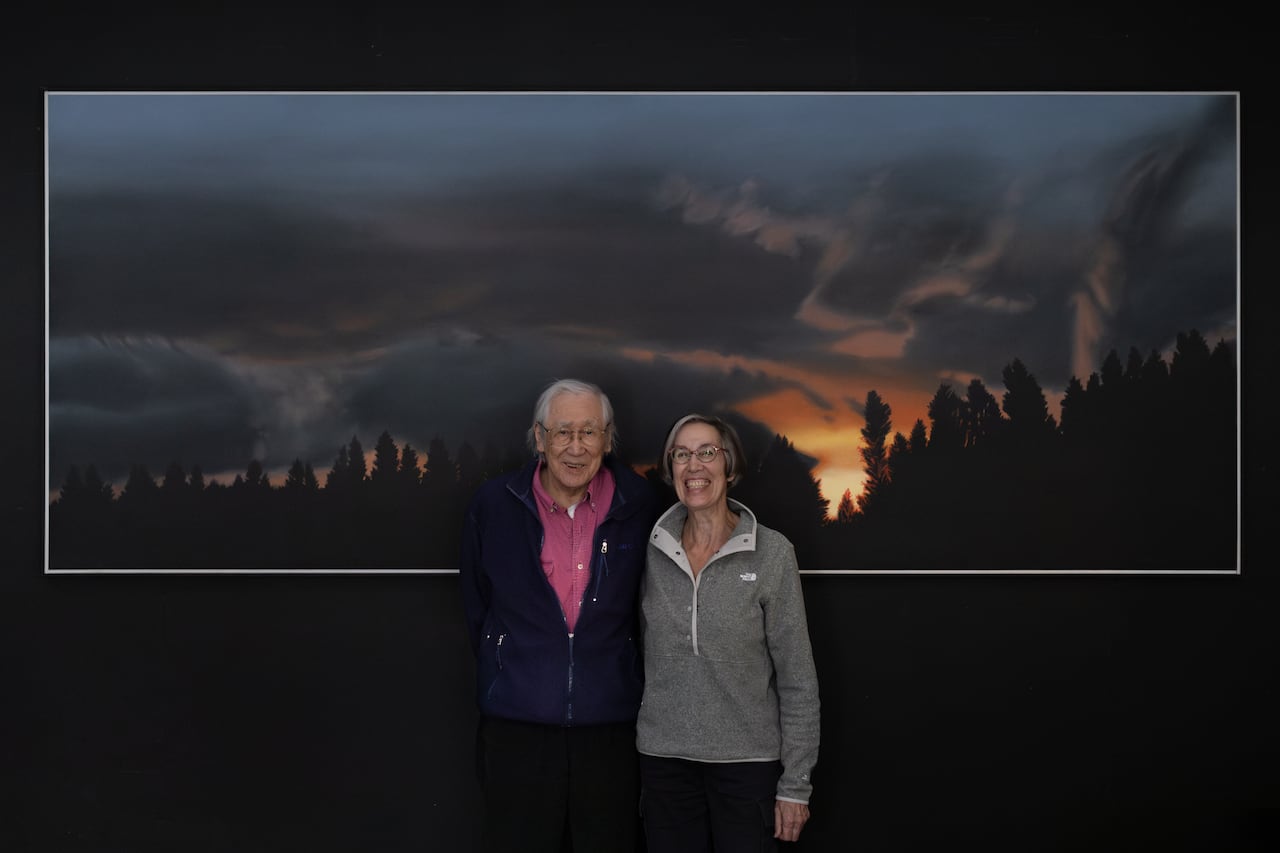 Takao Tanabe and his wife, Anona Thorne. (Kyle Graham)
Tanabe’s straight-talking, sometimes prickly demeanor has earned him the nickname “Crabby Tanabe.”
But Nikkei National Museum Director Sherri Shinobu Kajiwara said the man wandering the Audain Museum halls was relaxed and at ease.
“I have never seen him so gleeful, so joyful, just belly-laughing and smiling.”
As part of the birthday celebrations, Watanabe said the museum would donate 100 copies of the exhibition book to libraries and art galleries across Canada.
“We’re doing everything we can to make sure that Tanabe’s legacy will be remembered and celebrated.”
Tanabe, who has exhibited works throughout Canada, the United States and Europe, was made a Member of the Order of Canada in April 1999.
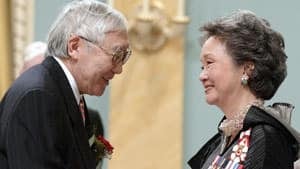 Takao Tanabe receives the Governor General’s Awards in Visual and Media Arts in 2003. (Canadian Press)Exploring identity
Tanabe’s career began at the Winnipeg School of Arts, where he was a student from 1946 to 1949.
“I went to art school thinking I could become a commercial artist and make a few dollars that way, and not have to work as a labourer for the rest of my life,” he said in 2006.
But he soon became enamoured with the idea of life as a creative.
“He never stopped exploring new styles … he was always curious about different combinations of art, colours, styles, lines and shapes,” Watanabe said.
“And once he sets to a certain direction, then he completely devotes himself to experimenting, coming up with variations of different styles.”
As a child of Japanese immigrants living in Canada during the 1940s, Tanabe and his family became the target of racist government policies introduced during the Second World War.
They were among 22,000 people of Japanese descent who were rounded up and sent to internment and work camps across Canada.
“Tak and his parents and younger siblings were incarcerated at Hastings Park … and the conditions were horrible,” Kajiwara said.
“It was so early in the internment era that the shacks were not ready for them. His father, who was a trained carpenter, and Tak actually helped build some of the housing that they were then further detained in.”
Despite his family’s experiences, Tanabe, who was born and raised in Canada without learning his parents’ native tongue, has resisted classification as a Japanese artist.
“I felt the mark of being branded Japanese, not knowing anything about Japan,” he said in 1961.
“People say there’s a Japanese influence in my work today but I don’t believe it. I nod my head now because I’m too tired to argue but I don’t believe it.”
But he did spend time in Japan.
In 1959, Tanabe used a grant from the Canada Arts Council to study the black-ink calligraphy of Sumi-e in Tokyo.
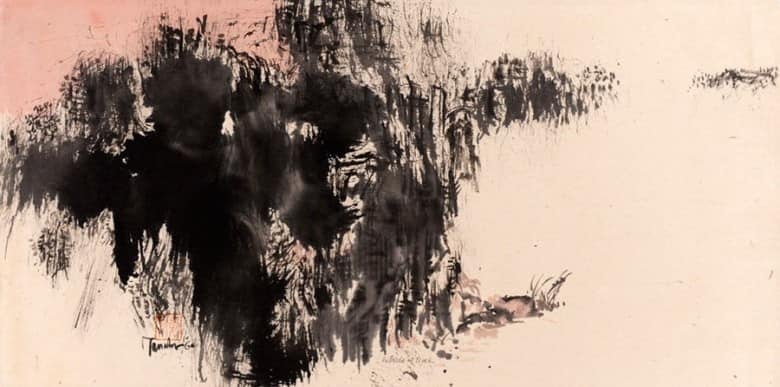 Hillside at Dusk, 1960. (Burnaby Art Gallery)
Kajiwara said his time there had a lot to do with identity.
“He was curious about learning to paint in Japanese style — but also — was he Japanese?
“Really, after two years, he concluded that he was not Japanese in the sense that the Japanese think of themselves,” she said.
“Having said that, it’s evident to me… in his work and especially the work that followed, there is such a strong influence.”
Back in the Vancouver Art Gallery, the final painting of Tanabe’s 2006 retrospective, Crossing the Strait, depicts a stormy night over Nanaimo’s Departure Bay.
Standing before the artwork all those years ago, Tanabe reflected on how visitors might perceive it.
“People will say, oh he’s getting to be 80, he’s looking at the end of his life. Darkness is creeping in and it’s going to envelop him completely.
“That’s one reading. But right after this, I did a seven-foot painting looking over the Pacific Ocean. And it’s dawn. If that was hanging here, what would people say?”
Takao Tanabe 100: Inside Passage runs until October 19.
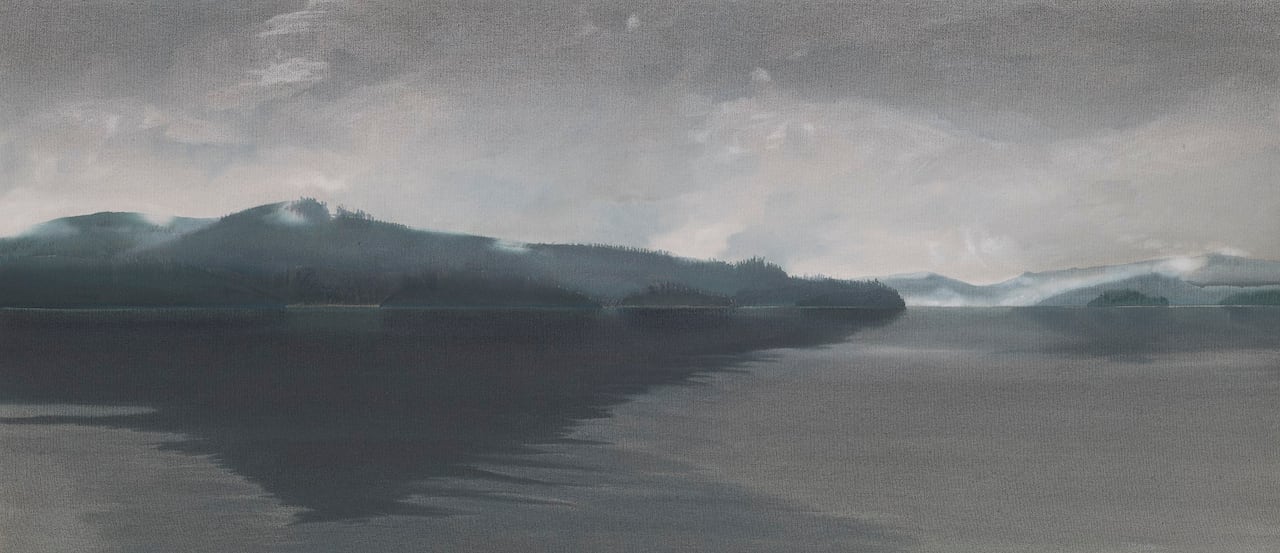 Queen Charlotte Summer, 1983. (Audain Art Museum)