
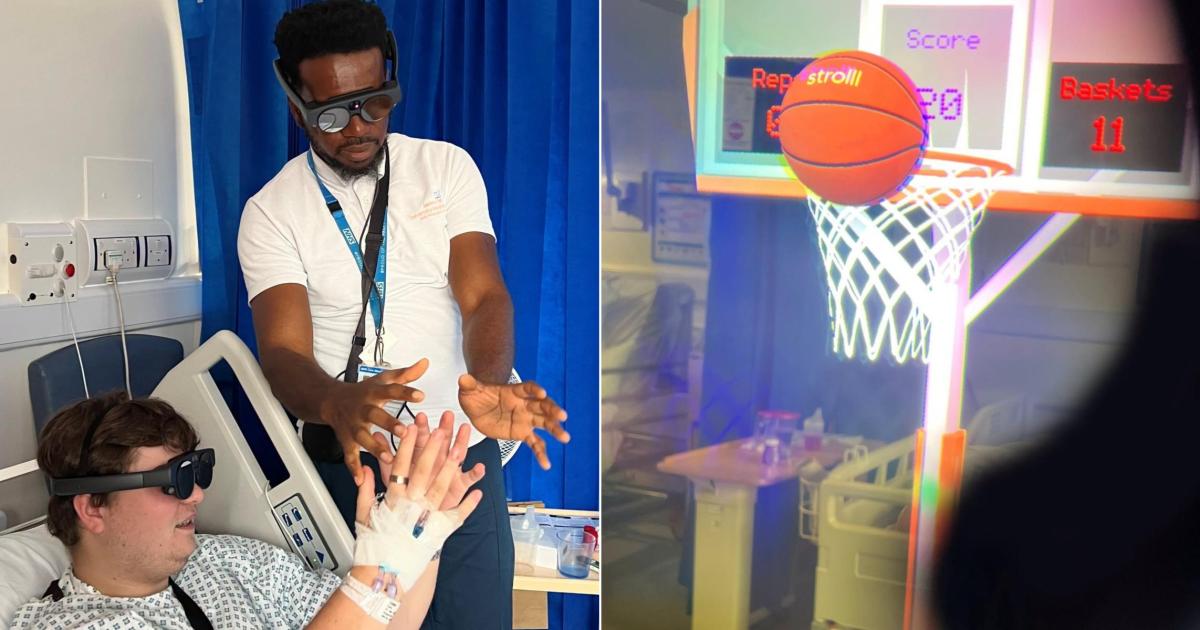
The James Paget University Hospital in Gorleston is trialling a new digital rehabilitation system on two wards to support patients’ rehabilitation.
Patients wear AR glasses that display therapist-controlled exercises in the form of interactive games, such as basketball or a ‘whack-a-mole’ style activity.
Patient Dylan Turner gets ready to throw a basketball, helped by senior physiotherapist Okechukwu Nwafor (Image: James Paget University Hospital)
Margaret Fuller, from Lowestoft and the first patient to try the system, said: “It’s excellent.
“When I had finished the exercises, I could really feel it in my arms – they gave me quite a work out.
“I think it will prove extremely popular. When I had finished, I actually wanted to do more.
“It was fun and made me want to push myself.”
Another patient, Dylan Turner, also enjoyed the experience and said: “It was cool.
“It’s fun and really got my arms moving but can get quite tiring, especially on a warm day.”
Dylan’s view through the Strolll glasses after throwing the basketball towards the hoop (Image: James Paget University Hospital)
Therapists using the Strolll digital therapeutic platform on wards 1 and 7 received training from Strolll representatives earlier this month to help with using the system.
The system records patient progress, including steps taken and reaction times, and offers exercises targeting gait, balance and cognitive skills.
It is also suitable for both mobile and bed-bound patients.
Aerial view of the James Paget Hospital in Gorleston (Image: James Paget University Hospital)
Senior physiotherapist Okechukwu Nwafor said: “Strolll will transform the way our patients engage with therapy sessions, making therapy more interactive and motivating while supporting mobility and functional recovery.”
Jennifer Lloyd, integrated therapies and dietetics clinical lead and who introduced the platform to the trust, said: “I am so excited to be launching Strolll on the wards.
“Hopefully this tool will help us keep patients more active, prevent deconditioning and get our people home faster and fitter.”
Following the trial, the hope is for it to be rolled out further as part of a two-year programme funded by the James Paget Hospital Charity.