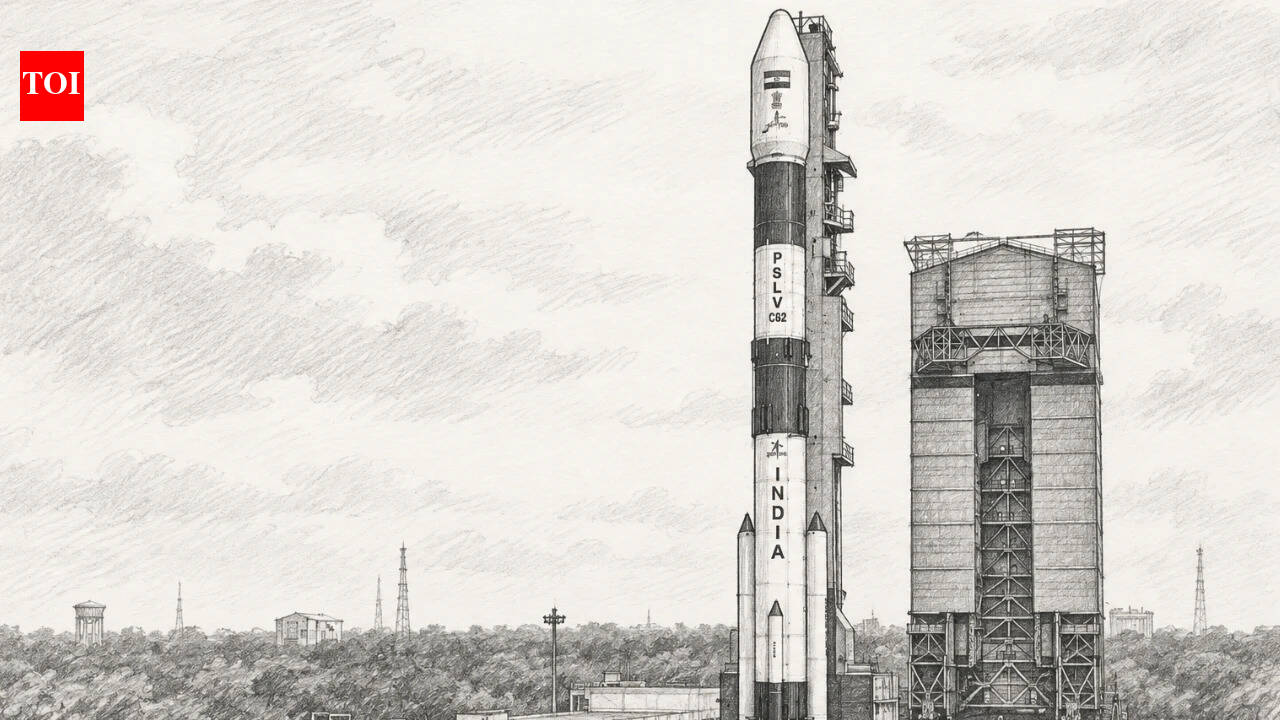
 Its history matters because PSLV has been viewed through the lens since 2025. Before 2025, the vehicle had a string of successful missions after the C39 failure in 2017. It isn’t flawless, but it has been dependable.! That’s the short story of PSLV’s long journey, which has now had a longer-than-expected pitstop. But a pitstop is all that will be.On this day (Sept 20) in 1993, the PSLV lifted off from Sriharikota for the very first time. That mission, the D1 with IRS-1E onboard, failed and it’s important to remember that failure. The second developmental flight, PSLV-D2, succeeded in Oct 1994, and the vehicle that followed was progressively modified and strengthened.Over the years, the launch vehicle, which eventually earned the moniker “Isro’s workhorse”, went from being a rocket designed to launch remote-sensing satellites into polar orbit to a launcher that carried different types of payloads which were deployed in different orbits. It took on several complex missions.Some of those missions have been milestones for the Indian space programme. The PSLV-C11 carried Chandrayaan-1 to the Moon in 2008, the C25 put the Mars Orbiter Mission in the path towards Mars in 2013. By this time, it had acquired another role that was less visible to the public but important to India’s ambitions: PSLV had become a launch service that foreign customers could rely on.
 The evolution is best seen in the missions themselves. On the C45 in 2019, PSLV didn’t just put a satellite into one orbit. EMISAT was placed at 748km, after which 28 customer satellites were deployed at 504km, while the fourth stage was subsequently moved to a lower circular orbit for experiments.The C59 carried Europe’s Proba-3, a pair of spacecraft designed to demonstrate precision formation flying. The C60 put the SpaDeX spacecraft into orbit for India’s autonomous docking experiment. The vehicle that had begun with a failed developmental flight had, over time, become a platform for increasingly demanding work.Its history matters because PSLV has been viewed through the lens since 2025. Before 2025, the vehicle had a string of successful missions after the C39 failure in 2017. Then came C61 in May 2025, when a problem involving the third stage brought the EOS-09 mission to an end. Eight months later, on Jan 12 this year, C62 failed, again with an anomaly involving the third stage, this time involving a disturbance in roll rate during the final stages of PS3 burning and a subsequent deviation from the expected flight path.Two failures in succession changed the conversation. This was no longer simply about adding another entry to a launch-vehicle failure list. The fact that both missions involved the same stage raised the obvious question of whether there was a connection, while also prompting a broader look at a vehicle that had been flying for 33 years.The circumstances surrounding C62 made that question harder to ignore. Isro had treated the return to flight with unusual caution, carrying out seven Mission Readiness Reviews compared with roughly three for a typical recent PSLV mission, along with hundreds of technical reviews across its centres. Recommendations from the C61 Failure Analysis Committee — never made formally public — had been implemented before C62. And yet the vehicle failed again.That does not, by itself, erase three decades of PSLV’s achievements. Nor does it establish that the two failures had the same cause. Those are precisely the questions an investigation is supposed to answer. But it does make the investigation more important, and not merely for the engineers who have to get the vehicle flying again.The PSLV, notwithstanding its legacy technology, isn’t just another Isro project. Indian satellites have depended on it, international customers have paid to use it, and generations of Indians have watched it become part of the country’s everyday space vocabulary.By Isro’s latest published list, Indian rockets had launched 434 foreign satellites by Dec 24, 2025 and 398 of those were carried by PSLV. That is about 92% of the foreign satellites launched by Indian rockets. Not to forget that the rocket’s success rate is also in the 90s — its cadence is a discussion for another Parallax piece.A vehicle with that kind of public and commercial history isn’t Govt’s concern alone. In a sense, PSLV has been given to the country through its successes — through Chandrayaan-1, the Mars mission, the 104-satellite flight, Aditya-L1, XPoSat and the many less celebrated missions that simply did what they were supposed to do. That creates a reasonable expectation that when something goes wrong, the country should be told what happened.It may not mean publishing every piece of telemetry, engineering drawing or technical parameter. It means explaining the findings in a form that a citizen can understand: what failed in C61, what the Failure Analysis Committee recommended, what was changed before C62, whether the two failures are connected, what the C62 investigation has found, what corrective measures are being taken and what tests will establish that those measures have worked.Isro has done this before. Transparency in failure, therefore, is not alien to the organisation or incompatible with protecting sensitive engineering information. The case for making at least a substantive summary of the PSLV-C61 and C62 findings public is consequently not an argument against Isro or Govt. It’s an argument for treating the public as a participant in a programme it has supported and followed for decades.There’s also a larger lesson here. Reliability is not something an engineering programme earns once and keeps forever. It has to be demonstrated again, particularly after a failure, and sometimes after two. PSLV’s extraordinary record makes that responsibility greater, not smaller, because expectations have been built over 33 years of mostly successful flights.The anniversary thus brings the PSLV story almost back to where it began. In 1993, its first flight failed, and the programme learnt, adapted and continued until the vehicle became one of the pillars of India’s space effort.In 2026, after two consecutive failures and an investigation whose findings remain closely held, the vehicle is again learning from failure and it will soon find its way back to the launchpad.And I think the country should be allowed to see at least some of what has been learnt from the two failures. Not because PSLV’s 33-year record deserves to be diminished, but because it deserves to be understood.–Postscript:The PSLV story after every failure has always been the same: examine, learn, change and fly again. Perhaps the Parallax now is to ask whether the country should also be allowed to see what was learnt before the next flight.