
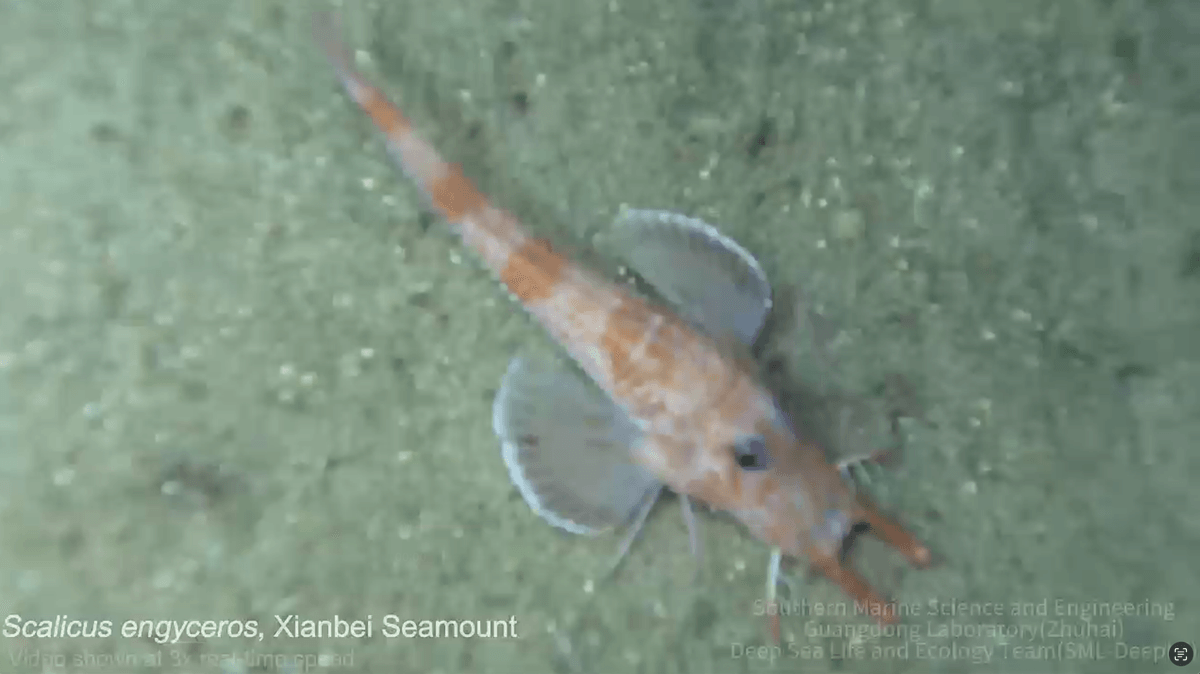
A bizarre deep-sea fish that looks part fish, part prawn has been filmed walking backwards for the first time, revealing an unusual behaviour that has never previously been recorded in a fish.
Researchers from Sun Yat-sen University and the Southern Marine Science and Engineering Guangdong Laboratory (both in the Guangdong Province of China) used remotely operated and human-occupied vehicles to observe three species of armoured searobin in their natural environment in the northern South China Sea.
The armoured searobin (Scalicus engyceros) was filmed using specialised rays extending from its pectoral fins to move along the seafloor. The footage confirmed that searobins can walk not only forwards and sideways, but also backwards using their free pectoral-fin rays.
The findings, published in the journal Ocean-Land-Atmosphere Research, provide a rare glimpse of the behaviour of a deep-sea animal that has traditionally been studied from preserved specimens.
“[Our] study delivers a paradigm-shifting revelation: the deep-sea fish Scalicus engyceros is among the few fish species known to walk”, says Han Tian, the study’s primary author and a doctoral researcher at Sun Yat-sen University.
“Commonly known as the armored searobin, this extraordinary creature boasts a striking shrimp-fish hybrid body appearance, earning it the nickname ‘fish-prawn hybrid’ in U.S. local media.”
The researchers observed three species of armoured searobin during their dives: Scalicus engyceros, Paraheminodus murrayi and Peristedion liorhynchus. All three were seen displaying distinctive behaviours on or close to the seafloor. When threatened, the fish can also make sudden, jerky leaps, using their specialised fin rays and tails to escape danger.
This video documents the distinctive deep-sea behaviours of three peristediid (armored searobin) fishes observed in the South China Sea: Scalicus engyceros, Paraheminodus murrayi and Peristedion liorhynchus. The video plays at 3x real-time speed. Credit: Kedong Yin
Armoured searobins belong to the family Peristediidae and have a particularly unusual body shape. Their free pectoral-fin rays have evolved into separate, leg-like structures that allow them to move across the seabed.
First described by zoologist Albert Günther in 1872, these unusual fish were not previously known to be capable of moving both sideways and backwards – a behaviour that has never been observed in other fish species.
Tian added: “Another unique trait is its outward-extending barbels, which looks like a farmer’s rake. The structure is awkward for moving around, but it allows the searobin to sense and probe potential prey in seafloor sediment or even dig into the surface sediment for efficient foraging.
“Meanwhile, the creature retains the pectoral fins, which have evolved into flat, round plates, improving balance during walking and swimming, while its shrimp-like fin rays and tail enable explosive, jerky shrimp-style leaps when threatened.”
How does the armoured searobin walk?
The fish has several pairs of barbels (whisker-like appendages around its mouth) that extend outwards like the teeth of a rake. These are used to search through sediment for potential prey and may even help the fish dig into the seafloor.
The remaining pectoral fins form flat, rounded plates that help the animal maintain its balance as it walks or swims. Its unusual body has led to the species being described as a ‘fish-prawn hybrid’, thanks to its combination of a fish-like body and shrimp-like appendages.
The researchers observed that the searobins have relatively large eyes. While one fish did not appear to see the approaching underwater vehicle, it reacted by rolling its eyes when exposed to the vehicle’s light. This suggests that the fish may retain some sensitivity to light, despite living in the deep sea.
Discover more fascinating fish facts:
Top image: screenshot from the researchers’ video. Credit: Kedong Yin