
For decades, rear-wheel drive has been the defining layout of the driver’s car, allowing enthusiasts to feel the rear axle work, control the vehicle with the throttle, and decide exactly how much power reaches the road. But as performance cars have become more powerful and acceleration targets more extreme, putting all that output through two driven wheels has become increasingly difficult. Add the demand for dependable year-round traction, and all-wheel drive has become harder for manufacturers to resist.
What was once viewed as a compromise for those who valued outright grip over driving involvement has gradually become a performance technology in its own right. For enthusiasts who grew up associating rear-wheel drive with the purest expression of a performance car, every new all-wheel-drive adoption feels like another small piece of an old formula disappearing.Now, one of the most important remaining rear-drive performance nameplates has finally joined the growing list of converts.
The Era Of Rear-Wheel Drive Was Never Supposed To End
Rear-wheel drive became synonymous with performance because it separates the jobs of steering and propulsion, leaving the front tires to focus on changing direction while the back tires deliver the engine’s power. That arrangement also gives drivers a uniquely direct relationship with the throttle. Apply enough power in a corner and the rear tires can exceed their grip, allowing the car to rotate and giving an experienced driver another way to control its attitude.
But there is a limit. As engines gained horsepower and torque, two tires increasingly struggled to convert that output into forward motion, particularly when manufacturers began chasing ever lower 0-to-60 mph times. The problem becomes especially apparent from a standing start, when weight transfers rearward, but the available traction can still be overwhelmed by a powerful engine. Modern electronic aids can manage that excess, but they cannot change the fundamental amount of grip available from the driven tires.
Porsche Was The First Warning That Even Icons Could Not Resist
The first major warning arrived with the 1989 Porsche 911 Carrera 4, introduced as part of the new 964 generation. Porsche adapted an all-wheel-drive system originally developed for the high-performance 959, giving the 911 technology that could actively optimize traction and stability rather than simply adding driven wheels.
Its electronically controlled system normally sends 31% of torque to the front axle and 69% to the rear, preserving a distinctly rear-biased character. Crucially, Porsche did not abandon the traditional formula. The rear-wheel-drive Carrera 2 followed, giving buyers a choice between the established layout and the new four-wheel-drive alternative. The decision made the Carrera 4 significant beyond Porsche itself because AWD had graduated from rally stages and off-road applications into a credible weapon for serious road-going sports cars.
It also established an important precedent for performance cars that followed, showing that additional driven wheels did not have to mean abandoning the characteristics enthusiasts already valued. Instead, the technology could be engineered around an existing chassis philosophy, adding another layer of capability without completely redefining the car.
AMG Turned All-Wheel Drive Into A Performance Weapon
By 2013, Mercedes-AMG was demonstrating that all-wheel drive could serve a very different purpose from simply improving security in poor weather. The E63 AMG 4MATIC paired a 5.5-liter twin-turbocharged V8 with a performance-focused AWD system, producing up to 577 hp and 590 lb-ft in its most powerful S model specification.
Rather than treating four-wheel drive as a fallback for slippery roads, AMG used it to put the V8’s prodigious output onto the tarmac more effectively. The system could distribute torque between the axles according to available grip, helping the E63 launch harder and maintain traction when accelerating out of corners. This was an important change in the AWD argument because four-driven wheels could now be presented as a way of exploiting huge power, rather than merely containing it. For high-performance car manufacturers, the situation made AWD increasingly difficult to dismiss as unnecessary complexity when it could directly improve how effectively a powerful engine was used.
The Jaguar F-Type Was Where Purists Started Losing Another Battle
By 2015, Jaguar was applying the same philosophy to one of its most important modern sports cars. The F-Type R gained an intelligent all-wheel-drive system designed to preserve the car’s rear-wheel-drive character while providing greater dynamic capability. Jaguar’s engineers were explicit about the objective: retain the engaging feel associated with rear-wheel drive while giving the car greater traction when the driver demanded maximum performance. The result was a 550-hp supercharged V8 sports car capable of reaching 60 mph in just 3.9 seconds.
The significance went beyond the numbers. Jaguar showed that AWD didn’t necessarily require abandoning a car’s established personality. Instead, the technology could integrate so subtly that the traditional character remained intact, making resistance to the technology harder to justify.
BMW’s M3 And M4 Proved Four Driven Wheels Could Be An M Car
BMW’s decision to offer M xDrive on the G80 M3 and G82 M4 set an important precedent for the smaller M car. Rather than treating all-wheel drive as a replacement for the traditional M formula, BMW positioned it as another tool within the driver’s arsenal.
The system could vary torque between the axles based on the demands placed on the car, giving drivers extra traction when exploiting the engine’s considerable output. Crucially, BMW retained a rear-wheel-drive mode, allowing the front axle to disconnect and the car to return to its traditional rear-wheel-drive configuration. That made the argument harder for purists to dismiss; now drivers do not necessarily have to choose between AWD grip and RWD character. They could have both, depending on the situation. There is very little else an enthusiast could require from a performance car besides this option.
The Corvette E-Ray Sacrificed Weight For Supercar Crushing Speed
The 2024 Chevrolet Corvette E-Ray took the AWD formula to an even more dramatic conclusion by combining a naturally aspirated 6.2-liter V8 with a front-mounted electric motor. Together, they produce 655 bhp, giving the hybrid Corvette a claimed 0-to-60 mph time of just 2.5 seconds. The front motor can also operate independently of the V8, allowing the E-Ray to drive on electric power alone at low speeds for short distances.
Unlike conventional mechanical AWD systems, the front axle is driven electrically, allowing Chevrolet to add traction without a driveshaft running from the engine to the front wheels. The compromise is weight. With its hybrid hardware and four-wheel drive system, the E-Ray weighs 3,774 pounds, making it one of the heaviest Corvettes yet.
The new Grand Sport X uses a similar mix of a mid-mounted V8 and a motor on the front axle. The result is now a total of 721 hp and the ability to reach 60 mph in 2.4 seconds.
The vehicle perfectly illustrates the modern performance bargain. Manufacturers are increasingly willing to accept additional weight when it delivers the kind of instant traction and acceleration that would be extremely difficult to achieve through the rear wheels alone.
The Last Pure BMW M Car Finally Gives In
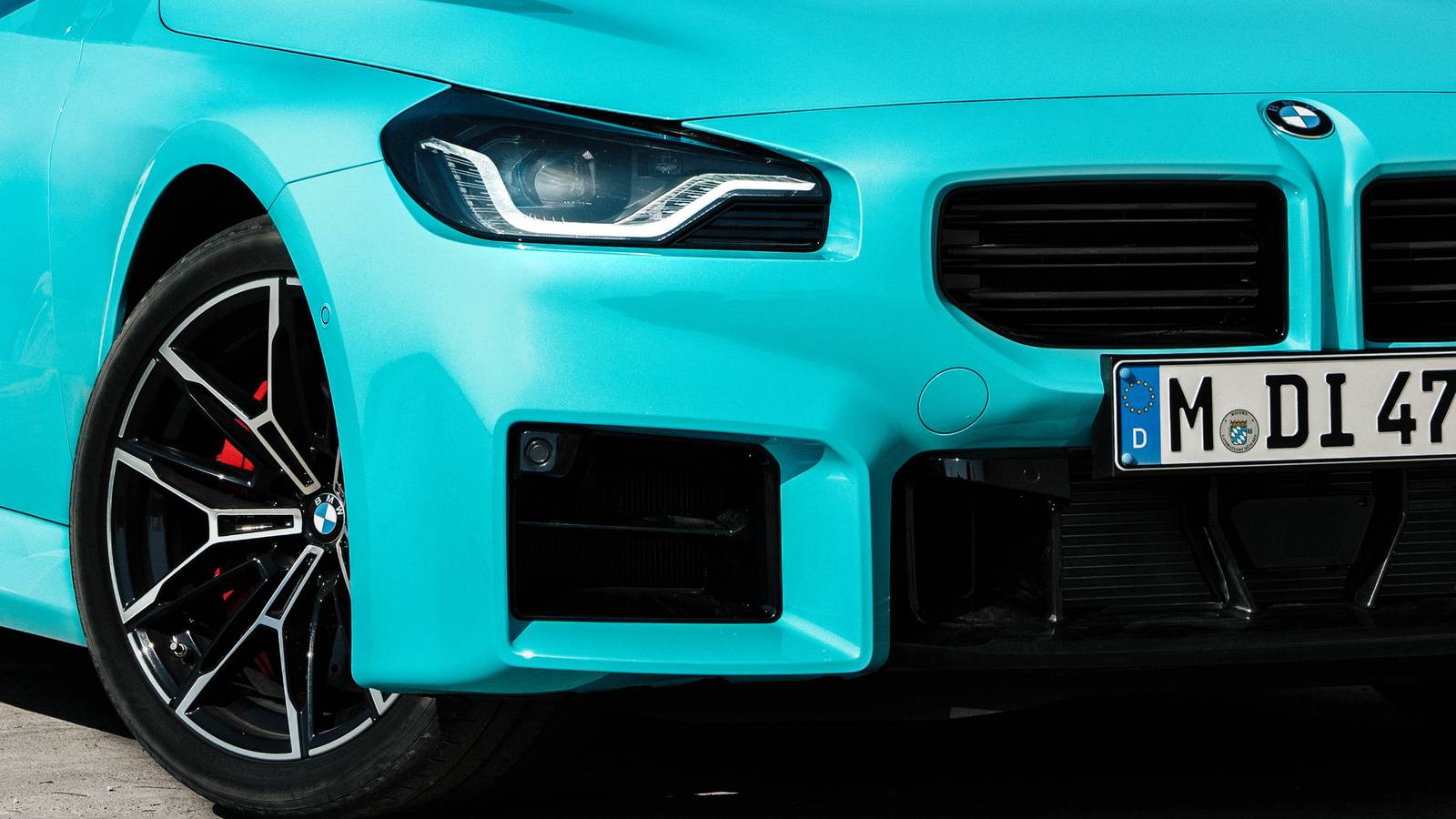
The final domino is perhaps the one that hurts most. For the 2027 BMW M2, all-wheel drive arrives for the first time through M xDrive, bringing 473 bhp and a 3.6-second 0-to-60 mph time in the US. That is 0.3 seconds quicker than the rear-wheel-drive model, a measurable gain that neatly explains why BMW believes buyers will accept the change.
Yet calling this the complete death of the rear-wheel-drive M2 would be unfair. The rear-biased M xDrive system includes a selectable rear-wheel-drive mode that disconnects the front axle and disables DSC, allowing the driver to recreate the traditional setup whenever desired. The penalty is weight, with AWD adding roughly 121 pounds. In return, buyers get both philosophies in one car: four-wheel traction when wanted and rear-wheel drive freedom when it matters.
Thankfully, unlike some earlier M xDrive models, the M2 does not use all-wheel drive as an exclusive specification, with BMW continuing to offer the rear-wheel drive alongside it.
Sources: BMW, GM, Jaguar, Mercedes-Benz, Porsche, Car and Driver