
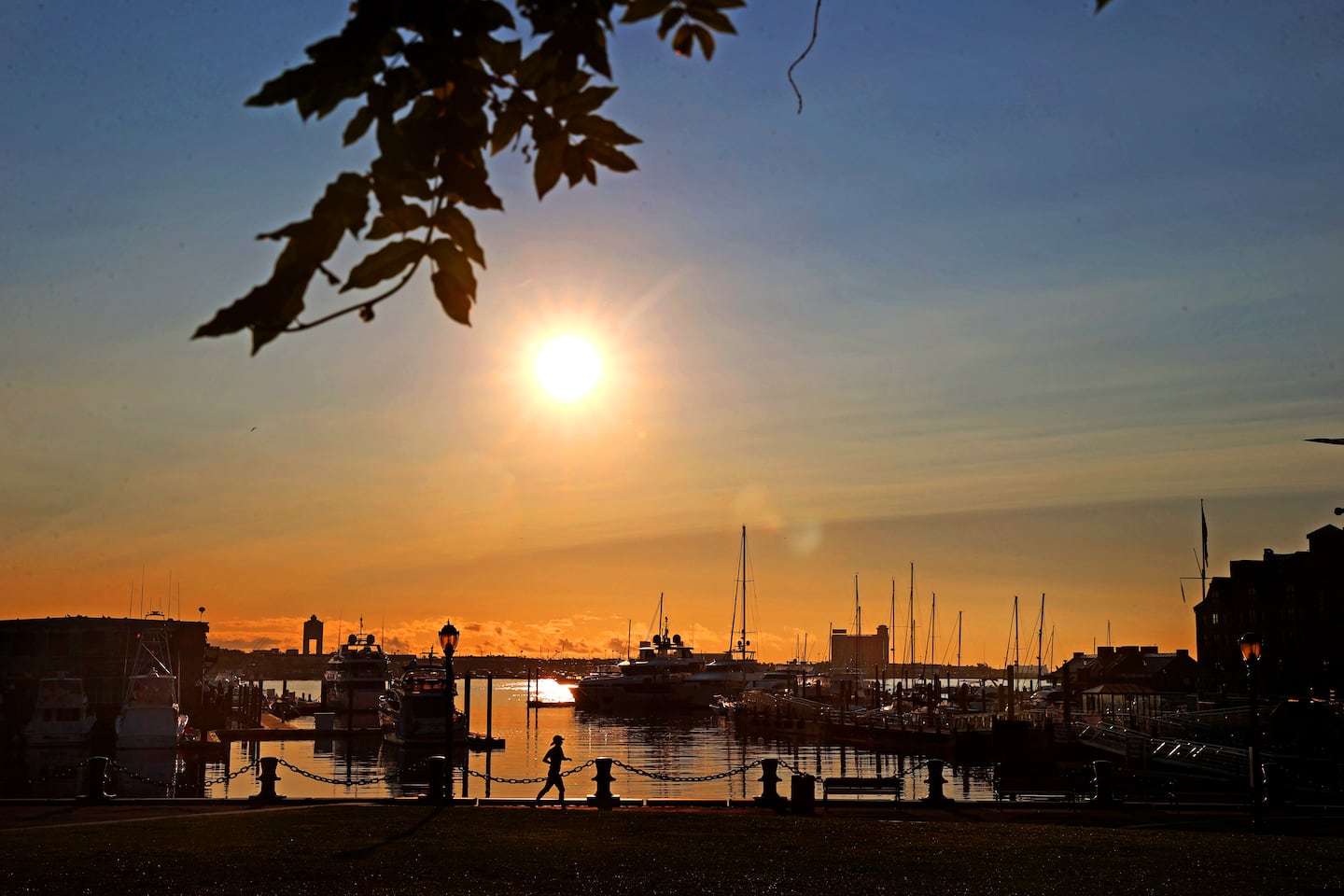
Let’s start with the myth.
The autumnal equinox marks the point at which the sun is directly overhead at some point along the equator. But the equinox is not actually a day of equal day and night. That balance, when daylight and darkness split evenly, is called the equilux, and it doesn’t arrive until a few days after the equinox, around Sept. 25 or 26. The gap comes down to two things: The sun isn’t a point of light, it’s a disc, so we get a few extra minutes of daylight as the top edge clears the horizon before the whole sun rises and the bottom edge lingers after it sets. Also, the atmosphere itself bends light, pulling the sun’s image up over the horizon a bit before it’s technically there, and holding it a bit after the sun is technically gone. Put those together and you get a few extra minutes of daylight tacked onto both ends, every single day, everywhere on Earth. We get nearly three minutes a day here in this part of the world. It’s less the farther south you go, and even more dramatic the closer you get to the poles.
 The autumnal equinox occurs on Sept. 22 this year, when daylight and nighttime are roughly equal in length.Boston Globe
Around the equinox, the rate at which we’re losing daylight is the fastest it will be all year, close to three minutes a day, compared to just seconds around the solstices. That’s not a small thing for the brain.
This time of year and that steady loss of light are intrinsically linked to your mood and how it may be changing, if you’ve been slowly feeling off since mid-August. I was chatting last week with my best friend from Toronto, not really knowing why he was feeling a bit down, as if winter were already here. It got me thinking: As we’ve been heading toward the equinox, what are the collective impacts?
 A couple stroll the beach on Nantucket at sunset on Sept. 11, 2026.Stan Grossfeld/Globe Staff
There’s research from Vanderbilt University in 2024 in which Sandra Rosenthal, a chemistry professor who also studies pharmacology, found something that surprised her. It wasn’t the total amount of daylight that mattered most to people with mood disorders. It was how fast that daylight was disappearing.
She noticed the pattern in her own life first. Every August, around the third week, she’d end up at the doctor feeling rundown, like she had mono, long before winter ever showed up on the calendar. Her research team tracked solar insolation, the actual amount of the sun’s energy reaching the ground, across small regions, and found that the rate of that decline predicted symptoms of depression better than the season itself did.
There’s another piece to this that has nothing to do with total daylight and everything to do with timing. The light that actually sets your body clock isn’t midday sun, it’s the low angle, right around sunrise and sunset. Your retina has cells built specifically to catch that kind of light and report straight to the brain’s master clock. Get that signal at a consistent early hour and your cortisol rises on schedule, which locks in when you feel awake and, about 16 hours later, when you feel sleepy.
Here’s the problem this time of year: Sunrise keeps sliding later, day by day, while most of us keep waking up at the same clock time we always have. So the exact light you need to anchor your rhythm is arriving after you’re already up, already checking your phone, already three cups of coffee into the day. You miss the window without ever knowing there was one.
This isn’t just one research study. We’ve got Rosenthal’s work on the rate of light change, but also that of Andrew Huberman, a Stanford neuroscientist who’s built a huge body of work around exactly this kind of light exposure. According to Huberman, an 2023 observational study of more than 85,000 people found that low daytime light exposure was tied to a real rise in depression and other mental health conditions.
I always knew, personally, that I felt better on the mornings I got my dog walk in right at sunrise, catching that low angle light. I just never had any research behind it, just a feeling I chalked up to being an early riser who likes his coffee outside.
But Rosenthal’s research points to the body’s own master clock, the suprachiasmatic nucleus in the hypothalamus region of the brain, as the part doing the sensing. It reads the pace of the light change and adjusts melatonin release accordingly, hence regulating circadian rhythms. SCN is a mechanism every one of us carries, whether or not we ever notice it working.
We can’t change the amount of sunlight that is going to occur over the next six months, but we can try to get more of it as it’s clearing the horizon first thing in the morning or before it disappears late in the afternoon. No matter what, if you’re feeling a bit down, you’re not alone.