
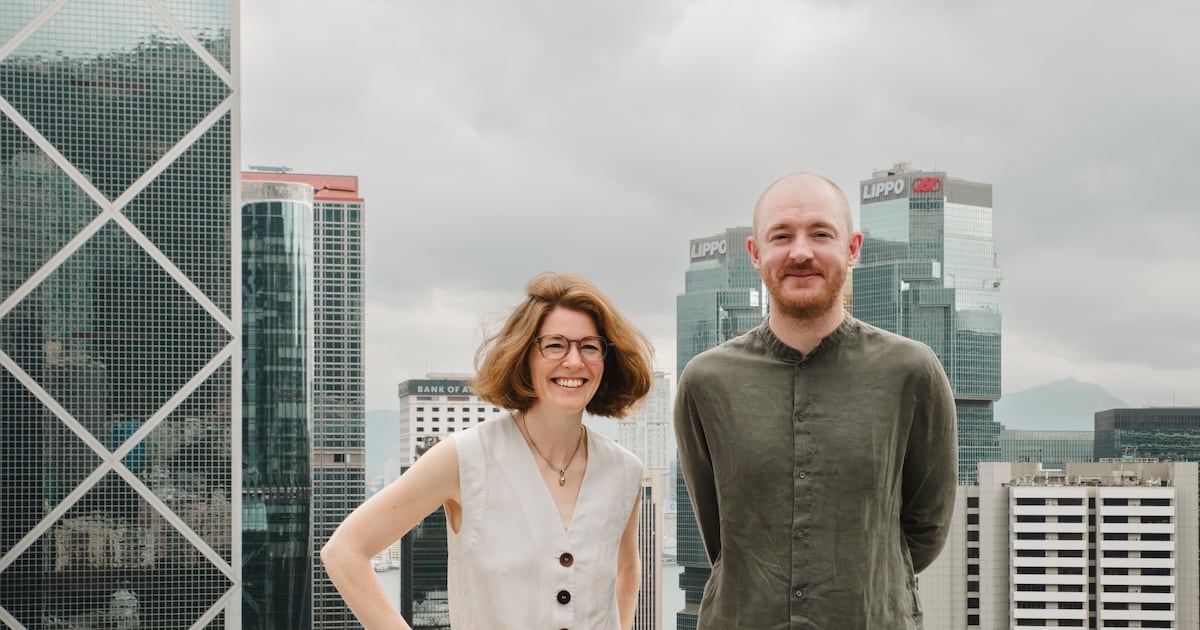
“Ireland is the land of sky … that’s the most confronting thing when you get there … It’s so dense here,” says Irish architect Donn Holohan.
Sitting beside his partner in life and work, Elspeth Lee, Holohan looks out the window of the University of Hong Kong campus where they teach. The sun is setting as crowds of students make their exodus into one of the world’s densest cities. It holds the accolade of having more skyscrapers than any other city.
When they brought their students almost 10,000km away to Letterfrack in Connemara last year, the visit left two lasting impressions of Ireland. They said “there were beautiful flowers on the sides of the roads” and “there is so much sky,” says Lee.
The pair met while studying architecture at UCD, graduating as the post-Celtic Tiger recession took hold. “It was a pretty challenging time,” says Lee.
Although they were fortunate enough to secure architecture jobs in Dublin, thoughts of travel beckoned and they were “quite excited by the possibility of an adventure”, she says.
When an opportunity came up for Holohan to teach in Hong Kong, the couple decided to move for two years. The city’s “vibrancy” and its connection to China and southeast Asia drew them there, says Lee. Those two years gradually turned into 12.
The speed at which building was happening when they arrived was an “eye-opener” and “super exciting”, Holohan says. “China was in the middle of an insane building bubble, building cities every year,” he says. China is estimated to have used more cement between 2011 and 2013 than the US used in the entire 20th century, according to historian Vaclav Smil. “Each year they were just building, building, building, and with that, there were loads of opportunities for architects,” he adds.
But Holohan and Lee’s focus was different. They were influenced by mentors in Ireland who had a “sensitivity to materials” and a “relationship to the place in which you work and ecologies”, says Lee.
[ Irish abroad: I really believe in ‘one world, one family’Opens in new window ]
Although “fascinating”, the particular type of architecture happening in China at the time was something “we didn’t want to necessarily do”, explains Lee.
“We came at a time when China itself was also changing,” says Holohan, noting how president Xi Jinping criticised “weird” architecture transposed from the US and Europe. “This idea was that China would begin shaping its own destiny, through its own history, its own way of making.”
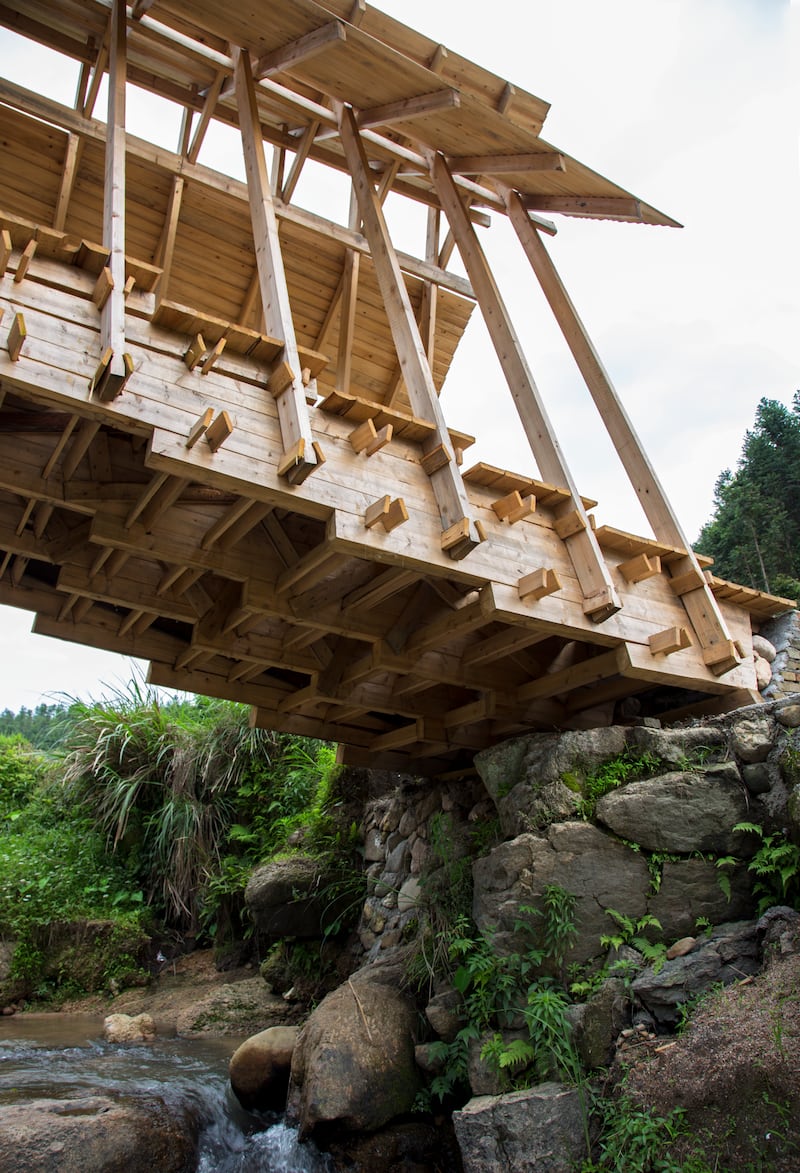 Abroad: Wind and Rain Bridge, outskirts of Peitian Village, Fujian Province, China
This brought opportunities to experiment and look at architecture “in a different way”, says Holohan. “There was an imperative to build stuff.”
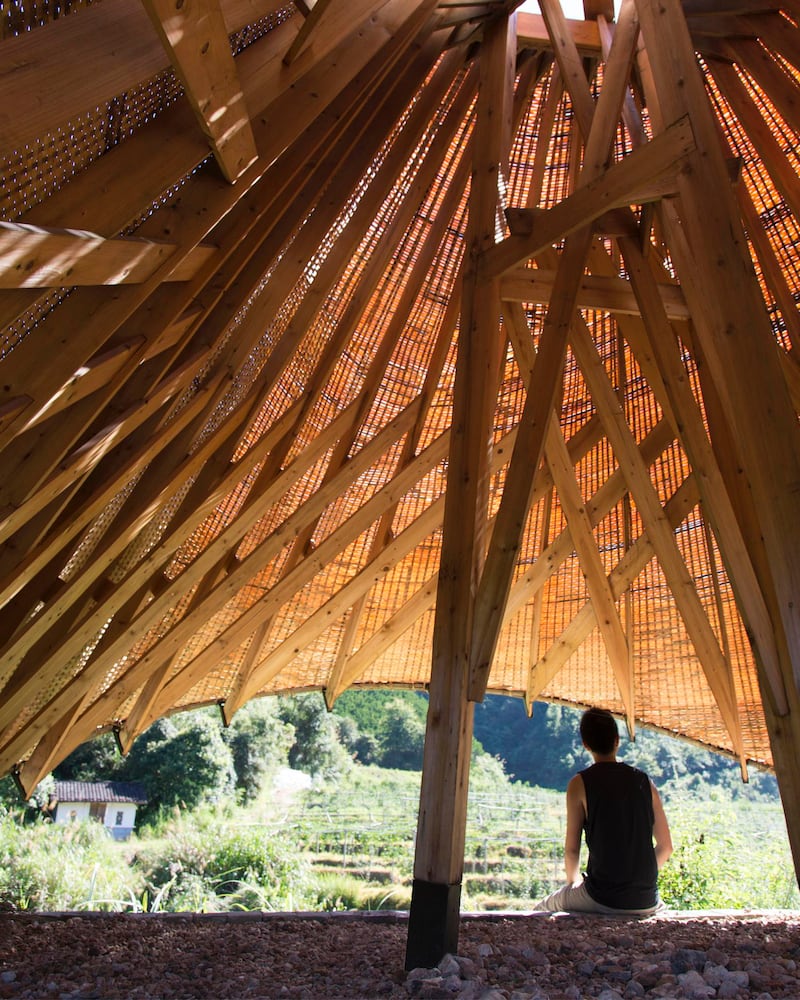
Such experiments include a bridge and a shelter in the 800-year-old Peitian village in Fujian province, an area renowned for historic Hakka architecture. An internal tourism boom with proposals for “crazy hotel buildings” threatened ancient heritage, explains Holohan. There was a move to find a different way to develop tourism infrastructure. “The question was how can we create new structures in this space in a way which is less damaging … how we build, not what we make.”
The first project, the Wind and Rain Bridge, was made with interlocking timber building techniques native to the region and local materials. The second project, Sun Room shelter and resting place, used local bamboo, a material broadly replaced by plastic in modern usage.
However, there was just one master carpenter in the village to work with timber, and one bamboo expert aged in his 90s. Neither had apprentices. “You’re very much on the cusp of something being forgotten,” Lee says. For both projects the architects used digital tools to adapt these traditional crafts so they could be used by volunteers with local materials. They hope this model can be rolled out in other Chinese villages.
This model also draws on the old Irish idea of meitheal, and they have brought this approach to adapting local materials and traditional crafts to a Co Clare project. They are helping to develop an agricultural training centre at Moy Hill Farm which is focused on regenerative farming.
Another project which could be “very applicable in an Irish context”, is in response to Hong Kong’s housing shortage, something Ireland also knows all too well.
We’re kind of like islanders; we move between these islands
— Donn Holohan
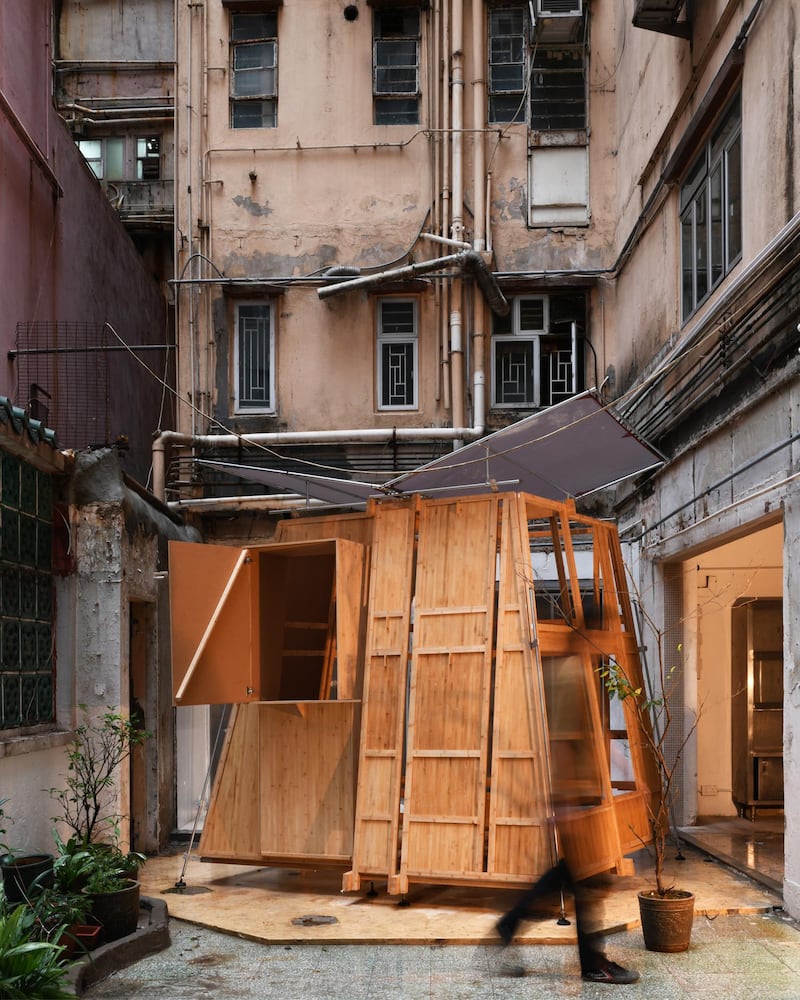
They piloted a transitional housing shelter for homeless people in one of the city’s densest areas. “The idea is we [in Hong Kong] have a housing crisis, but we also have quite a lot of vacant office space,” says Holohan.
Backpack Housing uses a temporary vacancy, when a building is unoccupied before it’s demolished or reconfigured. It creates small spaces which use the building’s infrastructure (electricity, water). “You get an enclosure that’s your own, it’s lockable, private and secure,” says Holohan. It is a reconfigurable kit of parts, so occupants can unpack the unit and move it with them through different housing systems.
“It’s a question of dignity,” says Holohan. The idea is “not a solution” to homelessness, “just a solution to a crisis right now.”
Their architectural practice, Superposition, spans both Hong Kong and Ireland. The couple describe themselves as “between two places” and this liminal state has influenced their approach. Being an emigrant gives them an “outsider perspective” while still being part of an architectural community.
“We’re kind of like islanders; we move between these islands … We don’t really see ourselves as being in one place in Hong Kong or Dublin,” says Holohan.
“Because we spend time in both places, we stay in one long enough to miss the other … and just before we get super-frustrated with the place that we’re in,” says Lee
Reflecting on the idea of home, Holohan adds: “I don’t really feel at home anywhere: that idea of home is becoming less important to me.”
Elspeth Lee and Donn Holohan are speaking on September 23rd as part of the Irish Architecture Foundation’s series of free online talks from Irish diaspora. Register for The Scale of Distance at IAF.ie. Holohan and Lee’s new book Material, Making and Place: A playbook for resource-conscious architecture (RIBA Publishing) will be released on October 1st.