
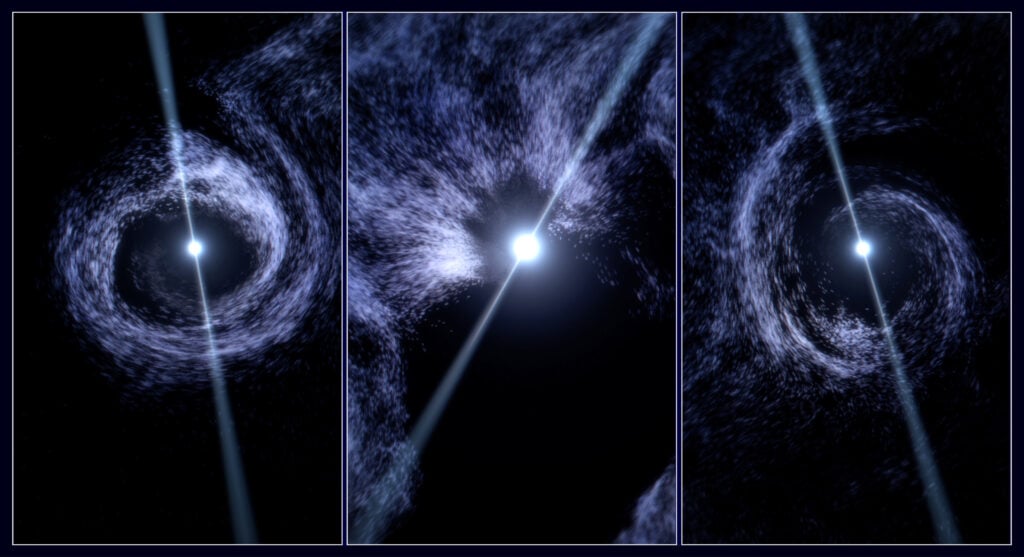
XRISM recorded plasma falling towards the X-ray pulsar GX 301−2 at least 540,000 kilometres per hour while the neutron star passed through a dense stream in the wind of the blue hypergiant Wray 977.
The Japan-led observatory began observing BP Crucis on 1 February 2025, collecting about 16 hours of usable data near the end of a strong flare. Resolve measured the gas’s motion and spectral changes that constrain its changing arrangement around the pulsar.
This is one observation of one flare. The direct result is spectroscopic evidence for inflow. Disk breakup and reversal are interpretations drawn from XRISM spectra, long-term Fermi timing and flow modelling, not frames from a resolved image.
Iron lines measured gas falling in
Roi Rahin and 12 colleagues report in Science Advances that Resolve detected redshifted lines from highly ionised iron and transitions from less ionised states.
The absorption lines appeared at lower energies than the same atomic transitions measured in a laboratory. That redshift shows that the plasma was moving away from Earth. Establishing motion towards GX 301−2 requires the orbital corrections and physical consistency checks that follow.
The two strongest lines were redshifted by 419 and 443 kilometres per second in the observer’s frame, with statistical uncertainties near 25 kilometres per second. Correcting for Earth, BP Crucis and the neutron star’s uncertain orbital velocity gives inflow faster than 150 kilometres per second under all three ephemerides tested.
Under the team’s adopted ephemeris, the range is 150 to 180 kilometres per second. The widely quoted 540,000 kilometres per hour is therefore a lower bound, not an exact speed.
The lines changed from absorption, through mixed intervals, to emission. Absorption marks gas in front of the bright X-ray source; emission can arrive from a wider volume. The transition gave evidence that the flow geometry was rearranging while matter accreted.
“Direct” needs a precise meaning here. XRISM did not photograph a stream touching the neutron star. It measured the motion and changing location of the plasma through its effect on X-ray photons.
A hypergiant feeding a city-sized remnant
BP Crucis lies about 13,000 light-years away in Crux. Wray 977 has roughly 40 solar masses and 60 solar radii. Its companion packs more than a solar mass into a neutron star about 20 kilometres across. GX 301−2 rotates every 11 minutes and orbits in 41.5 days.
What changed in the universe since you were born?
Six sourced measurements. No predictions. No astrology.
Wray 977 constantly loses ionised gas. Several-day X-ray flares occur near the pulsar’s closest and farthest orbital points. Astronomers think GX 301−2’s gravity helps create a denser stream within the wind; the pulsar brightens when it crosses and captures some of that material. The passage lasts about four days.
XRISM has already used Resolve to disentangle fast, Doppler-shifted gas in the stellar wind around Cygnus X-3, another compact object embedded in a massive companion’s outflow. The BP Crucis observation adds a time sequence close to a neutron star while a flare is under way.
Where the broken, reversed disk enters the story
The detailed disk sequence comes from the researchers’ interpretation, set out in NASA’s account. On entry, captured gas may have enough sideways motion to form a turbulent disk and spiral inward.
Farther in, the pulsar moves more directly against the flow. Incoming material then lacks the angular momentum to sustain a disk. The structure breaks apart and plasma falls more radially. XRISM observed near the end of this proposed phase.
Near the far edge of the stream, the relative flow changes once more. A messy disk can briefly re-form, now rotating in the opposite direction, before disappearing as the pulsar exits.
XRISM caught only the end of the stronger pre-periastron flare. It did not observe the initial disk, its breakup and the later reversed disk from start to finish. The peer-reviewed paper phrases the measured geometry more cautiously as an evolution from predominantly radial inflow to a transverse, potentially disk-like configuration. The spectrum does not independently resolve a disk or measure its rotation on the sky.
A different kind of disk-reversal evidence
SpaceDaily recently examined a possible reversal around pulsar 4U 1626−67 inferred from 22 years of spin timing. There, the clue was a long change in the torque exerted on the neutron star, and the statistical preference for reversal remained weak.
GX 301−2 offers a nearer view of the moving fuel. Its iron spectrum changed over hours, while roughly 17 years of Fermi timing supplied torque-sign evidence consistent with opposite angular momentum. Around flare entry and exit, 373 of 528 timing points matched the predicted pairing of spin-up with flare entry and spin-down with flare exit, against 155 mismatches. The reported odds ratio was 6.0, with an uncertainty of +1.2 and −1.1.
That timing evidence is substantial but not a movie of a reversal. Fermi measurements were usually one or two days apart and sometimes separated by as much as 20 days; changing pulse shapes could also bias frequency estimates. Turbulent flow without a coherent disk remains an alternative. Both pulsar cases are still inferences rather than resolved views of a disk reversing.
What repeat observations can decide
Wind-fed accretion is difficult because the incoming gas does not deliver a constant amount or direction of angular momentum. A disk may be temporary, irregular or absent. The new spectrum supplies a measured inflow velocity and a line-by-line record against which simulations of that unstable process can be tested.
The next check is repetition. Observations at the same stage of another 41.5-day orbit could establish whether the absorption-to-emission progression returns. Pointings at other phases could test whether the weaker flare and the stronger close passage organise gas in the same way.
XRISM was built to measure the velocity and composition of hot plasma. Around GX 301−2, that capability has turned a familiar statement, that a pulsar feeds from a companion’s wind, into a velocity measurement. Whether the disk always breaks and reverses remains the part that future spectra must settle.
About this article
This article is for general information and reflection. It is not professional advice. For your specific situation, consult a qualified professional.