
HALIFAX, Nova Scotia — The cost of borrowing is likely going up, according to an economist with a major lending institution.
Graeme Crosbie, senior economist with Farm Credit Canada, said short-term lending rates are heavily influenced by the Bank of Canada’s overnight rate.
That rate is at 2.25 and has been for a while because the central bank is taking a wait-and-see approach.
In June, FCC was forecasting that the rate would stay at 2.25 per cent for the remainder of 2026 and all through 2027.
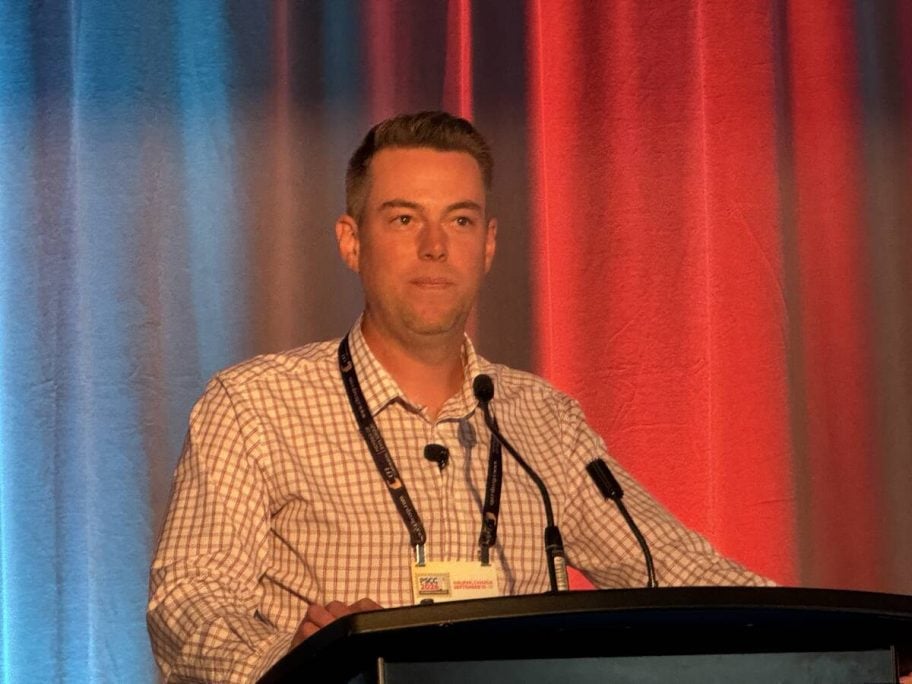
Graeme Crosbie, Farm Credit Canada.
Photo:
Sean Pratt
However, that was before the recent spike in fuel prices and before the Canada-United States-Mexico Agreement talks broke down and a trade war erupted between Canada and the U.S.
Crosbie said financial markets are now pricing in a rate hike as early as this December. FCC thinks that sounds about right.
The U.S. Federal Reserve just raised its benchmark interest rate by a quarter point, its first rate hike in three years.
Read Also

Borrowing costs are on the rise due to higher input and equipment costs, so any interest rate hike would be unwelcome.
Long-term rates, such as Government of Canada bonds ranging from two to 10 years, are not as dependent on the overnight rate.
They are more heavily influenced by U.S. bond market dynamics, inflation expectations and the growth in gross domestic product.
Long-term bond rates had been steadily falling since the beginning of this century until COVID hit. Then everything changed.
Rates have been climbing steadily since 2021 to combat inflation in markets such as Canada, the U.S., the United Kingdom and Japan.
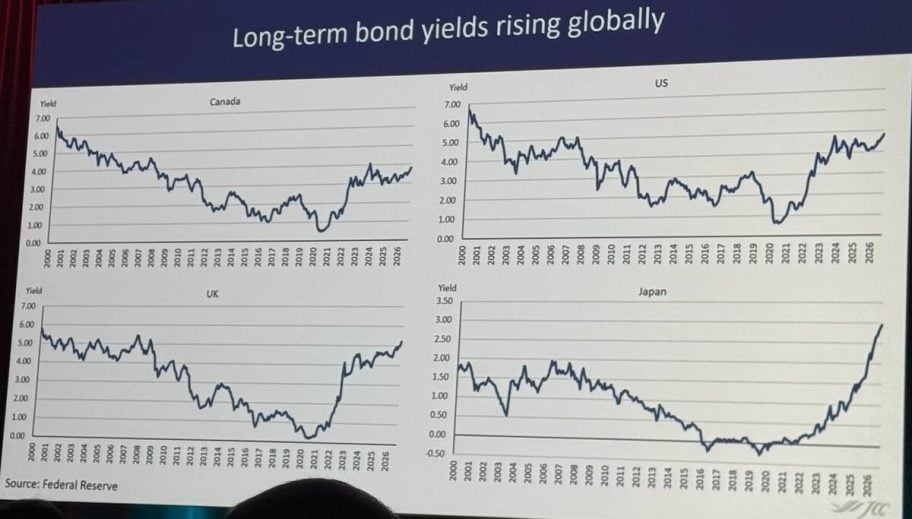
Long-term bond yields have been on the rise in Canada, the United States, the United Kingdom and Japan since the start of COVID.
Photo:
Farm Credit Canada
Crosbie doesn’t see that trend ending anytime soon.
“Those are going to continue to grind higher and higher and higher in the short-term,” he told delegates attending the 2026 Pulse & Special Crops Convention.
Bond yields in the U.S. are the highest since the 2008 global financial crisis. The U.K. hasn’t seen rates like this in 30 years, while Japan’s are the highest since the mid-1990s.
“Investors are getting incrementally more worried about the state of government finances and also inflation reigniting,” said Crosbie.
Rising oil prices are a big contributor to inflation.
Oil shipments through the Strait of Hormuz slowed to a crawl following the outbreak of war between the U.S. and Iran.
They rebounded somewhat in June and July when the two countries signed a memorandum of understanding , but shipments were back to a crawl in August and September when the agreement was scuttled.
U.S. crude oil reserves have been drawn down to 700 million barrels, which is well below the previous floor of about 800 million barrels.
Diesel prices have soared due to restricted flow through the Strait of Hormuz and damage to refining capacity in the Middle East and Russia.
U.S. diesel prices were at a record US$6.30 per gallon at the time of Crosbie’s presentation on Sept. 16.
That is why fixed lending rates will likely continue to rise despite the Bank of Canada’s overnight rate remaining stagnant for the time being.
The Government of Canada’s five-year bond has found a new floor of three per cent and was approaching 3.5 per cent at the time of his presentation.
Bond yields form the foundation of fixed rate loans.
“As those yields grind higher, fixed rate borrowing costs are also grinding higher,” said Crosbie.
That means higher fixed rates for residential mortgages, farm loans and corporate financing.
Higher borrowing costs will lead to slower economic growth, which means lower tax revenues for the government.
Government funding becomes more expensive because tax revenues are lower than budgeted, forcing governments to borrow more money in higher priced markets.
That financial dilemma is even more pronounced for countries with shorter debt maturity profiles such as Canada and the U.S.
Crosbie was asked if farmers are better off choosing variable rate over fixed rate loans.
He said that is the top question FCC receives and the answer is that it depends on the farm operation, the capital structure already in place, renewal dates and many other factors.
“Whether it is fixed or variable, the signals are there that both are going to kind of grind higher,” said Crosbie.