
Ireland will kick off their 2026/27 season later this week, with four UEFA Nations League games to come across an extended international window.
Kosovo will be the first opponents for Heimir Hallgrimsson’s side, with the game in Pristina taking place on Thursday evening. Ireland will also have two games against Israel and a home meeting with Austria over the next two weeks.
The Nations League is a competition that many supporters remain somewhat unsure of, with the fixtures in this event not quite holding the same weight as those in a major tournament qualification campaign.
Still, the next few weeks could go a long way towards helping Ireland’s chances of qualifying for Euro 2028.
Euro 2028 qualification will be linked to UEFA Nations League
Euro 2028 will be partly held in Ireland, meaning failing to reach the tournament would be a huge missed opportunity for the Boys in Green.
Their chances of doing of qualifying have already been given a sizeable boost by UEFA.
The four host nations (Ireland, England, Scotland, Wales) will all enter the regular qualification process. However, two places in the tournament will be reserved for host nations that fail to qualify via that method.
In other words, Ireland will be guaranteed to play at Euro 2028 as long as two other host nations qualify via the traditional method.
That is a huge boost, but they could also bolster their chances even further with a good showing in this season’s Nations League.
Ireland will play in League B in a group that also features Austria, Kosovo, and Israel.
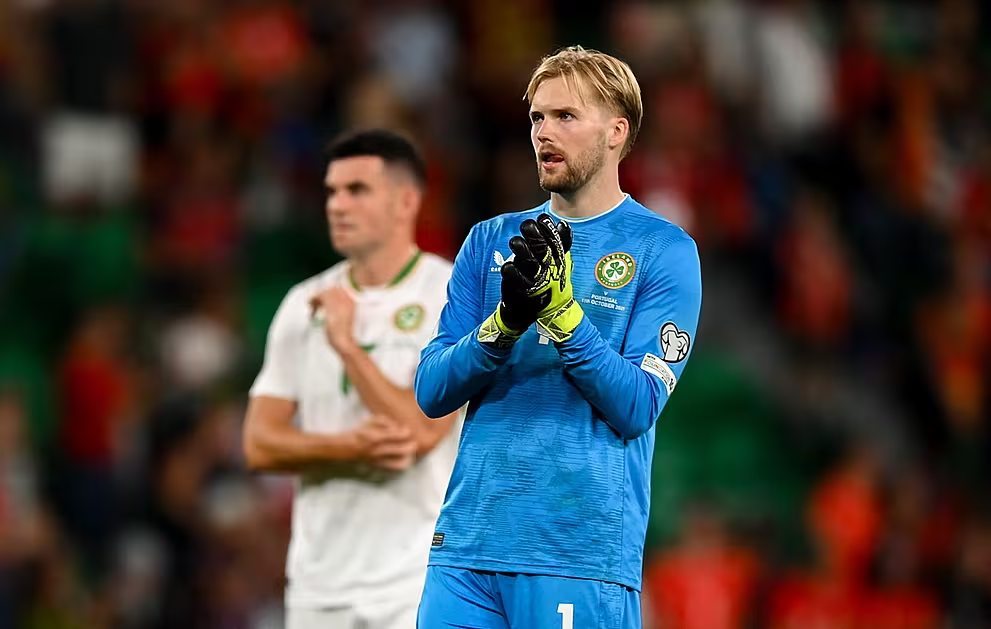
How Ireland can help Euro 2028 chances in UEFA Nations League
The upcoming UEFA Nations League campaign is set to be linked to Euro 2028 qualifying, and while the exact details have yet to be confirmed, we should have a fair idea as to how things will work based on previous editions.
Ireland topping their group will not only secure promotion to League A, but it is also likely to guarantee a play-off for Euro 2028 at the very least.
Recommended
In previous campaigns, play-off spots were reserved for group winners who did not finish in the top two of their subsequent qualifying groups. It is a format that has benefitted a number of teams, with Sweden qualifying for last summer’s World Cup via the play-offs despite not winning a single qualifying group fixture.
In saying that, it is more likely that Ireland will not be involved in a play-off during the Euro 2028 campaign.
Euro 2028 qualifying will see 12 groups drawn, consisting of either four or five teams. The top team from each group will qualify directly for the tournament, as well as the eight best group runner-ups.
The remaining four runner-ups will enter the play-offs, along with some of the top ranked UEFA Nations League teams that do not finish in the top two in their group. There will be up to four spots available via this route.
However, that is dependant on how the host nations fare. If two or more fail to qualify via the groups, they will take two of the spots previously earmarked for the play-offs.

Due to this format, Ireland are unlikely to feature in the play-offs.
Ireland would only have a chance of doing so if both they and at least two of the other host nations failed to qualify directly.
Should more than two of them not qualify for via the groups, the two reserved spots will go to the highest ranked teams based on the overall qualifying group stage rankings.
A good showing in the Nations League would also likely boost Ireland’s FIFA world ranking ahead of next year. The seedings for Euro 2028 qualifying will be based on those rankings, with a top two seeding likely to result in a much more straightforward draw.
What does it all mean for Ireland’s Euro 2028 chances?
In short, Ireland could greatly bolster their Euro 2028 qualification hopes by performing well in the UEFA Nations League.
A group win would guarantee them at least a play-off in the unlikely event that they are forced to go down that route.
Good results in a sequence of competitive games would also boost the team’s world ranking, something that could see them become second seeds for the qualifying group.
Heimir Hallgrimsson will no doubt have that in mind when it comes to his team selections over the coming weeks.