
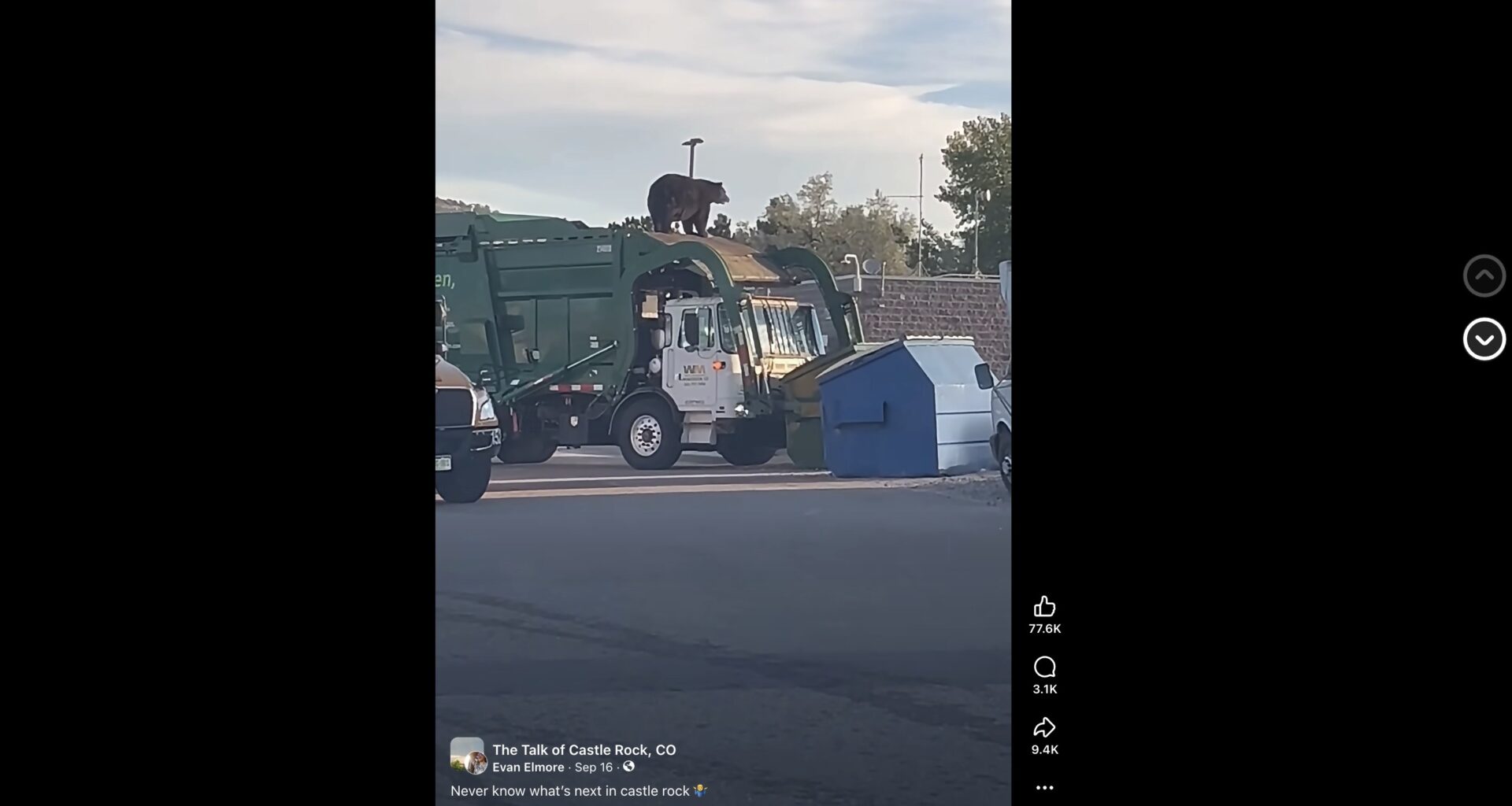
As bears across Colorado scour trash for their next meal amid the state’s ongoing drought, one unlucky creature was scooped up by a Waste Management garbage truck south of Denver last week, according to a Castle Rock resident.
“Never know what’s next in Castle Rock,” Evan Elmore wrote Wednesday in a post to a Castle Rock-based Facebook group, which included a partial video of the bear incident.
That video appears to show a black bear standing on top of a garbage truck and peering over the edge, but does not show how the bear got there or escaped the situation.
Elmore told CBS News that the bear had climbed into the dumpster when it was picked up and emptied into the back of the Waste Management truck. The bear eventually climbed down the side of the truck and was scared away by employees of a nearby business, Elmore told CBS.
Waste Management did not immediately respond to requests for comment Monday.
Bear activity has surged in Colorado amid the state’s ongoing drought, which has depleted the animals’ natural food sources, according to Colorado Parks and Wildlife. As food becomes harder to find, bears travel farther and take greater risks to eat, agency officials said.
Colorado Parks and Wildlife confirmed last week that the agency has responded to 10 bear attacks so far this year, a record high. The agency defines an attack as an incident where a bear injures or kills a person.
Between Jan. 1 and Aug. 31, Colorado Parks and Wildlife also received 8,672 reports of bear sightings and conflict, more than double the reports during that timeframe in 2025 and more than three times the five-year average, agency officials said. Colorado is on track to see the highest number of bear reports since 2019, when CPW implemented its statewide digital reporting system, agency officials said.
As of Sept. 3, 294 black bears had been euthanized in Colorado this year, and 98 had been relocated, according to Colorado Parks and Wildlife. That’s more than triple the 83 euthanizations and 33 relocations recorded in 2025.
Black bear encounters have also spiked in recent weeks as the animals enter hyperphagia: a late-summer and fall phase during which they spend up to 20 hours a day searching for food to build the fat reserves needed for winter, state wildlife officials said.
State wildlife officers typically receive the most bear sighting reports during this period, and nearly half of the bear incidents in 2025 occurred in August, September or October, according to Colorado Parks and Wildlife.
Get more Colorado news by signing up for our daily Your Morning Dozen email newsletter.