
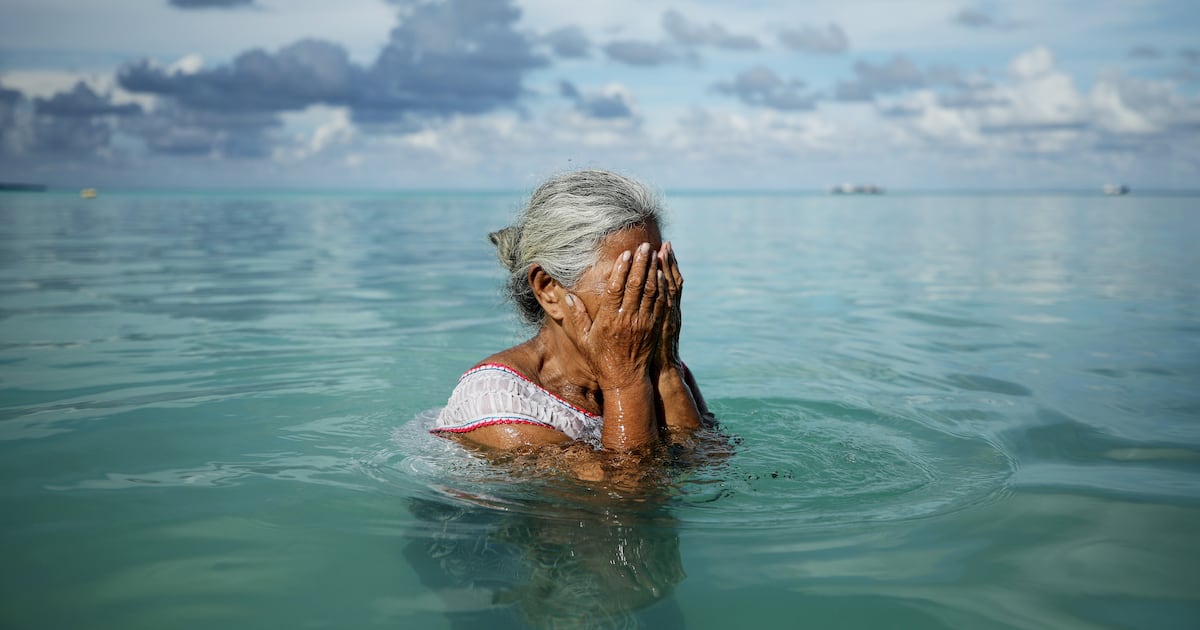
Tuvalu is the fourth smallest country in the world, with a population of only about 11,000 people. It is part of a circle of small coral islands lying halfway between Hawaii and Australia. Islanders say that although the islands are small, they see their country as large, because of the vast Pacific Ocean that connects them to the wider world.
The average elevation is only 6ft above the high-tide mark that poses an existential threat from the rising sea levels that climate change will bring. The island’s population has therefore always been at the forefront of international climate negotiations, raising the alarm, demanding more ambition, speaking truth to power, reminding everyone that if we can save Tuvalu, then we save the whole Earth.
Perhaps because of that tradition, Tuvalu asked to take on the chairing role of a major Transitioning Away from Fossil Fuels conference that will take place next spring. The event follows a conference held in the Colombian city of Santa Marta late last year, during which 57 governments came together to think about how we might accelerate away from the use of the fuels that are bankrupting and destroying our world.
The Colombian and Dutch governments facilitated, but what worked well was the civil society contribution that came just before the main intergovernmental event. It involved various stakeholders and experts considering how to finance the transition away from the use of the fuels while still protecting countries that depend on fossil fuel revenues. Everyone involved seemed to find the discussions very productive as they were less constrained than in a more formal UN process.
I was very glad that at the end of the Santa Marta meeting it was agreed Ireland should support Tuvalu as co-host of the next conference. We are still seen as a developed country that has a good relationship with small island states and more vulnerable countries. It was hoped our public service would also have the scale, capability and culture to best support a smaller state such as Tuvalu.
This week, the baton will be formally passed to the Tuvalu and Irish governments, as initial plans for the event are due to be announced at New York Climate Week. Never has the need for such meetings been more clear, as more “forever wars” push up oil and gas prices, the destruction from climate change becomes all the more real and the US government tries to dismantle every form of international co-operation.
The small size of Tuvalu and the limited number of flights to the island mean the event next year will be very different to what went before. It is expected the island will host a much smaller number of ministers and officials, and the wider civil society events are likely to take place in Ireland just before the main event.
This is going to put pressure on the Irish Civil Service, which is already pushed to the pin of its collar running the presidency of the Council of the European Union. However, not living up to our responsibility to deliver something special would be a real failure. We live in a world that desperately needs examples of good multilateral collaboration.
Last week, a climate gathering on the island of Inishbofin was convened to consider how we might raise public support for climate action. In the opening session, locals spoke about the generations that had gone before them, the future for young families on the island and about how they had come together to protect their own people during recent storms.
A woman from Tuvalu, Eliala Fihaki, who had grown up, as she put it, between her front garden, the ocean, and her back garden, the lagoon, spoke on a similar theme: respecting the people who had gone before and yearning for the next generation to be able to continue the island culture that she was so proud of and wanted to retain.
The Irish Government does not have much time to prepare for the conference. One initiative it could support is a series of in-person and online meetings of islanders, young and old, from all over the world. It would be a chance to share stories on how climate change is affecting them and how we can provide for and protect our people in these difficult times.
The “fifth province” meeting format that was used in Inishbofin is similar to the Pacific island concept of “talanoa”, which describes a process of inclusive, honest and transparent dialogue through storytelling.
What we need now is our two islands coming together in such a talanoa or meitheal – surprising the world with what can be done when you combine in this imaginative way. We need a new story about protecting our common home, so the seas do not rise up instead.