
The impact trillions of microbes living inside the gut have on our health, both physical and mental, is one of the fastest growing areas of research.
Global increases in bowel disorders have put the spotlight on complex interactions between the gut microbiome and its human host. Maintaining a balance between “good” and “bad” bacteria within is vital for wellbeing, to prevent damaging microbes going rogue.
Early-onset colorectal cancer is a particular concern, as in the US it has become the leading cause of cancer death in men aged 20-49 and the second-leading cause in women aged 20-49. In Ireland, the incidence of colorectal cancer in the under-50s has almost doubled over the last 25 years, with one in 10 diagnoses now in someone under 50.
Here, in consultation with Prof Sudipto Das, associate professor and principal investigator at RCSI, we look at gut health and signs that all may not be well. Das is one of the contributors to a MyHealth RCSI podcast and video dealing with gut health, to be released this week (Gut Health and You will be available from September 24th. See rcsi.com)
What is the gut microbiome?
It is an individualised ecosystem populated by bacterial, viral and fungal species. These species influence different body functions, including the immune, endocrine and nervous systems, as well as digestion. Genes, age, environmental and lifestyle factors all shape the composition of the microbiome. A key to gut health is nurturing the “good” bacteria – we feed them and they benefit us – while also trying to guard against overgrowth of “bad” bacteria.
When the balance goes askew, with beneficial bacteria decreasing and harmful bacteria increasing, it leads to “dysbiosis”, which is linked to various diseases. But the cause and effect of dysbiosis is still under research. For instance, we know chronic stress is bad for gut health, as is the inflammation it causes or exacerbates, but “we still don’t have proof that stress directly causes bowel cancer”, says Das.
How do we feed the gut well?
Eat plenty of fibre for a start. Adults should aim for 25-35g a day, yet about 80 per cent of people in Ireland fall well short of that. Fibre nourishes the beneficial microbes as food passes through the bowel; it reduces inflammation and supports the immune system.
A mix of soluble fibre and insoluble fibre is recommended. The former, found in foods such as oats, beans, berries, carrots and chia seeds, helps to slow digestion and reduce “bad” cholesterol. Insoluble fibre, contained in foods such as brown rice, leafy greens, cauliflower and fruit with edible skins, adds bulk to the stool and quickens its passage through the system.
Also make sure you are well hydrated. Drinking water helps to keep food-waste toxins moving through the gut, as will exercise.
What about probiotics and prebiotics?
Both are important for gut health. Just to be clear, probiotics are live, “good” bacteria (also yeast) in fermented foods, which help to counteract the growth of harmful bacteria in the gut. Prebiotics are high-fibre foods, such as vegetables and whole grains, that “feed” the probiotics, to help them do their work.
[ Ultraprocessed foods: Do they affect gut health?Opens in new window ]
For healthy people, a “food-first” approach, getting a variety of probiotics through eating yoghurt, kefir and sauerkraut, for instance, is reasonable, Das suggests.
Are there consumables to avoid? Prof Sudipto Das, associate professor and principal investigator at RCSI
Those with troublesome guts are often advised to limit or avoid fermentable carbohydrates that disrupt the microbiome, collectively known as Fodmap (Fermentable Oligosaccharides, Disaccharides, Monosaccharides, and Polyols). Think lactose, excess fructose, and sugar alcohols in some artificial sweeteners, for example. Some people are more sensitive than others to fermentation of these substances by the microbes in the large intestine.
Ultra-processed foods tend to contain emulsifiers and additives, which can disrupt the microbiome and gut lining. High alcohol consumption is likely to kill off beneficial bacteria, irritate the gut lining and increase permeability, also known as “leaky gut”.
‘Leaky gut’ sounds alarming, what exactly is it?
It is loss of the mucosal barrier function, says Das, which leads to illness. However, the question researchers are trying to answer is does the leaky gut come first, causing damage to the microbes within, or do bacterial changes in the gut weaken the barrier?
There is “crosstalk” between the host cells and the microbial species, which is really important, he says, to maintain normal microbiome. “When the leaky gut happens, this crosstalk gets imbalanced. Because it is a crosstalk, whatever is happening to the bacteria will obviously consequentially have an impact on the host itself.”
What are outward signs of trouble within?
Signs of good gut health include comfortable digestion; regular and easy bowel movements; minimal bloating; no excessive gas. A deviation from those might indicate all is not well.
Any sudden change in bowel movements, which then lasts for a prolonged period, is a concern that should be brought to a GP without delay. Blood in the stool is also a red flag.
The symptoms could indicate any one of a number of illnesses, including irritable bowel syndrome (IBS), or inflammatory bowel disease (IBD) – such as Crohn’s disease or colitis, or sometimes cancer.
Are IBS and IBD as similar as their acronyms suggest? Dr Orlaith Kelly, consultant gastroenterologist at Connolly Hospital, Dublin.
No – they’re two distinct and quite different conditions affecting the gastrointestinal tract, says Dr Orlaith Kelly, consultant gastroenterologist at Connolly Hospital, Dublin, and senior lecturer at the RCSI.
IBS is far more common – affecting about one in 10 people in Ireland during their lifetime – and it is a functional digestive disorder. “What that means is that it doesn’t limit your life; it doesn’t cause damage to the gut, but can cause quite severe symptoms, which definitely can alter your quality of life if they’re not dealt with,” she says on the RCSI’s new podcast. Symptoms include diarrhoea, cramping and constipation. The treatment is mainly diet, medication, and managing stress and lifestyle.
IBD, in contrast, is a digestive, inflammatory condition with genetic, environmental, and immune components. While onset is often between age 15 to 35, it can happen at any stage in life.
“This does cause damage to the digestive system,” she says. IBD is an umbrella term for a number of disorders, the most common of which are ulcerative colitis and Crohn’s disease. These certainly alter the quality of life for the approximately 40,000 people living with such conditions in Ireland, which has one of the highest rates of IBD in Europe. They also have a significant impact on health outcomes, says Kelly.
In earlier decades, IBD would have caused deaths. While that is much less common with modern treatment, it is still likely to involve hospital visits, often surgery in the case of Crohn’s, and serious outcomes can include deep inflammation, blockages and malnutrition.
Does a genetic link explain higher figures for IBD in Ireland?
There is a genetic link to increased susceptibility to IBD. However, it’s complex because of the interaction between genes and the environment, says Das. Cases are rising in countries that have relatively recently become more industrialised and are adopting a westernised diet.
Incidence is rising in Ireland, particularly among children, says Kelly, but that is mirrored across Europe. However, a caveat for all of this is that “our figures probably aren’t accurate because we don’t have a national database. This is based on literature and ad hoc data.”
What about early-onset bowel cancer?
Early-onset cancer of all types are on the rise globally, says Das, citing a general 79 per cent increase between 1990 and 2019.
“I think bowel cancer came into the limelight much faster, compared with other cancer types.” Many lifestyle factors, often interlinked, have been studied extensively and associated with increased early-onset cancer. These include rising obesity, wider consumption of processed food, lack of fibre intake, sedentary behaviour, alcohol and smoking.
Genetics cannot explain a shift of that speed in cancer rates, says Das, but his lab is studying the impact of “epigenetics”. These are chemical modifications that happen to a person’s DNA, he explains. It doesn’t change the structure of the DNA but changes the message it codes for. While there is crosstalk between environment and genetics, environmental factors have a much bigger impact on these epigenetic changes.
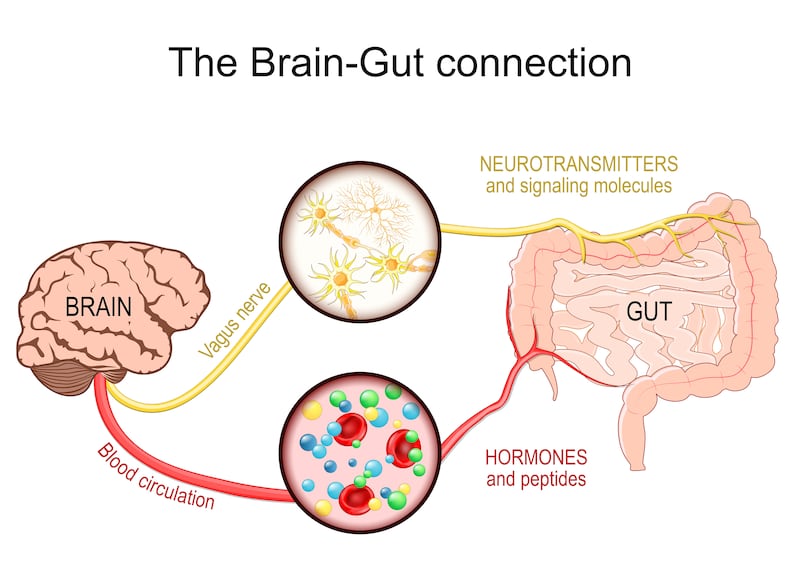 The gut has a number of neurons that connect with the brain, which governs functions such as mucus production, digestion and gut movement.
‘It’s not just the brain telling the gut what to do,’ says Das. ‘The gut also can message back.’
The question is, if there are widespread environmental or lifestyle changes within a population, how does that affect their epigenome, which is effectively a control panel for the DNA?
Das is leading research into what happens to specific species of bacteria that are being associated with early-onset colorectal cancer, as opposed to late onset, and what they do to the actual cells in the bowel. His lab is trying to decipher the molecular changes.
This is “to allow us to understand what exactly happens when some of these harmful bacteria, which typically are not supposed to be abundant in the gut, suddenly go up. That then also allows us to develop corrective measures, not just to reduce the amount of bacteria, but also to correct what is going on when your own gut cells go awry essentially.”
Could this lead to earlier interventions?
The question of whether testing for abundance of the bacteria associated with early-onset colorectal cancer could be a way of identifying higher-risk patients is being looked at, says Das.
[ IBD: ‘I’ve known people who have been nervous to leave their house’Opens in new window ]
It is part of an AI-assisted movement towards personalised medicine, in which testing of an individual’s gut microbiome would predict their likely response to certain treatments, enabling informed tailoring of medication, rather than needing to work on a trial-and-error basis.
Is the national bowel cancer screening programme adapting to early-onset developments?
BowelScreen currently invites men and women aged 57 to 71 to take a free, at-home screening test. In April this year, Minister for Health Jennifer Carroll MacNeill approved a recommendation from the National Screening Advisory Committee to include people aged 50-54.
“This builds upon the existing ambition to extend the programme from 55- to 74-year-olds,” explains a Department of Health spokesman. The full extension to those aged 50 to 74 will take some years to complete, “to ensure that there is sufficient capacity in the health system to diagnose and treat those who receive a positive screening result in a timely manner”.
However, population-based screening programmes are for people without symptoms, he stresses, and anyone with concerns should contact a medical professional. Das believes there is a case for lowering age eligibility further, to 45, as that is the recommended age in the US at which to start routine screening.
Why is the gut sometimes referred to as ‘the second brain’?
The gut has a number of different neurons that connect with the brain, which governs functions such as mucus production, digestion and gut movement.
However, “it’s not just the brain telling the gut what to do”, says Das. “The gut also can message back.”
It is on this basis that researchers worldwide are looking at a link between microbiome changes and the development of neurological conditions and decline, such as Alzheimer’s.
“Your gut and the brain are in a constant two-way conversation. Mostly it happens through a particular nerve called the vagus nerve.”
As we know, there are trillions of microbes, he adds, so while this communication is real, “it is far more nuanced than ‘your gut is your second brain’.”