
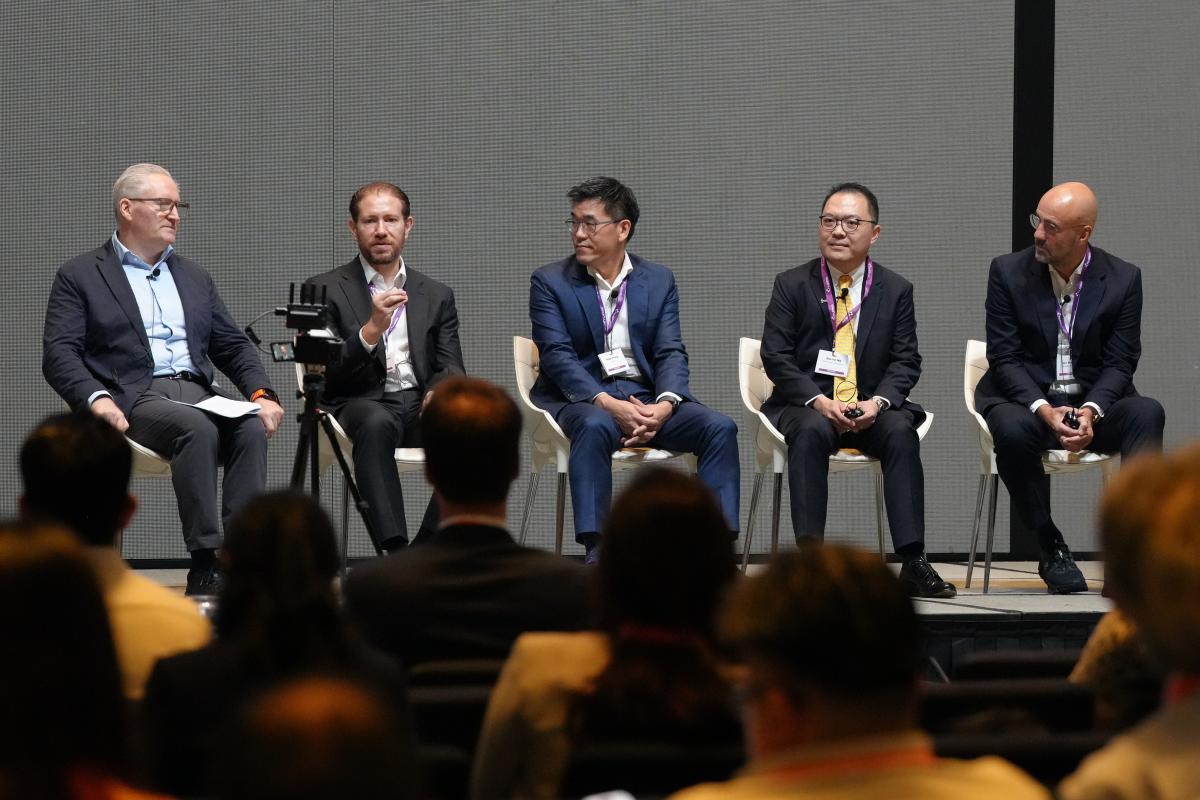
The opening panel at the Hubbis Investment Forum – Singapore 2026 examined how wealth managers can distinguish themselves when clients can obtain similar products, information and digital tools from many providers. A global private bank, independent wealth managers and a digital investment platform found no single model with an inherent advantage. Each firm has to connect its strengths to the needs of the client in front of it.
Product access remains useful, but it is becoming less scarce. Advice, alignment and reliable execution carry more weight. Repeat net new money, a larger share of a family’s assets, referrals and progress towards agreed goals offer firmer evidence than broad claims about service. Technology and artificial intelligence can support that work, but trust remains central to the relationship.
Chair: Michael Stanhope, Founder and Chief Executive Officer, Hubbis
Panellists
Garth Bregman, Head of Wealth Management Singapore and Southeast Asia, BNP Paribas Wealth Management
Darren Ng, Managing Director, Group Chief Financial Officer and Chief of Staff, WRISE Wealth Management
Hugh Chung, Chief Investment Officer, Endowus
Urs Brutsch, Managing Partner and Founder, HP Wealth Management
Key Takeaways
Clients value different parts of a wealth manager’s platform. Investment returns may matter alongside lending, trading, philanthropy, family needs or access to institutional capabilities.
Universal banks can draw on their balance sheets and investment-banking resources, while independent managers can offer wider choice across custodians and highly customised portfolios.
As product access becomes more widely available, portfolio construction, investor education and goals-based advice become more important sources of differentiation.
Assets under management and profitability measure the business. Share of wallet, repeat flows, family referrals and progress towards client goals provide stronger evidence of relationship value.
Growth must remain consistent with the service model. Expanding too quickly can weaken customisation, strain talent and bring in clients the firm is not equipped to serve.
The next generation is not a uniform digital segment. Inherited loyalty may be weaker, but wealth preservation, detailed information and human trust remain important.
Technology creates value when it improves advice, responsiveness and internal efficiency. The panel treated artificial intelligence as an adviser tool rather than a replacement for the relationship.
The Client Defines the Value Proposition
A wealth manager can begin with a sound investment principle and still misread what the client values. One panellist recalled promoting strategic asset allocation (SAA), disciplined risk taking and long-term compounding after arriving in Asia. Discretionary portfolio management (DPM) grew steadily, but regional penetration remained low because risk-adjusted return was not always the client’s first priority. Some clients wanted to trade, borrow against an operating business, finance a concentrated listed holding or organise their philanthropy.
The firms represented on the panel addressed those priorities in different ways. A universal bank could combine portfolio management with lending and investment-banking capabilities. A smaller independent firm could customise SAA and implement it economically through exchange-traded funds (ETFs) and other passive holdings. A digital platform could turn institutional and endowment-style strategies into simpler building blocks for individuals, non-profit organisations and family offices.
One participant gave conservative wealth management a deliberately plain description: “If you want to become rich, do not come to us. If you want to stay rich, come to us.” The comment defined a specific promise rather than a universal ideal. For clients focused on preserving the lifestyle of several generations, consistency and capital protection may matter more than a stream of new products.
Breadth and Independence Create Different Advantages
A large private bank can provide a broad investment platform, a substantial balance sheet and financing that reaches beyond the custody account. The examples discussed included lending to an operating company and collar financing on listed equity. External asset managers (EAMs) may also use such banks as custodians because they need execution, credit and product infrastructure that would be difficult to build independently. Few clients, however, use the full platform. The bank still has to identify which capabilities matter in each relationship.
Independent firms presented a different advantage. They can select among banks and custodians, customise portfolios and make perceived alignment part of their proposition. The panel did not treat open architecture as their exclusive territory. Large banks now source widely across structured products, funds, hedge funds and private assets. The distinction is narrower: an independent manager can also choose where assets are held and which bank services to use.
That freedom does not remove commercial pressure. Banks answer to shareholders and use key performance indicators (KPIs), which can influence behaviour, while independent firms also need profitable clients and sustainable revenue. The more useful question is how each model manages those incentives and whether the resulting advice fits the client’s objectives.
Product Access Is Losing Its Scarcity
Private equity, private credit, hedge funds and structured investments are available through more channels than they were several years ago. Minimum commitments have fallen in some areas, more platforms can source similar managers and competition has put pressure on prices. Access can still be valuable, particularly for specialised opportunities, but it is becoming harder to present availability alone as a durable advantage.
One panellist summarised the shift as follows: “Access is becoming commoditised. Proper advice is still scarce.” In this context, advice meant defining the goal, choosing the right structure, combining liquid and private assets appropriately and helping the client understand the trade-offs. It did not mean supplying a stock tip or making a short-term market call.
The same reasoning extends beyond investments. A donor-advised fund can help a family organise charitable giving, while tailored credit can solve a financing problem that portfolio performance cannot. Firms also add value by simplifying complex strategies into building blocks that clients can understand and combine. Differentiation therefore depends increasingly on coordination and judgement, rather than the length of an approved product list.
Client Behaviour Provides the Stronger Measure
The panel acknowledged the tension between client outcomes and commercial outcomes. Assets under management (AUM), net new money and profitability show whether the business is growing. They do not, by themselves, establish that clients are better served. Rising markets can increase AUM even when no new relationship value has been created.
A participant challenged any suggestion that one type of provider was free of commercial motives: “None of us is a charity. The test is whether clients are happy enough to entrust us with more.” One private bank reported that more than half of its annual net new cash came from existing clients. The figure was an internal measure, but it supported the view that repeat flows and a larger share of wallet can reveal confidence in the service.
An independent manager gave a second firm-specific example. One client increased the amount managed by the firm from 40 million to more than 100 million over four years; the currency was not stated. Other indicators included consolidation of family assets and introductions to the next generation. These measures do not prove investment skill on their own, but they show whether the relationship is becoming more important to the family.
Growth Should Not Outrun the Service Model
Rapid expansion can create its own weaknesses. One independent wealth manager said its AUM had passed 7 billion within four years, although the transcript did not specify the currency. That pace increases the need for capable advisers, sound controls and technology that can support a larger client base without making the service impersonal. Talent remains particularly difficult to find.
Another participant favoured a more selective approach, seeking the right clients at a pace the firm’s people could support. A specialised external asset manager or multi-family office (MFO) is not suitable for every family. Accepting that limit can protect the customisation and attention on which the model depends.
The discussion also separated market-led growth from relationship-led growth. Strong equity markets can lift asset values across the industry, while net new money, retention and referrals show whether a firm is winning additional trust. Both contribute to reported growth, but they say different things about the strength of the franchise.
The Next Generation Is Not One Segment
The next generation may be in their teens or their sixties. Some families bring children into the business and family office early, while others delay access until the founder dies. Relationship managers (RMs) therefore need to understand the family’s actual handover rather than build a strategy around age alone. They also cannot assume that the parent’s choice of provider will pass automatically to the heirs.
One panellist captured that weaker inherited loyalty with a familiar analogy: “You do not necessarily want to use the same tailor your father used.” Younger family members may have studied abroad, know advisers at competing firms and conduct detailed investment research independently. They often expect more information and easier digital access, not a less rigorous investment process.
Continuity was as visible as change. In one family example, adult children had risk profiles similar to their father’s and preferred discretionary management because they did not want to make every portfolio decision. They also made small cryptocurrency trades driven more by fear of missing out (FOMO) than conviction, and showed greater interest in philanthropy. The combination cautions against treating digital habits as a complete change in financial goals. Wealth preservation remained central.
Technology Must Strengthen the Adviser
Technology itself is becoming widely available. The differentiator is how a firm uses it to review portfolios, provide relevant information and respond when markets move overnight. Faster delivery matters only if the advice is useful and the adviser understands the client’s circumstances. Cost reduction may benefit the provider without improving the relationship.
A participant rejected the idea that digital delivery and personal advice sit at opposite ends of a spectrum: “We are 100% human and 100% digital.” Clients can research and transact online while still relying on an adviser for judgement, reassurance and accountability. In a trust-based business, the interface does not replace the person responsible for the advice.
This is particularly relevant for clients who can already buy many products directly. They need a reason to involve a wealth manager. Institutional capability, clear portfolio decisions and prompt interpretation of events can provide that reason, provided the technology makes the adviser better informed rather than simply adding another channel.
Artificial intelligence (AI) initiatives described by the panel were moving beyond isolated experiments. Firms had created a generative AI centre of excellence, a proprietary AI laboratory and internal programmes that help employees build agents. Potential uses included client onboarding, research, portfolio analysis, adviser support and administrative efficiency.
Panellists rejected treating AI as a conventional information technology project. The investment had to produce faster, more relevant advice or make complex strategies easier for clients to understand. Adoption for its own sake would not meet that test.
The panel included one early investment example. An independent manager said an AI-powered global-equity strategy had exceeded the MSCI All Country World Index by about three percentage points a year over roughly 18 months. The claim was not accompanied by an independently published track record, fee basis or calculation methodology, so it remains a firm-reported result rather than evidence for AI investing more generally.
Participants expected AI to improve efficiency but not to resolve every client problem. Family context and responsibility for advice still sit with people. Firms that move too slowly face competitive risk, but indiscriminate automation could weaken the service clients are paying to receive.
The Market Can Support Several Models
Asia’s continuing wealth creation gives private banks, EAMs, MFOs and digital advisers room to grow, from the mass-affluent market to ultra high net worth (UHNW) families and large family offices. Strong global equity markets have helped recent AUM growth, but panellists regarded new wealth creation as the more important long-term driver. A severe recession or sustained slowdown would provide a harder test. Independent advice may also expand, with one participant pointing to the scale of registered investment advisers (RIAs) in the United States as a possible direction for Asia.
Banks will continue to compete through their balance sheets and breadth, while independents and digital platforms will emphasise alignment, customisation and access to institutional methods. A firm does not need every capability, but it must be clear about the client problems it can solve. The best evidence will come from families that stay, consolidate more of their wealth, introduce the next generation and continue to see value after markets become less forgiving.
Disclaimer: This article summarises a panel discussion and reflects information available as at 22 September 2026. It is provided for general information only and does not constitute, and must not be construed or relied upon as, tax, legal, financial, investment or other professional advice, guidance or a recommendation. The information may not apply to individual circumstances, particular products or every jurisdiction. Hubbis accepts no responsibility or liability for any action taken, or not taken, in reliance on this article. Readers should obtain independent advice from appropriately qualified professionals before making any decision.