
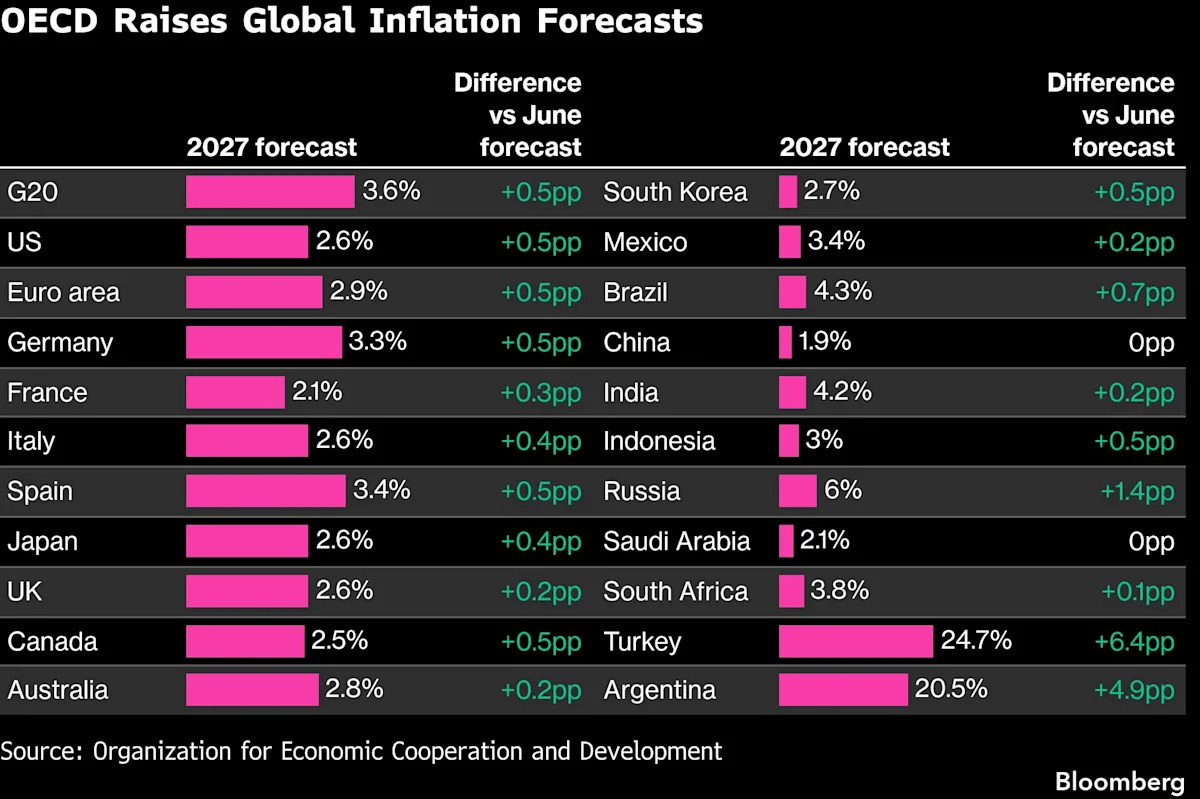
(Bloomberg) — Inflation around the world will be faster than forecast in 2027, an outlook that necessitates more tightening from the US to Australia, the OECD said.
Most Read from Bloomberg
In a report released on Wednesday, the Paris-based club of rich countries raised projections compared with June for consumer-price growth in every Group-of-20 economy apart from China and Saudi Arabia. Monetary policy across the globe may have to respond, its officials added.
“Faced with renewed energy price shocks and stronger-than-expected demand pressures, and at a time when inflation is already above target in many economies, central banks need to ensure that underlying inflation pressures are durably contained,” the OECD said in its report.
The analysis underscores how the economic impact of the Middle East war unleashed by US President Donald Trump is now set to endure into the second half of his term in office.
“Our main message is that central banks have to remain very vigilant,” OECD Chief Economist Stefano Scarpetta told Bloomberg Television’s Vonnie Quinn. “They need to intervene like they have done so far, perhaps more than what they did in 2022.”
The OECD’s assessment follows a round of tightening this month, with the US Federal Reserve, the European Central Bank and Bank of Japan all raising interest rates within little more than a week of each other.
The organization’s officials reckon more such action is in the offing, while suggesting it won’t match the aggressive policy moves seen in the wake of the 2022 Russian invasion of Ukraine.
It predicts one more hike this year by the Fed, “further modest increases” in the euro area, Australia and South Korea, and “additional policy rate increases” in Japan. By contrast, the OECD says that the Bank of England and the Bank of Canada will keep rates steady for now.
That jars slightly with the views of investors. Money markets are almost evenly split on whether the Fed, ECB and BOE will deliver one or two more hikes by the end of this year. However, traders are more certain that the BOJ will move just once more by then, and they also favor the BOC to raise rates by a quarter point in that period.
Growth Forecast
The path of global growth is roughly unchanged compared with June, according to the OECD. Standing out from modest adjustments to its forecasts are downgrades the outlooks for Canada, which faces a trade war with the US, and France, where a period of political instability looms.
“Global economic prospects remain heavily dependent on whether a durable resolution to the Middle East conflict is achieved,” the OECD said. “Continued changes in trade policies, both tariffs and export restrictions, add to policy uncertainty and contribute to supply disruptions.”
The report also covered a range of risks bearing down on the world. Officials repeated longstanding calls for countries to repair public finances, highlighting how recent increases in bond yields “underline more than ever” the need to keep spending under control.
The OECD touched on the dangers of artificial intelligence too, observing that the technology could boost growth and productivity, but that it brings threats too.
“There is a risk that AI investment returns disappoint or take longer to materialize,” while “mounting security concerns related to AI could also slow the development of the technology or its adoption,” it said.
Leverage and complex financing are another worry, and returns may fall short.
“Disappointing earnings growth could materially slow investment in the sector, transmitting to other associated industries such as engineering and construction, and result in deteriorating valuations in financial markets,” the OECD said.
–With assistance from James Hirai.
(Updates with chief economist in fifth paragraph)
Most Read from Bloomberg Businessweek
©2026 Bloomberg L.P.