

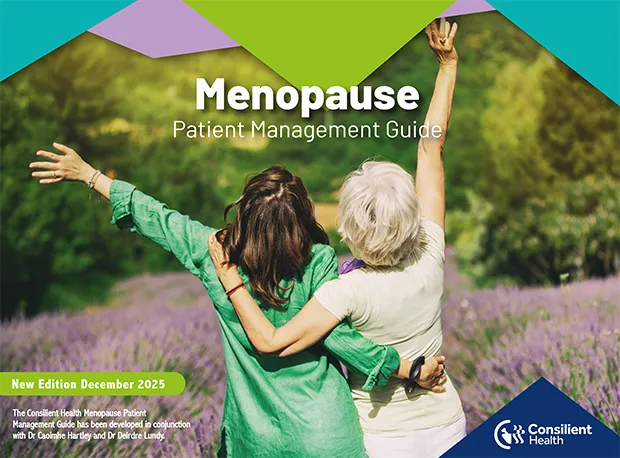
Consilient Health has updated its popular Menopause Patient Management Guide – at a recent webinar, authors Dr Caoimhe Hartley, Clinic Lead of the Rotunda Menopause Complex, and Dr Deirdre Lundy, Clinical Lead of the Complex Menopause Clinic at the National Maternity Hospital, Holles Street, were on hand to highlight the new changes, writes Dawn O’Shea
The 5th edition of Consilient Health’s Menopause Patient Management Guide continues to be updated in line with emerging evidence and the most up-to-date international guidance.
Hormone replacement therapy (HRT) remains the most effective treatment for symptom control including vasomotor symptoms (VMS), joint and muscle pains, mood changes and sleep disturbances. It has been associated with reduction in cardiovascular disease (CVD) for women aged <60 and within 10 years of the last menstrual period, and a significant reduction in osteoporosis.
The guide sets out dosing recommendations for oral and transdermal oestrogen preparations.
Dosing recommendations for progestogens are more complicated, Dr Hartley explained, since the guidance from the British Menopause Society (BMS) states that the dose of progestogen should be proportionate to the dose of oestrogen. She explained that the controversy arises because of conflicting advice from the BMS.
“In the joint statement on unscheduled bleeding, the BMS said that 75 micrograms is a moderate dose, but in the BMS tools for clinician, 75 micrograms is described as a high dose. I think you can err on the side of caution and treat it as a higher dose. But then in those women who don’t want to take a higher dose, I might look at risk factors in that case. If they don’t want the higher dose and they don’t have risk factors for endometrial cancer and they don’t have unscheduled bleeding, I’m fine parking it. But if every time something goes wrong with a bleeding pattern in one of your ladies, you’re reaching for that mouse to refer for hysteroscopy, I think the smart money is to go conservative with the progestogen and to make sure you’re keeping the levels of progestogen high if you go above a 50 microgram oestrogen patch,” Dr Hartley said.
Both Dr Hartley and Dr Lundy highlighted the benefit of combination preparations in terms of treatment adherence and noted that oral combination therapy can be of particular benefit for women with unscheduled bleeding.
Non-HRT options
The guide details the variety of non-HRT options available, including cognitive behavioural therapy for sleep and VMS, vaginal laser for genitourinary symptoms, and St John’s Wort for sweating and low mood.
SSRIs and SNRIs can be used for depression and anxiety. Some SSRIs inhibit cytochrome P450 activity which is involved in tamoxifen metabolism so most guidelines recommend that SSRIs must not be prescribed concomitantly with tamoxifen. Venlafaxine 75mg is the preferred treatment for breast cancer survivors taking tamoxifen.
Gabapentin 300mg daily increasing to 300mg tds or pregabalin 75-150mg BD have shown improvement in hot flushes compared to placebo. Patients should be started on a sub-therapeutic dose of 100mg to avoid side effects.
Oxybutynin 2.5 mg or 5 mg bd also appears to be effective in the treatment of hot flushes and can be used in breast cancer survivors.
It should be noted that it is not recommended to use the above medications in conjunction with one another.
Neurokinin receptor antagonists have demonstrated a rapid effect on VMS. Two are currently being assessed for use in people being treated for breast cancer.
Clonidine is licensed in Ireland for the treatment of hypertension and VMS symptom control. However, it is now rarely used in the management of VMS.
Genitourinary syndrome of menopause is linked to declining systemic oestrogen levels, oestrogen receptor numbers and thinning of both muscularity and epithelium
GSM symptoms
Genitourinary syndrome of menopause (GSM) is linked to declining systemic oestrogen levels,
oestrogen receptor numbers and thinning of both muscularity and epithelium. Most menopause societies recommend that patients should at least try non-prescription therapies.
Local vaginal oestrogen can be offered to almost all patients, including patients for whom systemic HRT is contraindicated. It can take four to six months to see the full results of local oestrogen. Vaginal oestrogen has no effect on endometrium and so opposing progestogen is not required. Vaginal oestrogens are safe for the majority of women diagnosed with gynaecological malignancies.
Treatments for vaginal atrophy to positively impact GSM are available as pessary, cream or gel formulations.
Fractional CO2 laser is a non-medical option for GSM, although this has largely been replaced by erbium laser rejuvenation, which is a cold laser.
Testosterone
Testosterone is currently not licensed in Ireland for the treatment of menopause but Dr Hartley said she is comfortable trialling testosterone for three to six months in an effort to bolster libido.
However, she said, patients should be made aware of the side effects. Current data suggest that short-term transdermal testosterone therapy does not impact breast cancer risk, but testosterone should be used with caution in women who have a history of hormone-sensitive breast cancer.
Dr Lundy stressed that oestrogen and progesterone should be stabilised before trialling testosterone.
Cardiovascular risk
The risk of VTE is increased two- to four-fold when starting oral oestrogen HRT and is highest in the first year. There is no increased risk with transdermal oestrogen when used in standard doses.
A non-oral route is preferred in patients at higher risk of VTE such as those aged >60 years, those with a BMI >30 kg/m2, patients with a personal or strong family history of VTE, and patients undergoing immobilisation or surgery etc.
Norpregnane derivative progestogens, particularly medroxy progesterone, are not recommended in patients with increased VTE risk. Micronised progesterone, dydrogesterone or Mirena should be considered instead.
The presence of cardiovascular risk factors is not a contraindication to HRT as long as these are optimally managed.
There is no reliable evidence linking the use of HRT to cardiovascular disease in women under 65 years. HRT has generally been contraindicated in women with a history of MI but more recent data suggest the cautious use of low dose transdermal oestrogen and micronised progesterone are acceptable if the patient is stable.
Unscheduled bleeding
“If a woman whose periods have finished starts bleeding again and she is not on HRT, she has cancer until proven otherwise, but the rule is not the same for people who are bleed unexpectedly on HRT,” Dr Lundy said.
Bleeding soon after starting HRT is common. An inadequate progestogenic effect can result in endometrial proliferation and possibly hyperplasia and bleeding. Investigation is not required within the first three months of initiating HRT and unscheduled bleeding may respond to modification of HRT doses or delivery systems. Bleeding which is unexpected or excessively heavy should be investigated.
Questions & answers
During the webinar, Dr Lundy and Dr Hartley took questions from the audience and the issue of discontinuing HRT was raised. Dr Hartley remarked that there is no clear guidance on discontinuation, but her advice would be to taper slowly over a few months to avoid rebound symptoms. Dr Lundy added:
“The only people I would have concern about is the older person who has maybe gotten some cardiovascular benefit from the long-term HRT use. The Women’s Health Initiative study found that a year after the ladies stopped taking HRT, they got a huge spike in cardiovascular events.”
Her advice was to maintain progesterone at normal levels and taper oestrogen downwards. On the day that the patient takes her last dose of oestrogen, she should also stop the progesterone.
The updated Menopause Patient Management-Guide includes practical gold standard guidance on managing various other aspects of menopause including obesity, smoking and contraception.
A free digital version of the guide can be downloaded here. For your hardcopy of the guide, please contact Siobhan Maguire at smaguire@consilienthealth.com (North Leinster and Connaught) or Gemma Fitzsimons gfitzsimons@consilienthealth.com (South Leinster and Munster). 
Job Code: IE-WH-266
This is an advertorial feature on behalf of Consilient Health.