
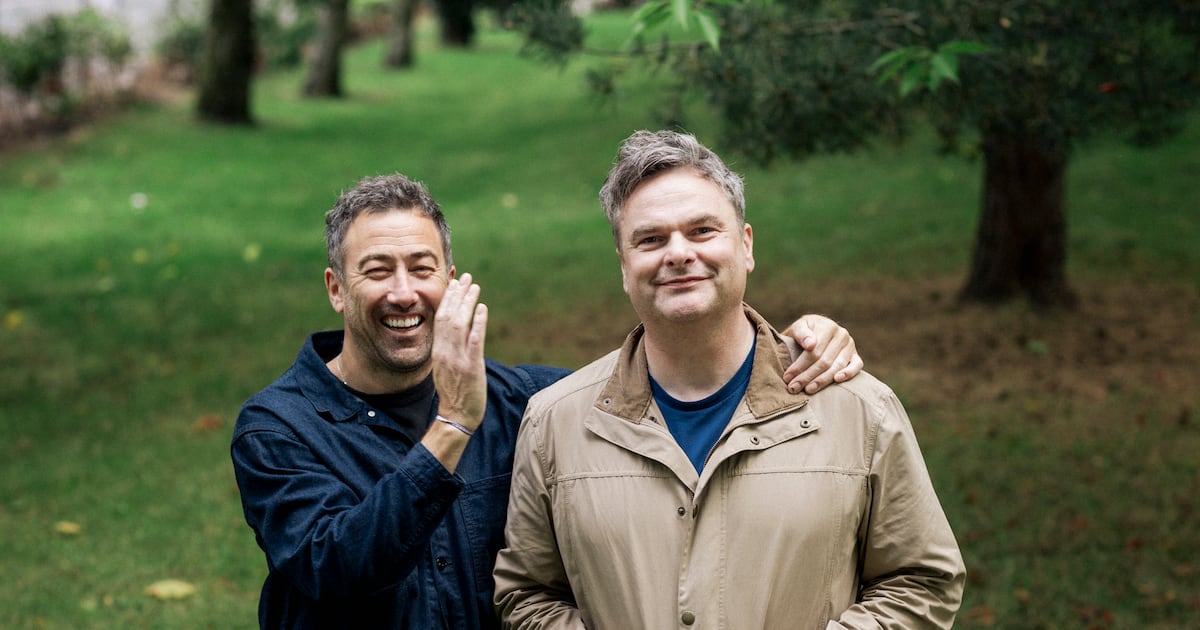
Screenwriters Declan Lawn and Adam Patterson have news that fans of Blue Lights, their Belfast police drama, might not wish to hear. The acclaimed BBC series about a fictional Police Service of Northern Ireland (PSNI) station will “take a beat” after its upcoming fourth season.
“Whatever iteration of the show happens afterwards, or whatever decision the BBC makes, great, but there’s a sense in which we definitely want to step back and look at it in the round,” Lawn says.
“It’s the end of a chapter,” says Patterson. “Declan says every season that it’s the best season, but I might finally agree with him. I think this season is really beautiful in many ways and will give people a lot of satisfaction in the end.”
The new six-episode run begins on BBC One on Tuesday in gritty fashion. Within 90 seconds, we’re in the grip of a tense standoff as anti-migration mobs coalesce across sectarian lines to force a Syrian refugee out of her home. The storyline, made even timelier by this summer’s Belfast race riots, was conceived in June 2025 as violent disorder erupted in Ballymena, Co Antrim.
“Police officers in the North were telling us that they were preparing for this to be a perennial issue,” Lawn says. “We thought it would be kind of cowardly and remiss if we didn’t try and tackle it, and it will probably be quite controversial, but that’s fine.”
As former investigative journalists, they strive to hold a mirror up to the city, Patterson says. “We want to touch on something each season that is prescient about Belfast and also relatable to the wider world.”
Blue Lights – produced by Two Cities Television and co-produced by Gallagher Films – was a breakout hit on its 2023 launch, attracting more than seven million viewers. The BBC swiftly commissioned a second season, which won a Bafta for best drama series, and two more seasons were ordered in 2024.
“We did think in the [first-season] edit that it was good, and quite emotional, and we liked it. But we had no presumptions that everybody else would think so, because when you make a show about Northern Ireland, there’s no guarantee that people in England or Scotland or Wales will care about it at all,” Lawn says.
Patterson mentions its international sales. (Blue Lights has been sold to more than 160 territories.) “It’s really big in Spain, and that’s kind of crazy,” he says. “If you ask Dec and I if we’re surprised by the magnitude of the success of Blue Lights, I would say we’re kind of blown away.”
Lawn estimates that the reception in the North has been 90 per cent positive, 10 per cent negative. Before it aired, he thought it might be the other way around.
“There was a negative reaction because there wasn’t enough of the DJ,” Patterson interjects.
“Adam played the DJ in season three and he never shuts up about it,” Lawn says. “Declan won’t write me into any more scenes. I’m very disappointed,” says Patterson, sitting beside Lawn in the offices of their Belfast production company, Hot Sauce Pictures.
This jokey rapport feeds into the authenticity of the series, which demonstrates their capacity for tonal shifts. “Dark humour is a facet of our society generally in the North, so we knew that if we were going to write a show in our own voice, humour had to be a part of it,” Lawn says.
I didn’t grow up in a family where you had that tribal Northern thing, that understanding of the Troubles
— Declan Lawn
Patterson, who says he’s “much funnier than Declan”, thinks humour helped them survive their journalism days. “You would often see terrible things and then get in a van and tell terrible jokes to try and make yourself feel a bit better. The police are very similar.”
When they were first approached by Stephen Wright and Louise Gallagher, their Blue Lights co-creators, to write about a social worker who becomes a PSNI response officer, they were reluctant. “Dec and I are not ashamed to say that initially we were quite petrified of taking on a show about the police here, because it’s a hot potato,” Patterson says.
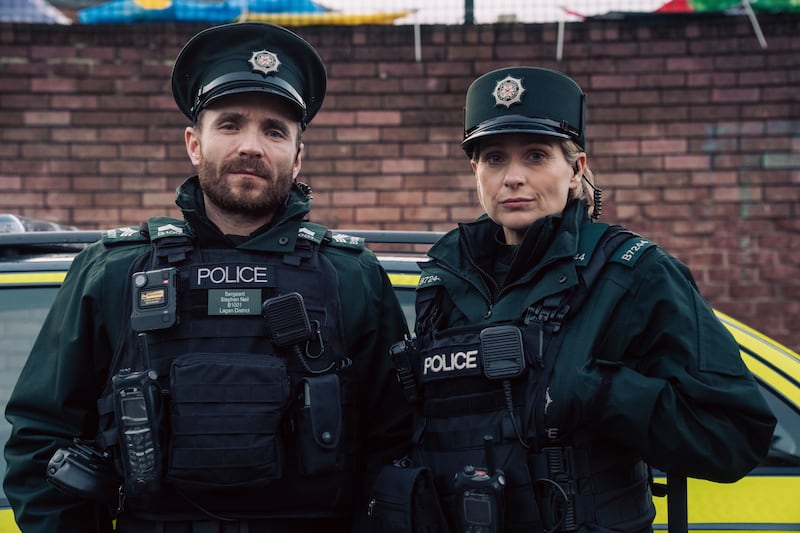 Blue Lights: Martin McCann as PSNI officer Stevie Neil and Siân Brooke, who plays officer Grace Ellis in the Belfast-set show. Photograph: BBC/Two Cities Television
“Very divisive,” Lawn says. “Doing a cop show in Northern Ireland is not like doing a cop show in Dublin or London.”
They decided to go ahead after they met three groups of female officers and were struck by their youth and their bravery. “When they talked about the transition from training college to being out on the street, we were like, ‘Wow, that’s fascinating.’ They crossed through into another world. That’s when we recalibrated and thought, right, let’s make this about a band of recruits and follow them on this journey,” Patterson says.
In the series, Catholic recruit Annie (Katherine Devlin) is targeted by dissident republicans for joining the PSNI – a storyline that echoes real threats faced by Catholic officers, who comprise less than a third of the force.
Lawn describes Blue Lights as “quite an oppressive responsibility”. They are writing about the city they both live in, after all. “Everything we’ve done has had an element of risk. We’ve looked at nationalist gangsters, loyalist gangsters, cartels and the middle classes involved in trafficking and grooming. Now we’re looking at crime against migrants and what’s behind it. So it’s both a wonderful thing to be able to do and also scary at times.”
The show wouldn’t get permission to film in certain areas if people were uncomfortable, Patterson says. “It’s always a good thing when residents come out and try to meet the cast. You do feel that love.”
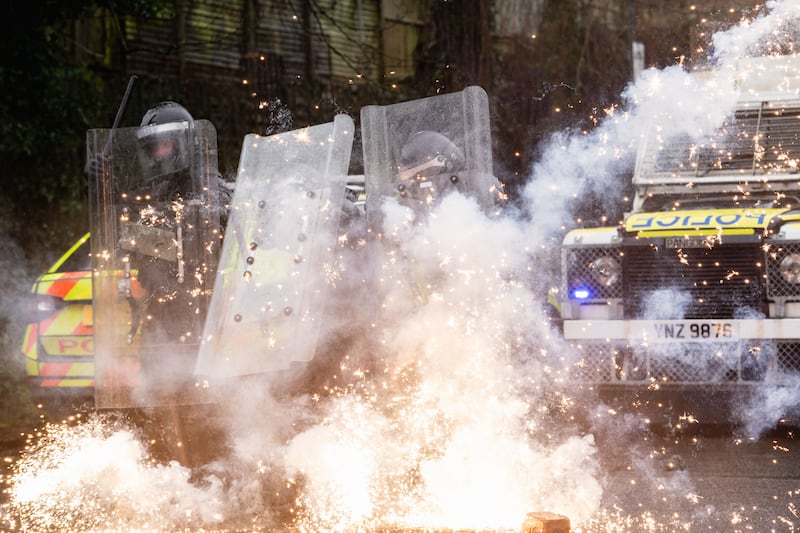 A scene from Blue Lights season four, which is filmed in Belfast. Photograph: BBC/Two Cities Television
The actors have occasionally been mistaken for PSNI officers, Lawn says. “People have said to us, ‘There were so many police cars in our estate, I thought something terrible had happened, but it was you guys.’ And there was an incident last summer when two extras walking to set [in uniform] were asked to give CPR to a guy who was having a heart attack.”
Fortunately, both were trained in CPR.
The fourth season opens with a script masterclass as viewers are introduced to three distinct yet related battles: the battle on the streets, the battle against “pretty dire” PSNI cutbacks and the battle to keep morale afloat.
They speak to 20-30 officers before each season, and the loss of hope suffered by Grace (Siân Brooke), the former social worker, reflects those conversations. She’s the conduit for real frustration, Patterson says. “Even the most idealistic person can be beaten down by the realities of working in a big bureaucratic machine.”
Their working relationship is “very symbiotic”. They research and come up with story outlines together, then Lawn writes the first draft. “Dec has been put on this planet to write dialogue,” Patterson says. “Anything visual or about actors’ performances, Adam tends to look after that,” says Lawn – when they direct, it’s Patterson who “runs the set”. But they always give each other notes and suggestions.
They think it “probably” helped Blue Lights that they come from different backgrounds. Lawn’s Catholic upbringing in Derry and Ballymena was “slightly unusual”. With a mother from Galway and father from Donegal, political talk at home looked towards the Dáil. “I didn’t grow up in a family where you had that tribal Northern thing, that understanding of the Troubles.”
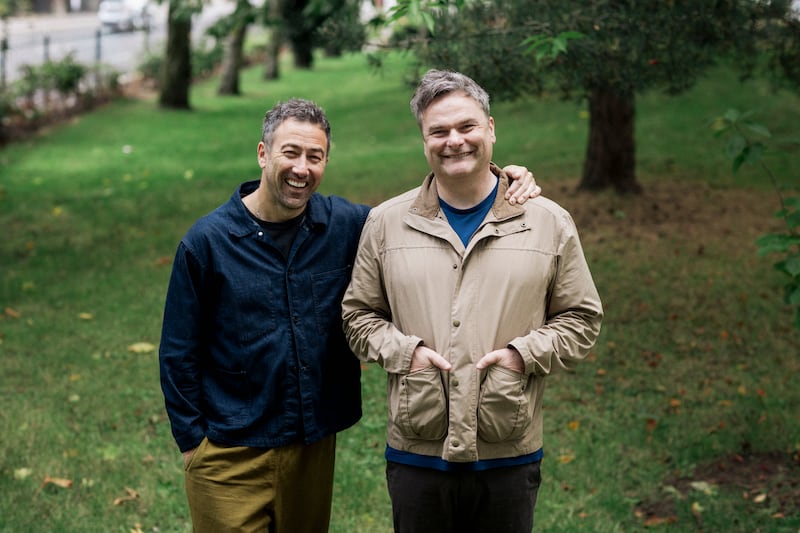 Declan Lawn and Adam Patterson, co-writers of BBC series Blue Lights, in Belfast. Photograph: Evanna Devine
Patterson comes from a Protestant background in Dromore, Co Down. “I had a pretty regular upbringing on the surface, like I went to a mixed school, played football with Protestants and Catholics. But my dad was a prison officer, so we had this thing that hung over the family. At the time, you didn’t think about it, because that was just the way life was. It’s only retrospectively you think, God, that’s a bit mad.”
His father kept a gun and their home had bulletproof windows but, again, this seemed normal: “All we knew is that you didn’t tell people what Dad did.”
Lawn left the North to study English at Trinity College Dublin, after which he became a journalist. He didn’t anticipate going back, but a job came up on the BBC Northern Ireland programme Spotlight. He has now settled in Belfast, but he spent 16 years working for the BBC’s Panorama, which involved “a lot of years” in London.
“I literally ran away,” says Patterson, who is the younger of the two. “I just wanted to get out at 18. I felt like I needed to explore the wider world.”
They met in Wales in 2009 when Lawn was sent to Swansea to cover a story about water companies dumping sewage. Patterson, a photographer turned documentary-maker, had started on Panorama as an assistant producer, and they ended up on a big night out. “We were in this karaoke bar where I sang Stan by Eminem and I think Adam fell in love with me,” Lawn says.
“Ha ha ha,” Patterson says. The next day, he filmed Lawn interviewing “a reputable MP who’d been in bed at 10pm, as opposed to Declan’s 3am” and wondered how he was able to ask serious, concise questions about environmental policies while hungover. “As he said, I think I fell in love. I thought, I have to work with this guy.”
They discovered they shared “a wee bit of an itch” – they wanted to become screenwriters. So they drank whiskey together and tried to work out how to break into it. They were so “green and naive”, the first script they sent to BBC was in Microsoft Word, not proper screenwriting software.
They kept trying in their spare time until 2018, when they were getting enough work to quit journalism. It was still a gamble, but it paid off when they were commissioned to write The Salisbury Poisonings, a well-received fact-based BBC drama that aired in 2020. “For the first time ever, instead of us knocking on people’s doors, people were asking us to do stuff, and that changed our lives,” Lawn says.
The culture of TV drama resembles journalism, he finds, in that it’s “full of very curious people” who are often obsessive. Patterson thinks they can “actually be more honest through dramatic storytelling”, not least because some of their documentary ideas weren’t commissioned. “Abstract insights” can be better suited to the emotion of drama, Lawn agrees.
They’re now “going back to where it all began” with D Notice, a six-part conspiracy thriller for the BBC. Partly based on their experiences at Panorama, it explores “where we’re at with fact and truth” in a world swamped by competing narratives. “You see a lot of stories coming out that would finish someone’s career 20 years ago. Now they just hold on for 48 hours,” Lawn says.
D Notice, their first project for Hot Sauce, marks a “really exciting” new chapter for the duo. They’re no longer just writers for hire, directors for hire, but employers planning for the future.
Their ambitions remain tied to home. “We really love the city. We want to build a place that means people can dream here and stay here if they want to be creators,” Patterson says. “Whatever we do,” Lawn says, “We have aspirations to keep Belfast as part of the story.”
Blue Lights is on BBC on Tuesday