
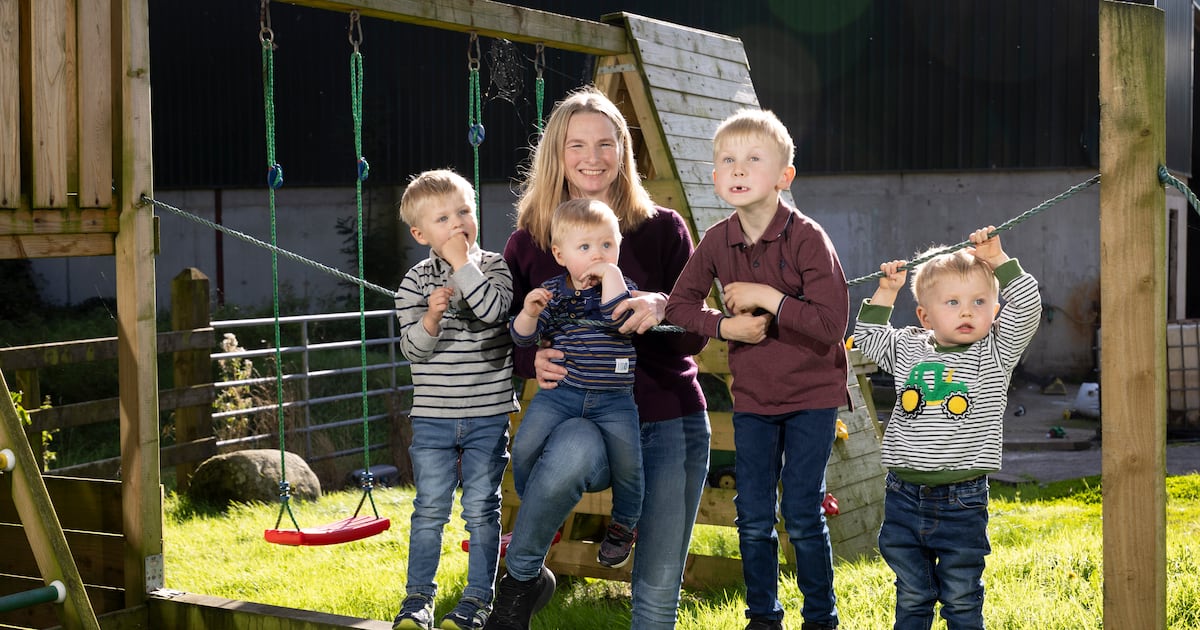
Jayne Patterson Roulston was dead set against the idea of breastfeeding her babies because, with a busy equestrian yard to run in Co Donegal, she did not want to be stuck indoors.
“From the very start I was, ‘no way, I’m not breastfeeding; I’m not sitting in the house’. I was out 24/7 with the horses,” she says.
Partly due to her commitment to four-legged creatures, “I didn’t even know if I ever wanted children”, says the now mother of four.
But when, at the age of 36, she married farmer George Roulston, Jayne’s perspective on life changed. “We met and married inside 18 months because we were that wee bit older and we knew that was what we wanted.”
Their first son, William, was born six years ago, followed by Jack, who is now nearly four. Both arrived a few weeks in advance of their due dates. The decision to bottle-feed their sons was a combination, she believes, of never seeing herself as a woman who would breastfeed and wanting to avoid being “entrapped” by a baby.
It was only after the premature birth of their third son, Louis, that she thought in hindsight he might have benefited from breastfeeding. He was born with a twist in his gut in Letterkenny hospital at just over 34 weeks, weighing 2.15kg (4lb 12oz). “He had to go to Dublin and he was in [CHI at] Crumlin in surgery within 24 hours of birth. Thankfully they didn’t have to cut anything out of him. They just had to go in and untwist it,” she says.
However, it took a while before his digestive system was able to cope with milk and staff had asked her about breastfeeding. He had to stay in the hospital for nearly five weeks, while his parents were up and down the road from their home outside Lifford every other day.
After Louis could manage formula feeding and was strong enough to be discharged from Crumlin, he continued to have bad reflux. “He would throw up bottles around me and I had to get medication for him.” About to turn three in October, he is still small for his age.
As soon as she became pregnant with her fourth and last baby, she was thinking about breastfeeding. But she told nobody. It was nearly seven months on before she mentioned it to her husband.
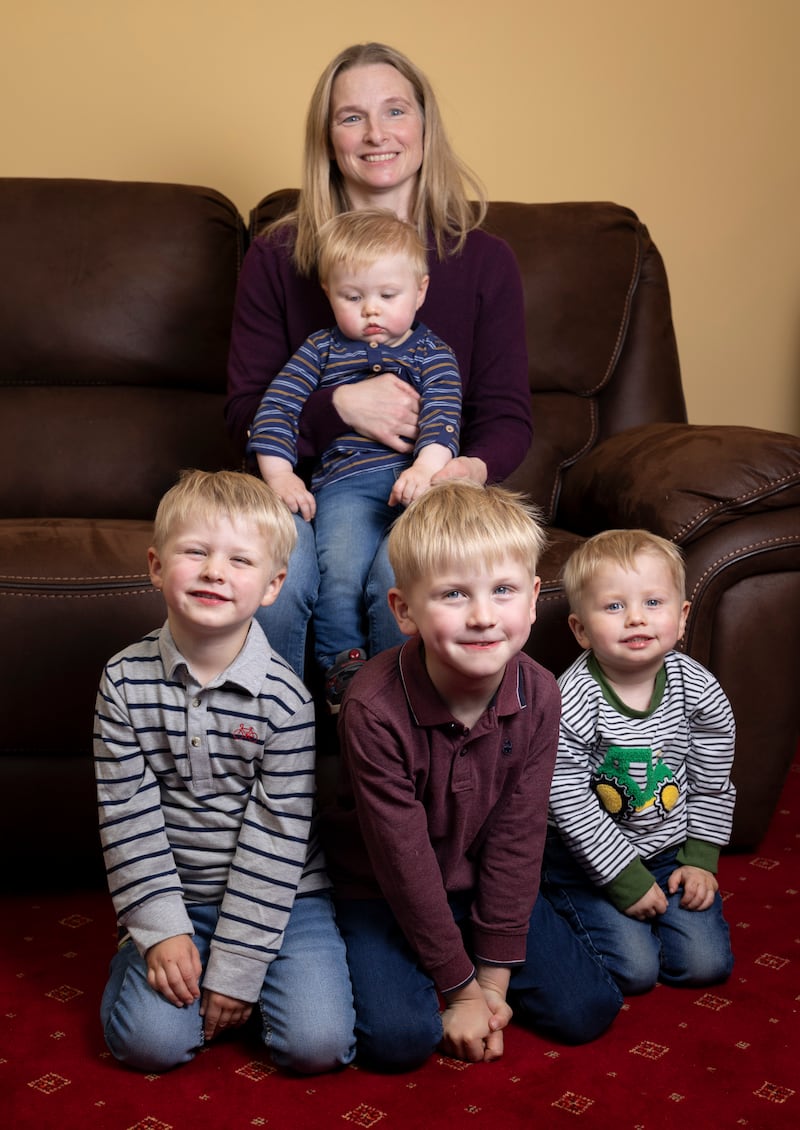 Jayne Patterson Roulston with her four boys in Co Donegal. Photograph: Joe Dunne
“He looks at me and he goes: ‘Are you feeling well?’ That shows you the extent that I definitely wouldn’t have breastfed the others.” But during this pregnancy she had reflected on how she ate healthily herself and, as this was going to be her last baby, she really wanted to experience breastfeeding.
Baby Robert arrived early too, and at speed. She was “roaring the house down”, waiting an hour for her brother and partner to arrive, via an unexpected road closure, to mind the other children while she and George went to Letterkenny hospital.
She reckons she was holding the baby in during the 20-minute drive to the hospital, where she was transferred by wheelchair. “On to a bed and, I think, two pushes and he delivered.”
Jayne is not going to pretend she found it easy to establish breastfeeding with Robert, who was born at 36 weeks and two days. “My [milk] supply wouldn’t be massive, so I did have to top up with formula after feeds.
“My nipples were very sensitive. Every time he went on, it was like a vice for me. If I had wanted to give up, I probably could have stopped the first two or three days. But I battled through.”
Breastfeeding rates continue to rise slowly in Ireland, as reflected in comparisons for the last decade, released in advance of National Breastfeeding Week, October 1st-7th. Just more than half, 51.5 per cent, of babies were breastfed at three months in 2025, a 16 per cent increase over 2015’s figure of 35.4 per cent. Some 65.8 per cent of mothers initiated breastfeeding after birth, up two per cent over the previous six years.
However, considering that the HSE recommends aiming for exclusive breastfeeding for the first six months, the fact that only 34.6 per cent of newborns were fed solely breastmilk during their stay in hospital seems low, especially compared with corresponding rates of 54 per cent in the UK and 74 per cent in Spain.
“It’s important to give the context on this,” says HSE national breastfeeding co-ordinator Laura McHugh. “There’s a lot of medical complexity around some of the maternity cases.” Rates of induction and birth by Caesarean section have increased, she points out, while preterm and sick babies may need alternative nutrition.
“Then there’s maternal choice. So, it’s multifactorial why some babies will receive formula in hospital.” At three months, 36 per cent of babies were exclusively breastfed in 2025, which is an increase of almost 10 per cent since 2015.
McHugh believes these figures reflect how breastfeeding is becoming more popular and that, due to increased investment, there are better supports available, both in the hospital and within the community. All midwives and public health nurses are trained to support mothers with breastfeeding. They are backed by 60 specialist infant feeding staff. There are also nearly 250 support groups listed on mychild.ie. (see mychild.ie/breastfeeding, where women are encouraged to report their experience, good or bad, of infant feeding care and support, through a continuing online survey to inform the HSE).
“All public health nurses have lactation public health nurses on their team. So if the midwife or the public health nurse needs to refer you on, there is a pathway now in every part of the country.”
But as reported recently in this newspaper, there has been stalling on the filling of five, fully funded extra lactation consultant jobs, which brings to 11 the total number of vacant posts. “We have about six posts in the community that are going through the recruitment process and we will always be looking to build more capacity around infant feeding post holders,” McHugh says. “There’s certainly some areas of the country that we would like to have more staff.”
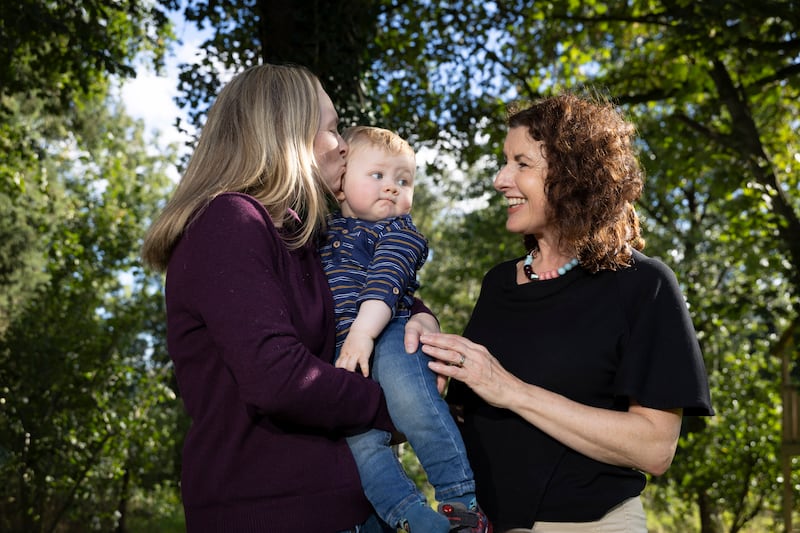 Jayne Patterson Roulston and her son Robert with lactation consultanat Mary McFeely. Photograph: Joe Dunne
However, the majority of mothers will not need to see a lactation consultant, who is trained to help babies with complex conditions, she says. Postnatal hubs, of which there are nine open around the country and a further four in development, have been “a fantastic addition” to resources for any mother having issues in the first six weeks, she adds.
Public health nurse (PHN) Mary McFeely is the only community lactation consultant for Co Donegal, where about 1,600 babies are born each year. Donegal traditionally would have had one of the lowest breastfeeding rates “but we’re really increasing and improving, and it’s all to do with support”, she says.
North Cork and South Tipperary have the lowest breastfeeding rates at 43 per cent and 49.7 per cent respectively, as recorded at the first PHN visit. The highest rates are found in Dublin South West (81.7 per cent) followed closely by Dún Laoghaire at 80.7 per cent.
McFeely is based in a Letterkenny health centre and tries to get mothers, who are referred by their PHNs, to come to her. However, “if somebody is on day three post Caesarean section with no transport, of course I will do home visits”.
She believes fear is one of the biggest obstacles to breastfeeding because mothers know it’s hard at the outset. “They’re afraid to try in case they don’t get help, or in case there’s no support. If word gets out there that there’s support groups and there’s education classes, then more people are going to try.”
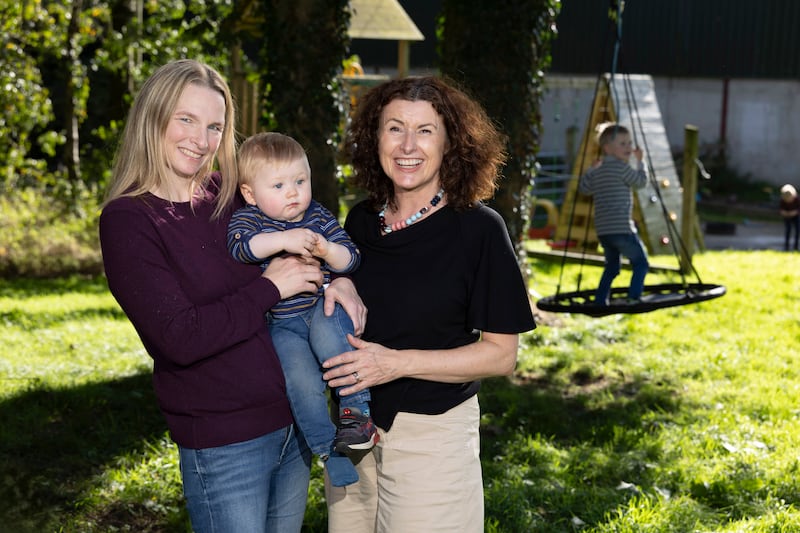 Mary McFeely was a great help to Jayne Patterson Roulston and Robert. Photograph: Joe Dunne
Pain or a perceived lack of milk supply are further stumbling blocks. Mothers need reassurance that what they are experiencing is normal.
McFeely says her “forte” is treating damaged nipples. She is one of a few lactation consultants who have been trained in low-level laser therapy, which is used for wound healing and reducing inflammation. “It’s been a game changer for mothers who have damaged and sore nipples.”
Very few mothers and babies can’t breastfeed, she says. “It’s a natural instinct but it does not come naturally to everyone. I can’t stress how important support is.”
One thing Jayne notes about postnatal support is that as she had Robert on a Saturday morning, the midwife responsible for lactation support in the hospital seemed to be off over the weekend. He had jaundice and was started on formula in the hospital. Jayne believes it was only for the fact that Robert had to be kept in the hospital until the following Friday, that she ended up receiving plenty of breastfeeding assistance there.
Once Robert was home, the PHN was out several times and was “brilliant”. After about a week Jayne felt he was not latching properly and her nipples were sore. The PHN arranged for McFeely to ring Jayne, who was then invited to attend the weekly infant feeding group in a local clinic two days later, as it would be a quicker way to see her in person rather than waiting for an appointment slot.
“It was a big help,” says Jayne, who continued to attend the group every couple of weeks and found it invaluable to be able to ask anything of McFeely and other mothers.
Robert had silent reflux. “He wasn’t throwing up much, but he was having a lot of pain for the first eight weeks. I knew that he wasn’t right.” After Jayne found a lactose-free formula that suited him for top-up feeding, and she cut lactose out of her own diet too, “he changed completely”.
Despite the initial challenges, Jayne is glad she decided to breastfeed Robert. It made her slow down and her time sitting with him on her breast, particularly in the evenings after the other boys were in bed, has been precious. He was four months old before she bought a breast pump. “I could be anywhere with the pumps on; I would flitter about and be outside.”
She had great support from her father, who lives beside the livery yard, which is half an hour from her own home. “My dad’s nearly 80, and he’s very good to me, because he makes dinners and all during the day for us. He would keep an eye on the wains if I needed him to. He adores them.”
One year on, Jayne still likes to sit down at night with Robert on her breast. “I did enjoy it more than I thought I would,” she says. “At the start, I thought if I did one week or I got to six weeks, or got to three months, I’d have been doing great – and I would have been. So, I surprised myself.”
What would she say to expectant mothers contemplating breastfeeding?
“If you’re any way thinking that you would like to, try it. If you’ve tried it, and you know it’s definitely not for you, well, you won’t look back and think, ‘I should have tried it’.”