
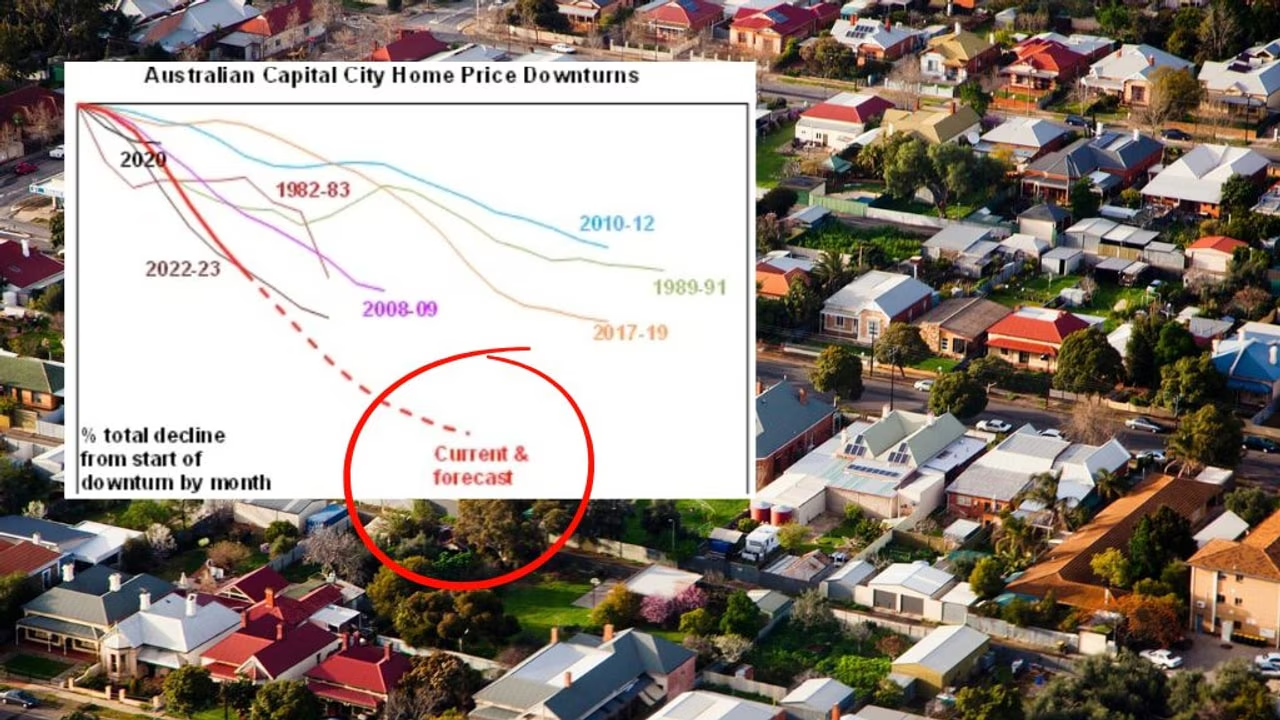
The grim predictions for Australia’s property market began in May, when Morgan Stanley tipped a national house price correction of up to 10 per cent.
Since then, pundits have become increasingly pessimistic as the Reserve Bank of Australia (RBA) has continued hiking interest rates and the Iran war has raged on.
On Thursday, two experts — Cotality Research Director Tim Lawless and AMP Chief Economist Shane Oliver — both said they expected a national peak-to-trough correction of up to 15 per cent, exceeding HSBC’s forecast of a 13 per cent decline.
If realised, a 15 per cent drop would be the worst fall in nominal house prices that Australia has seen in the post-war period.
“If you just take the current quarterly growth trends and annualise it, we’re sitting on a trend rate of decline that’s at 15 per cent nationally and at 17.1 per cent across the capital cities,” Mr Lawless told news.com.au.
“We’re already seeing values falling at that pace. The question obviously is whether or not that will be sustained.
“I think there’s a pretty good argument that we could see this housing downturn re-accelerate, given higher interest rates alongside inflationary pressures, and what looks to be no real resolution in the Middle East.”
His comments came as national home values had fallen 5.2 per cent from their March peak, according to the latest Cotality data.
The decline for the combined capitals was 6.4 per cent, while Sydney was the city leading the fall (8.6 per cent) followed by Melbourne (7.5 per cent).
The biggest fall the combined capitals have seen over the past 40 years was 8.2 per cent during the 19 months between 2017 and 2019.
“We’re already three quarters of the way there in six months, so we’re already beating that trajectory of decline in a fairly short space of time,” Mr Lawless said.
“A 10 to 15 per cent decline sounds reasonable to me. We don’t have an economic forecasting model here at Cotality, so it’s more of a view than a forecast.”
Mr Lawless ranked higher interest rates as the main driver of the decline, followed by tax reforms in the May budget, poor affordability and low confidence.
“When you look at the market peak, it was in March, so one month after the first rate hike. But even before rates started to rise, the market was clearly slowing down,” he said.
“I think that’s a clear reflection of things like affordability already becoming a barrier to participation and a headwind for demand.
“The peak level of activity in terms of the volume of sales was in October.
“Late last year, inflation was starting to pick up, the RBA was becoming hawkish, confidence was starting to sink. And then you saw rates going up, the war in Iran and the federal budget handed down.”
Mr Oliver also revised his outlook for the property market on Thursday, calling for a 10-15 per cent top-to-bottom fall in prices, up from his earlier forecast of 10 per cent.
“If you go back over the last 80 years, the worst decline has been about 8 per cent. We saw that in 2022 with rate hikes at the time, and we saw that in 2017-19,” Mr Oliver told news.com.au.
“There was a very sharp fall in house prices during the 1930s depression going into World War Two, so I suspect to get something comparable you’d have to go back to that — and of course that was a lot worse. But we haven’t experienced that sort of fall in the post-war period.”
Mr Oliver said he had changed his forecast because the present decline has “remained stronger than I expected”.
“We are seeing quite hefty declines (in national prices) month-on-month and they keep getting revised lower, so that’s one factor.
”Secondly, there is no sign of any let-up to the negative factors weighing on demand.
“You’ve got this combination of negatives: high rates, poor confidence levels and the tax hike on investors, along with poor affordability; all of these things are going to continue to weigh on the property market.”
Mr Oliver said house prices were likely to bottom by the June quarter next year as the market started to anticipate interest rate cuts.
“We expect the RBA to start cutting through the second half of next year, but a sharp fall in home prices could bring this forward to the first half as falling prices depress wealth, which weighs on consumer spending, which in turn would bring inflation back to target faster than the RBA is currently assuming,” he said.
Recent homebuyers more likely to be in negative equity – RBA
On Tuesday the Reserve Bank of Australia (RBA) lifted the official cash rate to 4.6 per cent, its highest point since 2011, with economists warning that more hikes will be needed to tame inflation.
Mr Lawless noted that households today carry heavier debt burdens than they did when rates last peaked 15 years ago.
“The last time interest rates were this high, the housing market and the household sector were fundamentally different and probably less sensitive to high interest rates because the debt levels were much lower and we were heading into a rate-cutting cycle, let alone a hiking one,” he said.
In its six-monthly Financial Stability Review released on Thursday, the RBA named government tax reforms as playing a role in the market downturn and said first homebuyers who had taken advantage of the Albanese government’s expanded 5 per cent deposit scheme were “more likely” to be in negative equity as house prices fell.
“Housing prices have declined in recent months as housing market sentiment has weakened, reflecting the somewhat restrictive stance of monetary policy and changes to negative gearing and capital gains tax discount policies (in the May budget),” the report said.
“Despite this, most household balance sheets remain strong, with less than 1 per cent of borrowers estimated to owe more on their loan than the value of their property (negative equity).
“Recent buyers and those who took out higher LVR loans are more likely to be in negative equity. This includes first home buyers participating in the Australian Government 5 per cent Deposit Scheme.”
The RBA board meets again in November, with ANZ currently the only big four bank predicting a further cash rate hike to 4.85 per cent, the highest setting since 2008.