
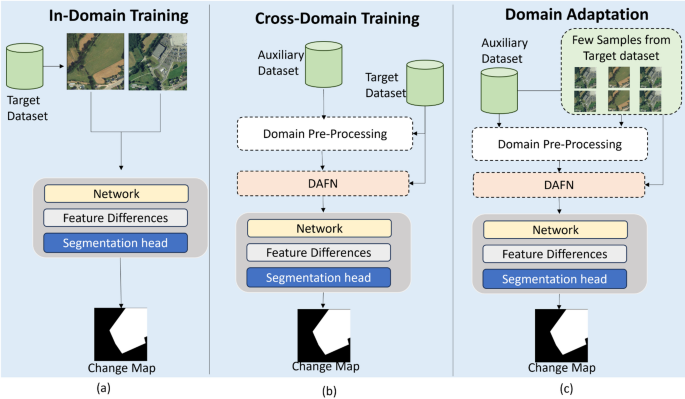
This section presents the experimental evaluation of the proposed CrossCD-Eval framework and its integrated architecture across multiple domain configurations. All experiments are designed to investigate model generalization, domain adaptation efficiency, and the impact of the Domain-Aware Feature Normalization (DAFN) module. Results are reported for in-domain, cross-domain, and domain adaptation settings using both quantitative metrics and qualitative visualization of predicted change maps.
Datasets
Three widely used benchmark datasets are employed in this study: CLCD, HRSCD, and LEVIR-CD.
The first two serve as primary source–target pairs, while LEVIR-CD43 functions as an auxiliary dataset for domain enrichment and adaptation. A small description of their main characteristics is summarized in Table 2.
CLCD (Changsha Land Cover Change Detection)40:
A high-resolution optical dataset capturing urban and rural regions in China. It contains 512 × 512 bi-temporal patches with building and land-cover changes labeled at the pixel level. CLCD exhibits strong spatial diversity, making it suitable for evaluating generalization to heterogeneous urban structures.
HRSCD (High-Resolution Semantic Change Detection)39:
A large-scale dataset built from Sentinel and aerial imagery over France, consisting of 30,000 + patch pairs (256 × 256 pixels). It features significant scene variability and complex object boundaries, providing a challenging benchmark for cross-domain transfer. In this study, HRSCD was used under the binary change detection setting. Specifically, we used the official change labels provided with the dataset, where class 0 denotes no-change and class 1 denotes change.
LEVIR-CD43:
A medium-scale dataset containing 637 image pairs (1024 × 1024 pixels) of urban scenes captured at different times. It includes detailed building-level annotations and consistent spatial resolution, making it a valuable auxiliary domain for adaptation experiments.
LEVIR-CD is considered an auxiliary dataset that provides additional bi-temporal urban change samples that are not part of the main CLCD–HRSCD source target evaluation pair. Its role is to enrich domain variability during adaptation by exposing the models to additional differences in spatial resolution, scene scale, sensor characteristics, spectral/radiometric appearance, and annotation style. This allows CrossCD-Eval to evaluate whether adding an additional change detection dataset can improve model generalization under heterogeneous cross-domain conditions.
All datasets are preprocessed using the pipeline described in Section Preprocessing and Dataset Alignment, ensuring consistent ground sampling distance (GSD), patch size, and spectral alignment across domains.
Table 2 Summary of datasets used in CrossCD-Eval experiments.Evaluation metrics
To ensure a fair and consistent assessment across all models and configurations, multiple quantitative metrics are employed, covering pixel-level accuracy, region overlap, and detection balance:
Intersection over Union (IoU): Measures the overlap ratio between predicted and reference change areas:
$$\:\begin{array}{cccc}&\:IoU=\frac{TP}{TP+FP+FN}&\:&\:\end{array}$$
(8)
where \(\:TP\), \(\:FP\), and \(\:FN\)represent true positives, false positives, and false negatives, respectively.
F1 Score: Harmonic means of precision and recall, reflecting overall detection balance:
$$\:\begin{array}{cccc}&\:F1=\frac{2\times\:Precision\times\:Recall}{Precision+Recall}&\:&\:\end{array}$$
(9)
Precision: Quantifies correctness of detected change pixels:
$$\:\begin{array}{cccc}&\:Precision=\frac{TP}{TP+FP}&\:&\:\end{array}$$
(10)
Recall: Measures of completeness detected change regions:
$$\:\begin{array}{cccc}&\:Recall=\frac{TP}{TP+FN}&\:&\:\end{array}$$
(11)
Overall Accuracy (OA): Represents the proportion of correctly classified pixels (changed and unchanged):
$$\:\begin{array}{cccc}&\:OA=\frac{TP+TN}{TP+TN+FP+FN}&\:&\:\end{array}$$
(12)
First experiment (CLCD as target domain)
The first set of experiments evaluates model generalization when CLCD is used as the target domain under three different training conditions: (i) in-domain training, (ii) cross-domain training using HRSCD and LEVIR-CD as source datasets, and (iii) few-shot domain adaptation, where cross-domain training is augmented with 10 labeled CLCD samples. Table 3 summarizes the results in terms of Intersection over Union (IoU), F1 Score, Precision, and Recall. The IoU columns report on the performance before and after applying the proposed Domain-Aware Feature Normalization (DAFN) module. For in-domain rows, F1 Score, Precision, and Recall correspond to the baseline in-domain model, while for cross-domain and adaptation rows they correspond to the DAFN-enhanced setting. For the 10-shot adaptation rows, IoU and F1 are reported as mean ± standard deviation over five random draws of the 10 labeled CLCD samples using seeds 1–5. The target test set was kept fixed and unseen during adaptation.
Across all models, a clear degradation in performance is observed when moving from the in-domain setting to the cross-domain settings, confirming the presence of substantial domain shift between CLCD and the other datasets. When the models are trained and tested within the same CLCD domain, they achieve strong results, with Change-Mamba2 obtaining the highest in-domain IoU of 90.50%, followed by STNet5 with 89.20%, GLAFormer1 with 88.42%, ELGC-Net4 with 87.91%, and EHCTNet3 with 86.84%. However, when the source dataset is changed to HRSCD or LEVIR-CD while CLCD is used as the target domain, performance decreases noticeably. This drop is expected because the source and target datasets differ in spatial resolution, scene scale, spectral/radiometric appearance, and annotation style. As a result, models trained on one dataset may learn domain-specific visual patterns that do not transfer well to CLCD. The degradation is generally more pronounced when LEVIR-CD is used as the source dataset, indicating a larger domain discrepancy with CLCD compared with some HRSCD-based transfers.
The introduction of DAFN improves the cross-domain results across all evaluated architectures by reducing the mismatch between source and target feature distributions. For example, under the HRSCD → CLCD setting, GLAFormer1 improves from 68.73% to 71.14% IoU, Change-Mamba2 improves from 76.13% to 80.58%, and STNet5 improves from 78.45% to 83.10%. These improvements suggest that DAFN helps the models focus more on change-relevant representations rather than dataset-specific appearance variations. In particular, STNet achieves the highest IoU under the HRSCD → CLCD setting after applying DAFN, indicating that the combination of a strong spatio-temporal backbone and feature-level domain alignment is effective for this target domain.
The 10-shot domain adaptation setting further improves performance because the additional labeled CLCD samples provide direct target-domain supervision. Even though only 10 target samples are used, they help the models better calibrate their decision boundaries to the visual and annotation characteristics of CLCD. When combined with DAFN, these samples act as target-domain anchors that guide the feature-alignment process and reduce the remaining gap between source and target distributions. For instance, EHCTNet3 improves from 65.48% in the direct HRSCD → CLCD setting to 80.25 ± 0.80% with 10-shot adaptation and DAFN, while ELGC-Net4 increases from 78.29% to 83.60 ± 0.70% under the same configuration. Similarly, STNet5 improves from 78.45% in direct HRSCD → CLCD transfer to 85.20 ± 0.74% when 10 labeled CLCD samples and DAFN are used. These results show that limited target-domain supervision is especially useful when the initial cross-domain gap is large, because it provides the model with a small but informative sample of the target-domain distribution. The repeated-draw analysis also confirms that DAFN improves the stability of the 10-shot adaptation setting. Across the CLCD target-domain adaptation rows, the IoU standard deviation is reduced by approximately 16.7% to 22.7% after applying DAFN. This indicates that the adapted models become less sensitive to the particular selection of the 10 labeled target samples, which is important in few-shot adaptation scenarios where performance can otherwise vary depending on the sampled target patches. From a comparative perspective, Change-Mamba2 delivers the best overall in-domain performance and achieves the highest adapted IoU of 86.20 ± 0.68% under the HRSCD + 10 CLCD + DAFN setting. This suggests that its strong representation capacity remains beneficial after adaptation. Meanwhile, STNet5 shows highly competitive performance across the CLCD target experiment, ranking second in the in-domain setting and achieving strong cross-domain and adaptation results. In particular, STNet reaches 83.10% IoU under HRSCD → CLCD + DAFN and 85.20 ± 0.74% under HRSCD + 10 CLCD + DAFN, confirming its robustness under both direct cross-domain transfer and few-shot adaptation. Figure 3 summarizes the performance of the five models and highlights the improvement achieved by DAFN.
Fig. 3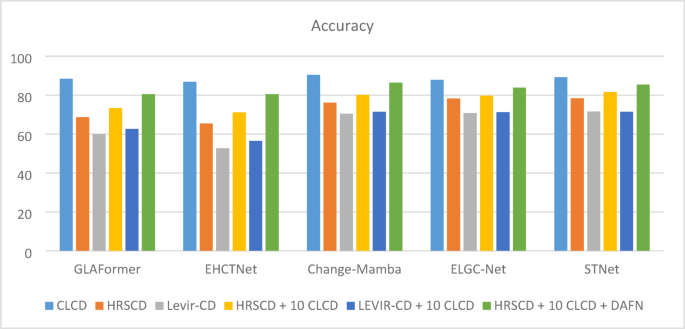
Accuracy comparison of five models under in-domain, cross-domain, and domain adaptation settings with and without DAFN.
Complementary qualitative results are presented in Fig. 4, which compares the predicted change maps from all models under in-domain, cross-domain, and domain-adapted conditions. The visual results confirm the quantitative findings: models trained in-domain produce the most accurate and spatially consistent predictions, while cross-domain models suffer from false alarms and missed detections. The integration of DAFN significantly refines boundary localization and suppresses background noise, resulting in change maps that are visually closer to the ground truth. Among the evaluated architectures, Change-Mamba2 and EHCTNet3 exhibit the clearest improvement after domain adaptation with DAFN, demonstrating enhanced stability and generalization across heterogeneous datasets.
Table 3 Quantitative comparison on CLCD target domain under different training settings. DAFN improves cross-domain performance across all models.Fig. 4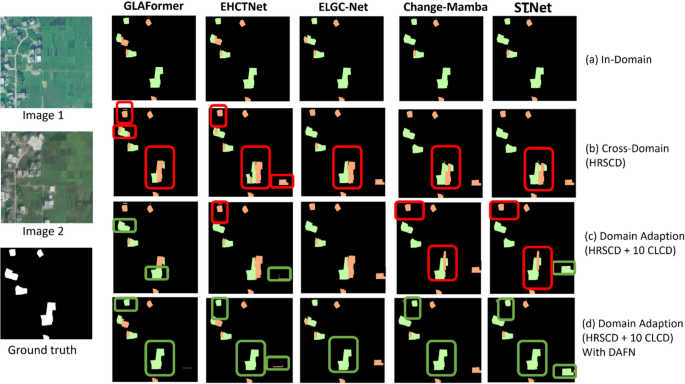
Qualitative comparison on the CLCD target dataset. Red boxes highlight false detections and boundary noise under cross-domain transfer, while green boxes show improved regions after applying DAFN with few-shot adaptation. Green regions denote correct detections, and orange/red regions indicate false detections. The input satellite imagery was obtained from the CLCD dataset40, introduced by Liu et al. (2022)
Second experiment (HRSCD as target domain)
The second set of experiments evaluates model generalization when HRSCD is used as the target domain. Table 4 reports the quantitative metrics in terms of IoU, F1 Score, Precision, and Recall, with and without Domain-Aware Feature Normalization (DAFN). The IoU columns show the performance before and after applying DAFN. For in-domain rows, F1 Score, Precision, and Recall correspond to the baseline in-domain model, while for cross-domain and adaptation rows they correspond to the DAFN-enhanced setting. For the 10-shot adaptation rows, IoU and F1 are reported as mean ± standard deviation over five random draws of the 10 labeled HRSCD samples using seeds 1–5. The target test set was kept fixed and unseen during adaptation.
In-domain training achieves the strongest results because the models are trained and evaluated on the same HRSCD distribution. Change-Mamba2 obtains the highest in-domain IoU of 93.91%, followed by STNet5 with 93.12%, ELGC-Net4 with 92.58%, GLAFormer1 with 92.40%, and EHCTNet3 with 91.60%. These results indicate that all models can effectively learn HRSCD-specific change patterns under the in-domain setting. As clarified in SectioinDatasets, these results correspond to the binary changed/unchanged HRSCD protocol using the official binary change labels, rather than to multi-class semantic change detection.
When the models are transferred from CLCD or LEVIR-CD to HRSCD, performance decreases because the source and target datasets differ in spatial coverage, scene scale, acquisition characteristics, radiometric appearance, and annotation style. For example, GLAFormer1 drops from 92.40% in the in-domain setting to 80.50% under CLCD → HRSCD and 74.20% under LEVIR-CD → HRSCD. EHCTNet3 shows a similar drop from 91.60% to 79.58% and 68.58%, respectively. The larger degradation from LEVIR-CD indicates a stronger domain discrepancy with HRSCD. DAFN improves cross-domain performance by reducing the mismatch between source and target feature statistics. Under CLCD → HRSCD, GLAFormer1 improves from 80.50% to 84.78%, EHCTNet3 from 79.58% to 85.48%, ELGC-Net4 from 86.48% to 90.58%, and STNet5] from 91.22% to 91.88%. The improvement is smaller for Change-Mamba, from 90.78% to 91.25%, because its baseline cross-domain performance is already high, leaving a smaller margin for improvement. Under LEVIR-CD → HRSCD, the gains are more noticeable for several models, such as Change-Mamba from 80.47% to 85.55% and ELGC-Net from 80.44% to 85.55%, which suggests that DAFN is more beneficial when the initial domain gap is larger.
The 10-shot adaptation setting further improves performance because the added HRSCD samples provide direct target-domain supervision. These samples help the models adjust their decision boundaries to HRSCD-specific appearance and annotation characteristics. When combined with DAFN, they also provide target-domain anchors for feature alignment. Change-Mamba2 achieves the highest adapted IoU of 92.60 ± 0.68% under the CLCD + 10 HRSCD + DAFN setting, approaching its in-domain performance. STNet5 also remains competitive, improving from 91.40 ± 0.86% to 91.55 ± 0.68% with DAFN. The repeated-draw analysis shows that DAFN also improves adaptation stability. Across the HRSCD target-domain adaptation rows, the IoU standard deviation is reduced by approximately 19.1% to 21.7%, indicating that the adapted models are less sensitive to the specific selection of the 10 labeled HRSCD samples.
From a comparative perspective, Change-Mamba2 achieves the best overall performance in the HRSCD target-domain experiment, obtaining the highest in-domain IoU of 93.91% and the highest adapted IoU of 92.60 ± 0.68%. STNet5 ranks second in the in-domain setting and remains competitive under cross-domain and 10-shot adaptation settings. Overall, the results demonstrate that DAFN improves cross-domain generalization and adaptation stability while preserving a realistic performance gap between cross-domain adaptation and in-domain training.
Figure 5 visualizes accuracy trends, showing that domain adaptation combined with DAFN minimizes the domain-shift gap across all models. Figure 6 presents qualitative examples: cross-domain models suffer from boundary noise and missed detections, while DAFN-enhanced and adapted models exhibit more coherent and accurate change maps. In particular, Change-Mamba retains fine-grained consistency across domains, and ELGC-Net achieves almost perfect visual alignment with the ground truth after domain adaptation + DAFN.
Table 4 Quantitative comparison on HRSCD target domain under different training settings. DAFN improves cross-domain performance across all models.Fig. 5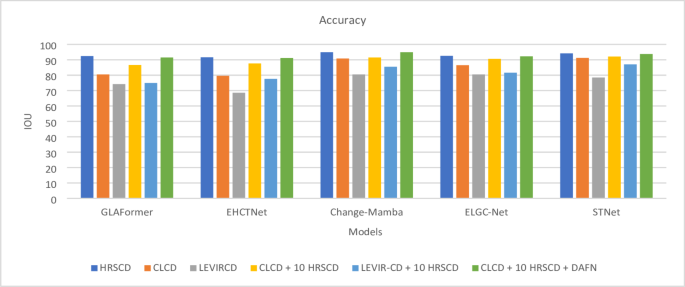
Accuracy comparison of five models under in-domain, cross-domain, and domain adaptation settings with and without DAFN.
Fig. 6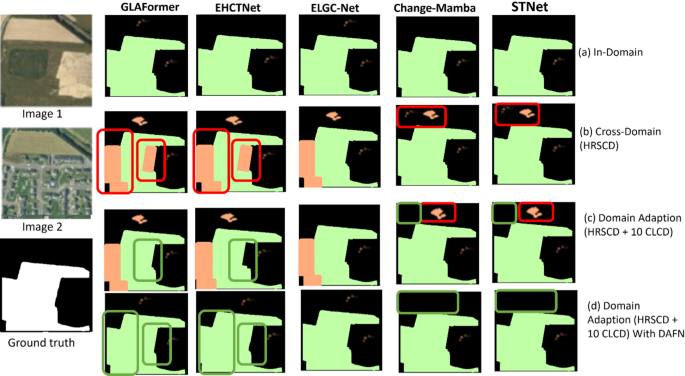
Qualitative comparison on the HRSCD target dataset. Red boxes highlight false detections and boundary noise under cross-domain transfer, while green boxes show improved regions after applying DAFN with few-shot adaptation. Green regions denote correct detections, and orange/red regions indicate false detections. Input aerial imagery was obtained from the HRSCD dataset39, based on IGN BD ORTHO® imagery.
Ablation study and baseline comparison
To better isolate the contribution of the proposed DAFN module, we conducted an additional ablation and baseline-comparison study. The purpose of this experiment is to determine whether the observed performance gains come from DAFN itself, or whether similar improvements can be achieved using existing domain-alignment strategies such as batch-normalization adaptation, instance-normalization-based change detection44, or adversarial feature alignment.
Accordingly, we compare DAFN against three representative and closely related baselines: AdaBN41, which adapts batch-normalization statistics using target-domain data; CrossCDNet by Song et al.32, which represents an instance-normalization-based cross-domain change detection model; and a DANN-style adversarial feature-alignment baseline42.
The comparison is conducted under the same source-target settings using Change-Mamba and STNet as representative backbone architectures. These two models were selected because they show strong performance in the main experiments and represent different architectural desig.
ns, allowing us to examine whether the benefit of DAFN is consistent across different model families. The comparison was performed on the main cross-domain source–target settings, CLCD → HRSCD and HRSCD → CLCD. These two settings were selected because they represent the primary domain-shift scenario studied in this work and include clear differences in spatial resolution, scene scale, sensor/acquisition characteristics, spectral/radiometric appearance, and annotation style. In addition, we include source-only/basic preprocessing and full-preprocessing-only settings to separate the effect of the preprocessing pipeline from the effect of the proposed domain-aware feature normalization. The source-only/basic-preprocessing setting refers to the minimum preprocessing required to make the datasets compatible with the model input format. This includes image-pair and mask integrity checking, binary-mask validation, input-size resizing or cropping when required, and pixel-value normalization. It does not include domain-alignment preprocessing steps such as GSD rescaling, pixel-spacing harmonization, or histogram matching. In contrast, the full-preprocessing setting applies to the complete preprocessing pipeline described in Section Preprocessing and Dataset Alignment, including GSD normalization and histogram matching.
AdaBN41 baseline. The source-trained model was first trained using the same training protocol as the full-preprocessing baseline. During adaptation, the model weights were frozen, and only the running mean and running variance of the existing BatchNorm layers were updated using target-domain training/adaptation samples. The target test set was not used during this process. The adapted model was then directly evaluated on the target test set.
For instance-normalization-based comparison, we used CrossCDNet proposed by Song et al.32 as a representative IN-based cross-domain change detection method. CrossCDNet was trained and evaluated under the same source–target settings and evaluation protocol used in our experiments. Since CrossCDNet is a standalone architecture rather than a plug-in module applied to Change-Mamba or STNet, its ΔIoU relative to the full-preprocessing backbone is reported as N/A.
For the adversarial baseline42, a domain discriminator was added to the feature representation extracted by the backbone. The backbone was optimized using the change detection loss, while the discriminator was trained to distinguish source-domain features from target-domain features. Through adversarial training, the feature extractor was encouraged to produce more domain-invariant representations. The same source–target splits and target test set were used for evaluation.
Table 5 presents the additional ablation and baseline-comparison results. The results show that full preprocessing improves the source-only baseline in most cases, confirming that preprocessing reduces part of the domain gap. This improvement is mainly due to the reduction of low-level geometric and radiometric differences through GSD normalization and histogram matching. However, preprocessing alone is not sufficient to fully address cross-domain degradation, because it does not explicitly align the learned feature distributions between the source and target domains.
Compared with the full-preprocessing baseline, AdaBN provides only limited and sometimes inconsistent gains. This is particularly clear for Change-Mamba in the HRSCD → CLCD setting, where AdaBN slightly decreases IoU from 77.25% to 76.21%. This limited effect can be explained by the normalization design of Change-Mamba in our implementation. Since the model is primarily based on Mamba/VMamba-style blocks and contains only limited BatchNorm layers in the main adaptation path, AdaBN has only a small number of normalization statistics to update. Since AdaBN can only update the running statistics of existing BatchNorm layers, its ability to modify the feature distribution of Change-Mamba is limited. This highlights an important limitation of BN-statistics adaptation methods: their effectiveness depends on the presence and placement of BatchNorm layers in the backbone. In contrast, STNet benefits more from AdaBN, improving from 91.22% to 91.74% in CLCD → HRSCD and from 78.45% to 78.84% in HRSCD → CLCD. This suggests that AdaBN can be useful when the architecture contains normalization layers that are more directly involved in the transferable feature path, but its effect remains architecture dependent.
The adversarial feature-alignment baseline achieves larger improvements than AdaBN in both directions, especially in the more challenging HRSCD → CLCD setting. For example, Change-Mamba improves from 77.25% to 78.15%, while STNet improves from 78.45% to 80.15%. This is because adversarial alignment directly encourages source and target features to become less distinguishable, instead of only updating normalization statistics. However, its gains remain lower than those of DAFN, which suggests that global adversarial alignment may not be sufficient to preserve change-discriminative information while reducing domain discrepancy.
DAFN achieves the strongest improvement among the plug-in alignment strategies. For Change-Mamba, DAFN improves IoU from 90.78% to 91.25% in CLCD → HRSCD and from 77.25% to 80.58% in HRSCD → CLCD. For STNet, DAFN improves IoU from 91.22% to 91.88% and from 78.45% to 83.10% in the two directions, respectively. The gains are smaller in CLCD → HRSCD because the full-preprocessing baseline is already strong, leaving less room for improvement. In contrast, the gains are larger in HRSCD → CLCD, where the initial cross-domain gap is more pronounced. These results indicate that DAFN provides additional benefits beyond preprocessing, AdaBN, and adversarial alignment by explicitly aligning source and target feature statistics at the feature level.
CrossCDNet32, as an instance-normalization-based standalone model, achieves competitive performance. In the HRSCD → CLCD setting, it slightly outperforms Change-Mamba + DAFN, reaching 80.98% IoU compared with 80.58%. However, STNet + DAFN achieves the best result in this direction with 83.10% IoU, outperforming CrossCDNet by 2.12%. This indicates that, although CrossCDNet is a strong standalone baseline, DAFN can achieve stronger performance when integrated with a more effective backbone. It also supports the advantage of DAFN as a plug-in alignment module rather than a fixed architecture-specific solution.
Overall, the ablation results indicate that the improvements are not solely caused by preprocessing or generic normalization adaptation. Instead, DAFN consistently provides stronger feature-level adaptation than AdaBN and achieves competitive or superior performance compared with adversarial alignment and the instance-normalization-based CrossCDNet baseline.
Table 5 Ablation study and baseline comparison for evaluating the contribution of DAFN under cross-domain change detection settings. The best result in each source–target setting is highlighted in bold and italic.