
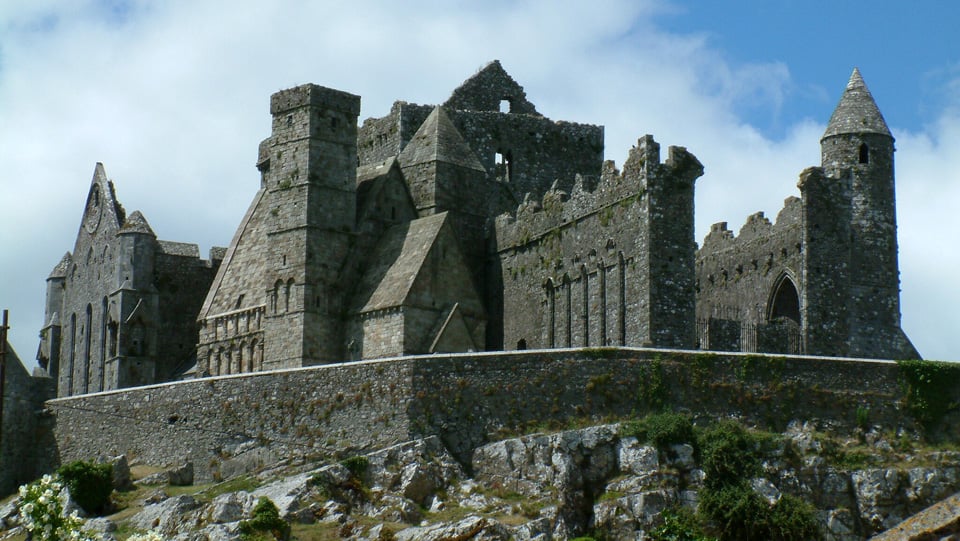
The Irish government announced last year that it intends to participate in The Year of the Normans – People of Europe in 2027 – a year-long event that will celebrate and commemorate Norman culture and the 1,000th anniversary of the birth of William the Conqueror.
However, how can the Irish government celebrate and commemorate Norman culture and England’s first Norman king – when there were never Normans in Ireland?
The term ‘Norman’ within an Irish context is, at best, historically inaccurate and, at worst, one of the greatest distortions in Irish history.
According to historians and primary sources, the ‘Normans’ in Ireland never self-identified as ‘Norman’.
The ‘Normans’ in Ireland self-identified as ‘English’.
In an Irish Times article from last year, Professor Seán Duffy of Trinity College stated: ‘The problem with painting everyone with the “Norman” brush is that many of those who began arriving in Ireland in the late 1160s had probably never set foot in Normandy’. Duffy later added: ‘The reality is that – whatever their direct or indirect links to the actual Normans of Normandy – most of those who settled in Ireland after 1169 came either from England or Anglo-Norman settlements in Wales’.
Duffy emphasised that: ‘Almost without exception – whenever any of the so-called Normans who came to Ireland refer to themselves, they call themselves not Norman but English’.
Other historians quoted in this article, such as Brendan Smith, professor of medieval history at the University of Bristol, and Sparky Booker, assistant professor in medieval Irish history at Trinity College Dublin, also identified the ‘Normans’ in Ireland as ‘English’.
Two key primary sources that support the identification of the ‘Normans’ as ‘English’ are Gerald of Wales’s Expugnatio Hibernica (c. 1189), which repeatedly identifies the invaders as Angli (‘English’) and records Maurice FitzGerald as saying, ‘we are English to the Irish’, and the Old French poem The Song of Dermot and the Earl (c. 1230), which also repeatedly uses the term Engleis (‘English’).
The blanket use of the term ‘Norman’ in Ireland only emerged in the 19th century, when the Norman misnomer was applied retrospectively. For centuries, the ‘Normans’ in Ireland were commonly described as ‘English’. Duffy attributes this shift from ‘English’ to ‘Norman’ to two reasons: ‘One is the extraordinary popularity of Sir Walter Scott’s novel Ivanhoe (1819) which practically invented the myth of the Normans and made the Normans “sexy”. The second reason is less benign and had to do with Anglo-Irish relations’.
Rather than being painted with the broadest brush of ‘Norman’, as Duffy highlighted, or with the broad, yet more accurate brushes of ‘Anglo-Norman’ and ‘Cambro-Norman’, the first invading ‘Normans’ who self-identified as ‘English’ in Ireland should be historically called ‘The First English’.
The Norman descent of many of the First English, whose family origins can be traced to Normandy, is undeniable. However, it is equally undeniable that they self-identified as ‘English’ and that many were several generations removed from Normandy. The Norman descent of the First English presents only part of their history. The fact that they self-identified as ‘English’ rather than ‘Norman’ represents the other crucial part.
Four reasons form the cornerstone of the term ‘The First English’:
The First English in Ireland did not self-identify as Norman, Anglo-Norman, or Cambro-Norman – they self-identified as ‘English’.
The First English in Ireland pledged their political allegiance and loyalty to the English crown and had cultural and familial ties to England.
The First English in Ireland introduced and enforced English common law and the English feudal system in Ireland. Many were likely bilingual in French and English, while their armies included English-speaking soldiers who brought the English language and English customs to Ireland.
Many of the First English in Ireland intermarried with elite members of Gaelic dynasties and, over time, Gaelicised, while their descendants were later known as the ‘English of Ireland’ and the ‘Old English’.
The term ‘The First English’ is not ahistorical. It works within the historical framework, both linguistically and culturally, reflecting how their self-identity as ‘English’ developed in Ireland. The First English left a monumental mark when they invaded Ireland in 1169. By self-identifying as ‘English’, they forged a direct historical link to English presence in Ireland. In A New History of Ireland (2008), historian Christine Kinealy observes that 1169 began ‘the long political entanglement between Ireland and England’.
The First English invasion of Ireland, with the likes of Strongbow (a distant cousin of the Conqueror), fanned the flames that would forge the second linked invasion: the invasion of Ireland in 1171 by the Conqueror’s great-grandson, Henry II, king of England. Henry II’s invasion followed the English pope Adrian IV’s Laudabiliter (c. 1155), which appears to have authorised Henry II’s invasion of Ireland.
In order for the Irish government to celebrate and commemorate ‘Norman’ culture in Ireland during The Year of the Normans – People of Europe in 2027, there must have been ‘Normans’ in Ireland, but as Smith remarked, ‘Not a Norman in sight in Ireland in 1169’.
Three questions for Irish historians to reflect on:
Should we continue calling a nearly 900-year-old ‘English’ spade a ‘Norman’ spade?
Can we point out that an older part of the ‘English’ spade was once partly ‘Norman’ while still respecting the ‘English’ spade?
If we respect how people identify themselves today, should we not also respect how they identified themselves in the past – and call a spade a spade?
Éamon Ó Caoineachán is a poet, writer and historian from Bundoran, Co Donegal. He is a PhD postgraduate in Arts at Mary Immaculate College in Limerick