
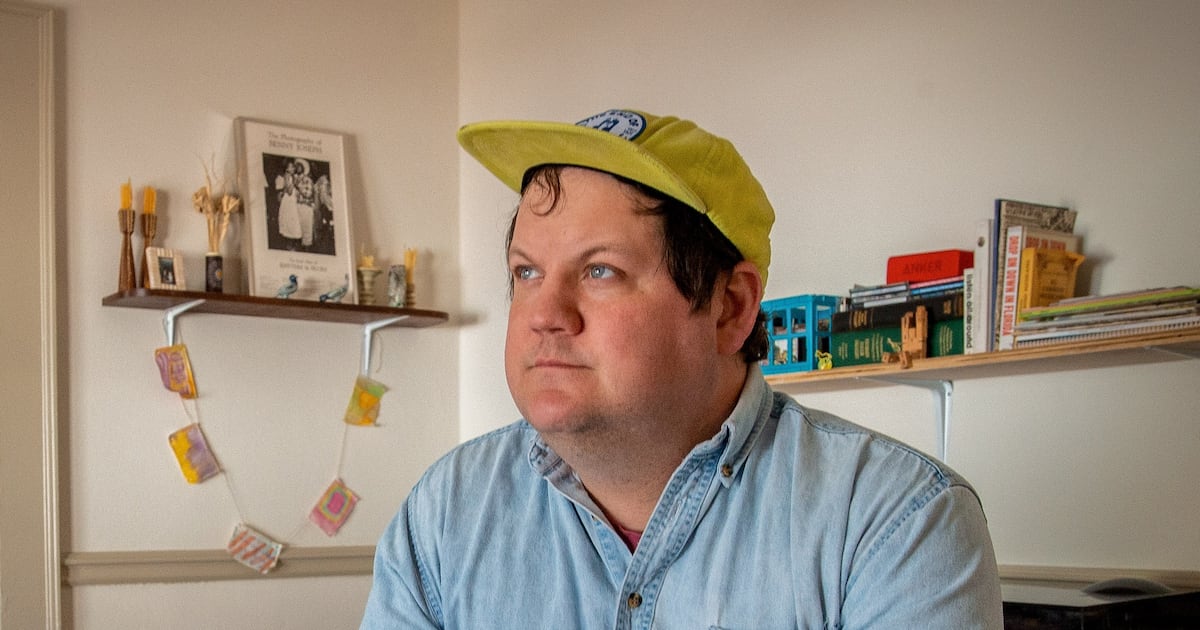
Every so often, when the mood takes him, Jake Xerxes Fussell will grab his guitar and travel backwards through time.
“You can go back to ancient folk songs that are hundreds of years old, and you can find themes in there that are still the stuff that we’re singing about now,” the singer says as sunshine streams into his office in his home in Durham, in North Carolina.
Fussell is a songwriter, but he is also a time traveller, a musical Indiana Jones recovering largely forgotten relics and introducing his discoveries to audiences who would otherwise never have encountered them.
He isn’t an academic, and he rejects terms such as “folklorist”, yet over the course of his career he has become a category of one: a singer with two feet in the past and his head in the present.
He presses onwards with that mission on his charming new album, The Old Beloved Path, a homespun collection of folk that revitalises music that has lain dormant for decades, if not centuries.
One striking example is Boney, which has its origins as a maritime work song, a “short drag” shanty associated with the age of sail, and which he revives as a fingerpicking blues track – think Dire Straits by way of a Ken Burns American civil war documentary.
It’s an extraordinary act of preservation, but it is also a song about missing home and about a war that consumed everything in its path – even Napoleon in the end (“Boney broke his heart and died / way in St Helena”).
That humanity is where Fussell finds the crucial connection. These songs, he says, are about all the big themes. “I find that I relate to a lot of songs that are quite old.”
Napoleonic sea shanties are nobody’s idea of mainstream entertainment but there turns out to be an enthusiastic audience for this kind of music, and critics have swooned over Fussell’s sonic reclamation. Pitchfork has heralded his talent for finding “ingenious ways to pull old obscurities into the anxious present”, while Spin has praised his “knack for unexpectedly astute arrangements”, saying, “The music of old, weird America has never sounded so spry”.
Fussell wears this praise lightly. He has the affable, ambling quality of someone who knows when to hurry and when to slow down. He’ll be doing a bit of both this month as he crosses the Atlantic for a short Irish tour.
It will be a homecoming, in a certain sense. The connection between Irish and American traditional music is long established, and Fussell has swapped notes with artists on this side of the ocean such as Lankum, to whom he was introduced after a show at Bello Bar in Dublin.
His interest in Irish folk extends to the Traveller singer Thomas McCarthy, through whom he discovered the ballad Michael Was Hearty, about a young man who marries for wealth rather than love and comes to rue his decision.
Fussell was introduced to the tune by Nathan Salsburg, curator of the archive of the 20th-century ethnomusicologist Alan Lomax, and instantly understood that he had to record his own take, which he did in 2019. He adds that he and McCarthy have yet to cross paths, but he would love for them to one day play together.
“I want to meet him. At some point we were in contact, we wanted to do a show together. It just didn’t pan out. I think we were going to do [it] and then Covid happened.
“Nathan Salsburg sent me a video of Thomas McCarthy singing that song. I thought it was the most beautiful thing I’d ever seen. I had the melody kicking around in my head for a long time.
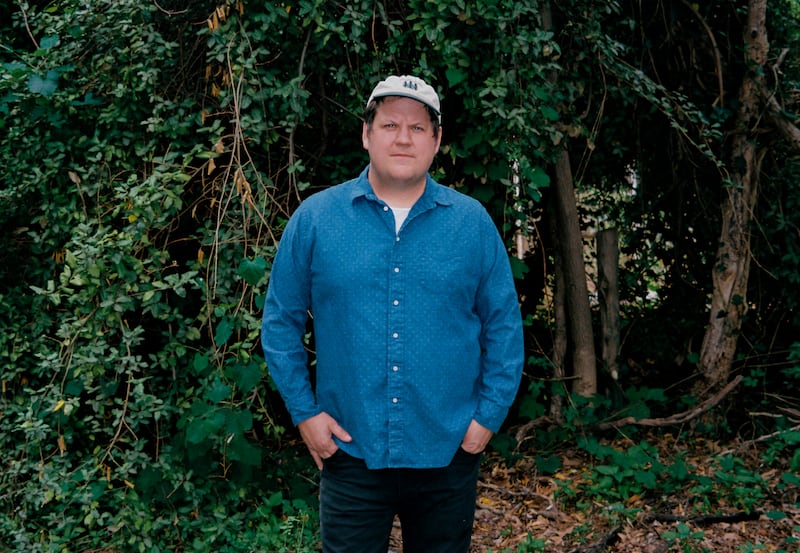 Jake Xerxes Fussell. Photograph: Paige Prather
“Irish music is such a thing. And I’m not Irish. It wouldn’t normally be something I’d try to fool with that much, to re-create an Irish song. That one I couldn’t get rid of. I’ve played it in Ireland a few times, and it’s been well received.”
Folk music has a long history of activism; the question of whether politics and the arts should mix has acquired a fresh relevancy since Macklemore was chucked off Ed Sheeran’s tour after speaking out about Gaza.
This interview takes place before that incident galvanised opinions, but, speaking more generally, Fussell has a nuanced take on folk and its affiliations. He is certainly versed in the history.
“There’s a big tradition of that going back at least until the 1930s and 1940s, if not earlier. There was a first big wave of protest singing with people like Woody Guthrie, Pete Seeger and The Almanac Singers, and that sort of early folk revival of the 1930s,” he says.
“Then there was sort of a revival of that revival in the 1950s and 1960s, mostly in New York and Boston, which of course led to Bob Dylan, Joan Baez and those people. And singers like Phil Ochs, who were deeply political, and then people like Dylan, who could skim along the surface of those sort of topical songs but weren’t necessarily in their personal lives deeply political.
“There’s a long legacy of that. It’s always been around. You see it crop up here and there with different singers. Certainly, there’s an association there with the left wing for a long time.”
Does Fussell see himself in that tradition? “I definitely relate to it, and at different times I have sung songs that have been topical in that way. I have mixed feelings about it, because I don’t necessarily see music as having an immediate material application to geopolitical problems.
“There’s something to be said for people having a big benefit concert, when they raise a bunch of money for a cause. That’s a very material way of applying music or performance. Or at least giving attention to a cause.
“I also see a lot of strength in songs that can bring attention or have a transformative effect on someone on an individual level; certain protest songs can do that.”
He isn’t sure whether music itself can change things, however. “I don’t necessarily delve into that world too much, just because I feel like it isn’t the best use of my time in music.”
Fussell is looking forward to returning to Ireland; he sees an affinity between Irish people and those from the American South. Growing up in Georgia, close to the border with Alabama, he had an “acute awareness” of his southernness and the assumptions people would make about, for instance, racism.
“Especially when I travelled outside of the region, and people would comment on my accent a lot of the time. I never took that as an insult. It’s more sometimes ‘otherised’, in a way. ‘Oh, you have an accent.’ When, in fact, everybody has an accent.”
He’ll bring a little bit of the south with him when he comes to Ireland, singing songs steeped in the American past but brought to life with a passion that locates them firmly in the here and now.
“It’s a lot of the same basic stuff – about life and death and love and relationships and family, loss,” he says. As he pauses to smile you can hear a bird twitter outside. “It’s all sorts of things.”
The Old Beloved Path is released on Bandcamp and via Fat Possum Records. Jake Xerxes Fussell plays Cyprus Avenue, Cork, on Thursday, October 8th; Róisín Dubh, Galway, on Friday, October 9th; and Button Factory, Dublin, on Saturday, October 10th