
Back in 2000, a new phenomenon was about to break. Playing digital puppet master to families of virtual characters, The Sims gave you god-like control over every aspect of their lives. There was no finish line to cross or goal to achieve; you just had to tend to their needs – or not, should the mood take you – and occasionally try to stop them from burning down the house or getting trapped in the pool.
It spawned a host of follow-ups and expansion packs, from parties and holidays to magical new abilities and career paths. And it’s still going: The Sims and its follow-ups have sold more than 200 million copies.
More than a quarter of a century later, the low-stakes gaming genre has exploded in popularity, particularly since Covid lockdowns turned unlikely people into gamers.
Perhaps you’ve taken up tending digital crops, found yourself power-washing a digitally rendered fire engine until it gleams or raising a small family of colourful cartoon creatures. If so, congratulations: you are officially part of the cosy-gaming movement.
Forget about high-octane battles, car chases and climbing the leader boards via fast reflexes; cosy gaming is all about relaxation, creativity and mindfulness. You can make coffee, decorate homes, grow plants, organise fridges and lunch boxes, oversee an island and solve puzzles.
“Your mind is always trying to be busy,” says Brendan Rooney, director of the media and entertainment psychology lab in University College Dublin’s school of psychology.
“The right busy is when it’s not overly stimulating, not overly challenging but can give your mind something to do, almost like a treadmill or chewing gum, something like a rocking chair for the mind. It keeps us busy, but in a low-effort way.
“Those patterns can be fashionable or marketed, but they can also be about what people need as well.”
The growth of the cosy genre has also expanded what it means to be a gamer. Forget about the (misleading) stereotype of gamers as largely teenage boys. “I think the average age of a gamer is much higher than people expect,” Rooney says. “There’s a huge number of female gamers compared to people’s estimations of how many women are playing games. And that’s because games are now so broad.”
A quick look at the numbers shows exactly how popular it has become. Nintendo’s Animal Crossing: New Horizons set digital sales records when it launched in 2020, selling between 44 and 50 million copies. The farm-simulation game Stardew Valley has sold more than 50 million copies across console, PC and mobile platforms.
In 2020 the games platform Steam had just 19 titles tagged as cosy games; a search for the cosy tag today will turn up thousands.
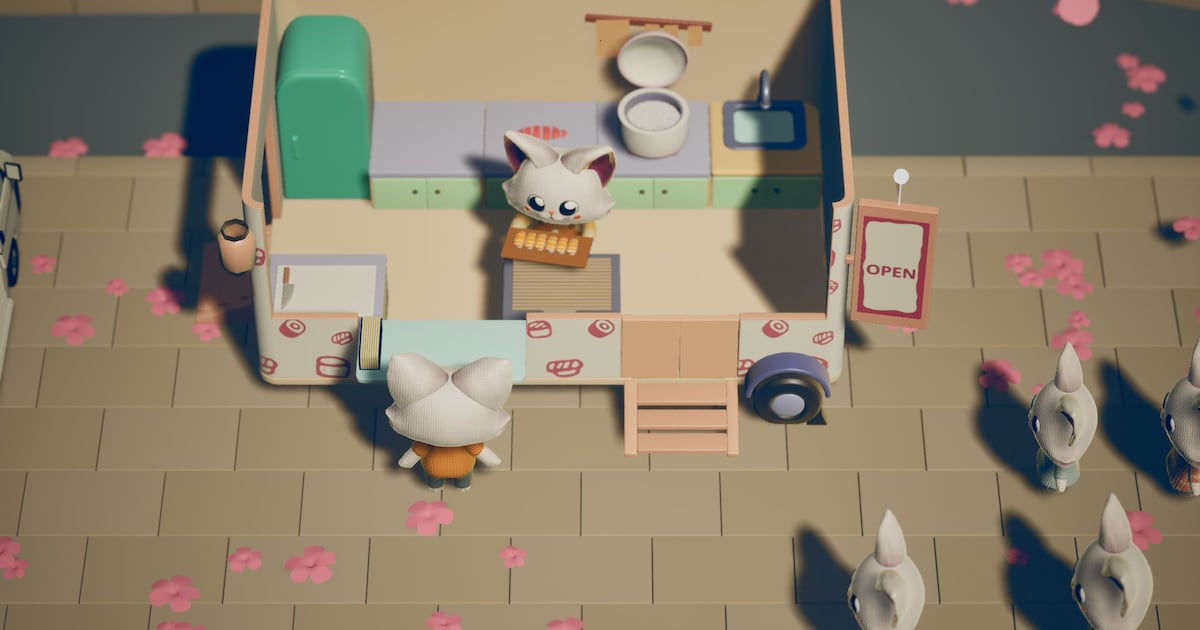
It’s a market that Neil O’Sullivan Greene, an Irish games developer, is hoping to tap into. Greene Rapture, his Cork-based development company, is preparing to launch Sushi on Wheels, a cosy management game that sees players inherit their grandmother’s sushi truck on Japan’s Izu Peninsula.
Players must build the business, serving customers and upgrading the truck as they go, with the ultimate goal of opening a permanent restaurant – something the recently deceased grandmother never got to achieve.
Greene was inspired to create the game after spending six months living in Tokyo and travelling around the Izu Peninsula. “I thought it had a huge character that I hadn’t seen in a place before, and I thought it would be a really interesting setting for the game.”
He had originally been considering a horror game based on Celtic mythology. “I was going to be looking at this every single day for a while, and how enjoyable is it to make something with loads of gross monsters versus making the funnest, cutest animations?
“Also, I thought, do I want to make something that also brings fear and anxiety into the community of people that play games in a time when there’s so much of that around anyway, or do I want to make something that’s comforting and provide some escapism?
“I went for that at the end, because I just felt it was better for me and maybe for the people I was making it for.”
Sushi on Wheels can be as stressful or as stress-free as the player chooses. “For the most part it’s just ‘I’m going to be a nice cute cat, travelling around, trying to grow a little food-truck business at a nice pace and meet nice characters. Which sounds to me like a more comfortable experience that you want to play for a while longer.”
Greene Rapture isn’t the only Irish developer that has recognised the potential for the growing genre. Beyond the Bark, which is based in Limerick, found a cult online following with Éalú, its handcrafted stop-motion game starring a wooden mouse.
The idea came about following Ivan Fisher-Owen’s work with the musician Will Wood on the Tomcat Disposables video. Fisher-Owen wanted to give the mouse a better ending than falling through darkness. He considered creating a stop-motion short film for TikTok, encouraging audience participation in a sort of choose-your-own-adventure, but decided against it.
“I’m not really on social media much other than for business purposes,” he says. “I was taking a look at TikTok as an application, and it really disturbed me – not so much the content but the way in which content was presented and the algorithm was driving it,” he says. “I realised I had no idea how any of this works and I felt like I’m also in a maze.”
Fisher-Owen approached a friend who knew about coding with the idea to use stop motion as the medium. “We could tell this story, create something that is centred around the themes of algorithmic loops and the potential for them to be self-destructive, but also for there to be a way to avoid and escape them, and have a lovely time and turn that into a silent narrative.”
About 18,000 photographs and 1,200 hours of work later, Fisher-Owen – along with Wood, the programmer Benjamin Orr and the illustrator JT Paton – had Éalú. He wanted it to be photorealistic, with all the lighting, shadows and surface reflections recreated perfectly. Relying on high-tech shortcuts wasn’t an option.
“We didn’t have access to that nor the skills required to do that kind of 3D design. The only way to do it was to literally animate everything with the mouse in situ,” he says.
Part of what Fisher-Owen was trying to create was the childhood experience of playing Myst, a game published in 1993.
“It is a piece of art,” he says. “I have these memories of sitting with my sister; we’d have a notebook and a pencil, and as we tried to figure out and solve that game together, we would be taking notes and writing things down and talking to each other. I wanted to recreate that kind of experience in a modern context.”
The reactions from players suggests the team has managed to achieve that. “There were some people that would sit down and play it together and chat with each other about how to solve the puzzles,” Fisher-Owen says.
“The game responds to the way that you play it, essentially. What we’re hoping is that for a lot of people it would create a feeling of cosiness and relaxation but also just the slightest bit of mystery.”
[ Struggling to get your children off Fortnite? There’s a reason for thatOpens in new window ]
Research into cosy gaming conducted by Sago across the US, UK, France, Spain and Germany last year found that more than half of players were looking for stress relief, using the games as a way to switch off from anxiety.
Rooney says using gaming as a coping mechanism isn’t negative in itself; it’s about doing it healthily.
“If we continue to do it from a place of ‘I can’t cope’, ‘I don’t want to think; things are too much,’ ‘I’m going to get lost in this game’ or this music or this TV show, then we’re training ourselves to not regulate our own emotions or look after ourselves,” he says.
“What we need is a diverse range of strategies, coping mechanisms, activities that we can engage in for pleasure so that if we need to calm down we can do some cosy gaming – or if we need to motivate ourselves, maybe we’ll use upbeat music. It’s about diversity and choice. If we’ve no diversity, then our agency is gone as well.”