
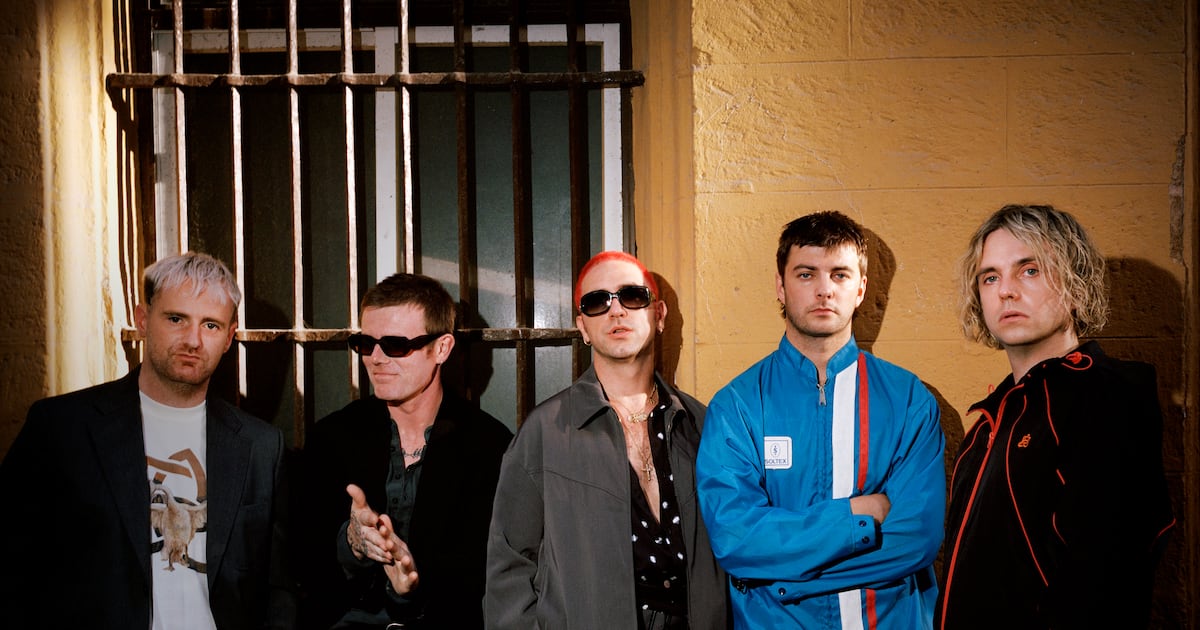
Fontaines DC have no issue declaring their insularity as a band. Their capacity to create, they say, is down to the fact that their main artistic connections are between one another, as well as to a work ethic they’ve had ever since they formed in Dublin more than a decade ago.
But insularity doesn’t mean they’re closed to the existential questions of our time. The scope of Dopamine Chamber, their new album, tells us so.
Its predecessor, Romance, won the Choice Music Prize and was nominated for the Mercury Prize and two Grammys. It brought an aesthetic shift and a demanding touring schedule. One might think Fontaines DC were due a break. But that’s not how they operate.
The new album, their fifth in seven years, is arguably their finest. Previously bathed in the neon of Romance, the band return filtered through the cold blue tones of an LP that articulates the oppressive nature of our age – its anxieties, uncertainties and sense of tipping points – through smashing guitars, sweeping strings, wonderfully coloured synths and songs that speak to a band dropping a pin in a glitching map, with new territory loading in real time.
Thematically, it touches on artificial-intelligence scepticism, the residue of crumbling European grandeur, hedonism, climate anxiety and despondency. The band’s lead singer, Grian Chatten, says Dopamine Chamber needed to be a “catastrophic warning”.
Impeccably sung and played, it is also, in its scale and ambition, made for enormous crowds. With production from James Ford and engineering led by Marta Salogni, Fontaines DC have made an album on which avant-garde textures sit happily alongside stadium-sized gestures.
Conor Deegan III, the band’s bassist, and Tom Coll, their drummer, are in New York when we talk. They’re in the city to prepare for a US festival with some of the biggest rock bands around: The Strokes, Turnstile, Geese.
Fontaines DC are a rock band too, of course, but much will likely be made of the way this album, inky with synths, stretches the limits of such categorisation.
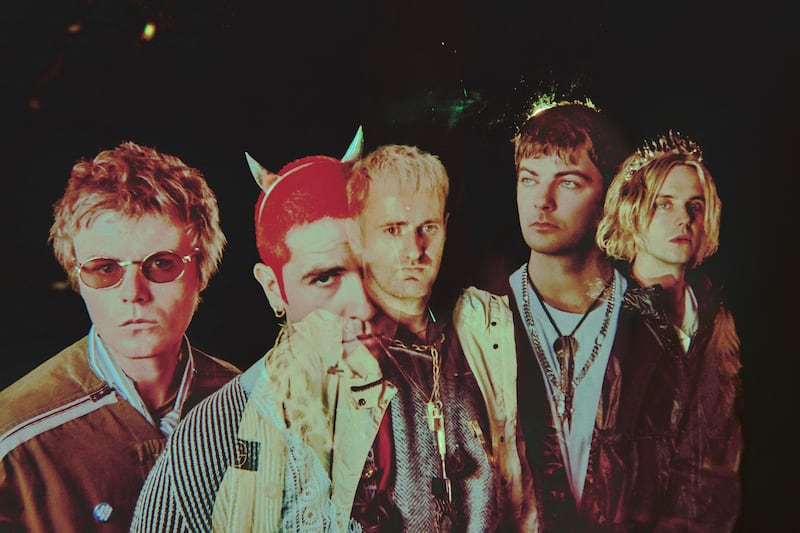 Fontaines DC. Photograph: Elizaveta Porodina
“It’s trying to mix a lot of different things together that seem like they don’t make sense together on paper, or that they’re conflicting,” Deegan says.
“But in actual fact, they really well describe what it feels like to be in this moment in time. You can doomscroll while sitting at the Parthenon. Do you know what I mean?”
Before Romance, Deegan says, their development process was “very much of The Rolling Stones’ world: if you can’t play it with your hands and sing it with your voices all at once, you’re not doing it”.
Fontaines now have a different approach. Having come off tour in the early autumn of 2025, the band spent a month apart. “When you’re so institutionalised with seeing each other every day, a month felt like a f**king year,” Coll says.
When they reconvened, they spent three months together in a studio in London, developing the album’s sound and recording demos, Deegan says, like “a group of mad scientists in the lab, with all the equipment and tools at our disposal, trying to find sounds”.
“Everyone was really firing,” Coll says. “It’s always interesting trying to break new sonic palettes. Sometimes you want to go too far, and then rein it back a bit. I found that process amazing.”
As they set about “trying to figure out how we were all feeling about the world, about our environment”, as Deegan puts it, they were also attempting to discover what “the spark for this new collection of work” would be.
It turned out to be Six Shot Morning, the album’s opening track. Its pulsating machine heartbeat underpins a sense of teetering on a precipice. Two songs later, on Mimesis – potentially the best pop song the band have made – Chatten captures the album’s duality, sunnily singing, “Well, everybody’s depressed / We’re running on a wheel.”
“There’s a lot of anxiety as well that we’re experiencing and people are experiencing,” Deegan says of the album’s themes. “A lack of hope. Disconnection. Everyone is looking for something to escape into and make themselves feel better.”
The work of the French sociologist Bruno Latour was a touchstone.
“There’s this great book. It’s called Où Suis-Je? – Where Am I?,” Deegan says. “Our friend Nikolaj Schultz was working underneath [Latour]. He has this great line in it: ‘The moon is the only thing in nature I can look upon without guilt.’
“That’s a very powerful and haunting line, and it’s very true. We look at rivers, we look at trees, and we feel guilty for what we’ve been doing to the natural world.
“The moon is this kind of thing, a celestial body, we could look at and feel okay.”
Yet when the band were recording the album in the English countryside and looking at stars in a night sky free from the light pollution of London, “we were realising a lot of them were satellites”.
“It was this reminder that we can’t even look into the night sky and look at these celestial bodies any more without feeling some kind of guilt – how much we have disturbed even space.”
The closing lyrics of Mimesis come to mind: “If you’re a star, show me / If you’re not, let me be.”
The “innate claustrophobia to the modern world”, as Deegan puts it – “ironically because of the amount of connection we have to everyone else, and the amount of information we have” – is fundamental to the album.
“This big window we have to the outer world in our pocket, everywhere we go, somehow makes everywhere much more claustrophobic.”
Chatten travelled around Europe to write his lyrics, stopping in Vienna to visit the Sigmund Freud Museum, viewing work by Egon Schiele and Gustav Klimt at the Leopold Museum and reading Arthur Schnitzler’s Dream Story, the novella from which Stanley Kubrick made his film Eyes Wide Shut.
But Venice, the band say, is the album’s defining metaphor. Chatten wrote lyrics there before recording them in Palermo, in Sicily. He was also obsessively listening to the mid-20th-century Italian singer Mina.
A pair of remarkable songs anchor the album. The first, One Man, contains the album’s title in a track bookended by the sounds of children playing football outside Palermo cathedral: “Dopamine chamber, just tryna kill the pain / you can’t escape the feeling once you’ve given it a name.”
The second, Where Is Gone?, is a sweeping ballad featuring the Spanish star Rosalía. “That’s my favourite song on the record,” Deegan says. “I think that’s something really special Grian came up with.
“He was having this bit of a thing where he was uncontactable for a week, and we were just kind of hearing snippets from the friends he was with that he was in Europe.”
When a voice note arrived from Chatten about Where Is Gone?, Deegan thought it was “crazy good”.
The band is effusive about Rosalía. “We’ve respected her music for years,” Deegan says. Coll and Carlos O’Connell, the band’s guitar and synth player, went to one of the Catalan singer’s concerts last year.
“It was a dance piece, a theatre piece, an orchestra pit in the middle. The visual work, the camerawork – amazing,” Coll says.
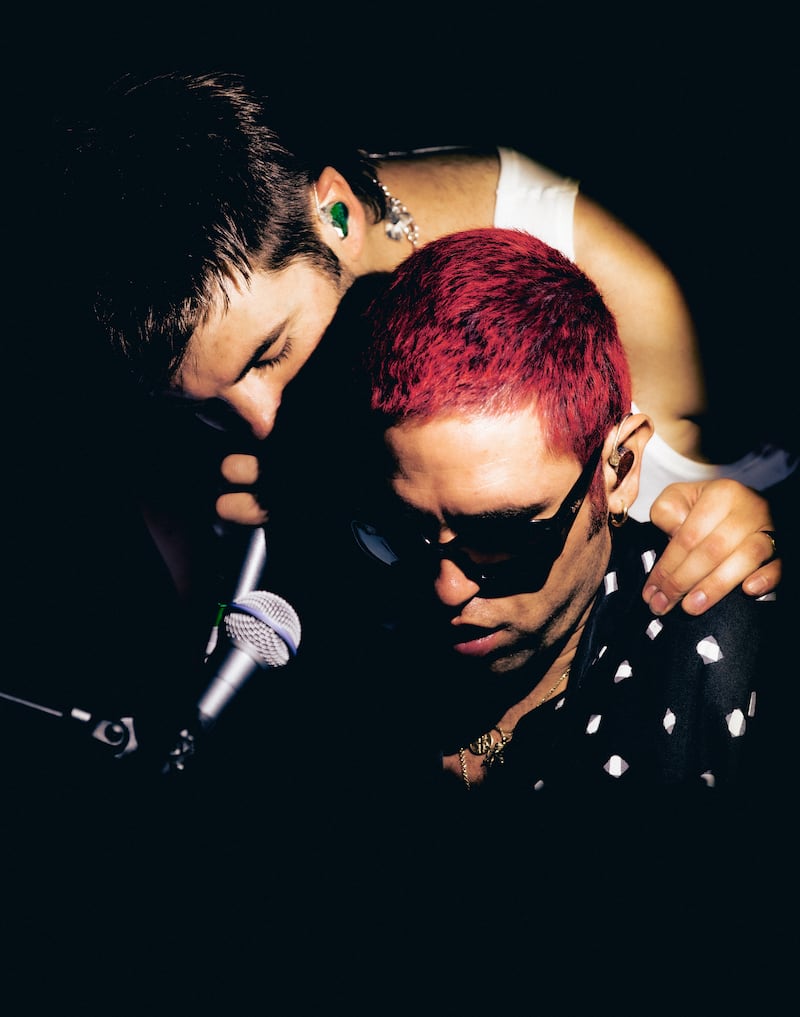 Fontaines DC: Grian Chatten and Carlos O’Connell during the band’s performance at Leeds Festival in August. Photograph: Charlie Barclay Harris
Where Is Gone? makes Deegan think of the Ingmar Bergman film Wild Strawberries and of Proust’s madeleine – “or, if you want to be less pretentious about it, the ratatouille in Ratatouille”.
The song poses an existential question, he says.
“We are spinning out so much now, we don’t even know where we’re going to end up, and not just where we’re going to end up but what that’s going to look like.”
Fontaines DC have always been committed artists. “We started with a really high work ethic,” Deegan says. “We really did spend five days a week in that rehearsal room when we were starting off.”
Then, as their profile grew, they took on twice as many summer bookings as before. “That set a standard of busyness,” Deegan says. “So when we were releasing an album or two – recording two albums in a year, like we did with Dogrel and Hero’s Death – we didn’t notice. Also, we didn’t know any different straight into the music industry.”
Since then, he says, their insularity has been their strength. “We’ve just been ticking along, not watching what anyone else has been doing too much, not doing too much comparison, just doing our own thing. We have our goals of what we want to achieve, and we know what we have to do to do them.”
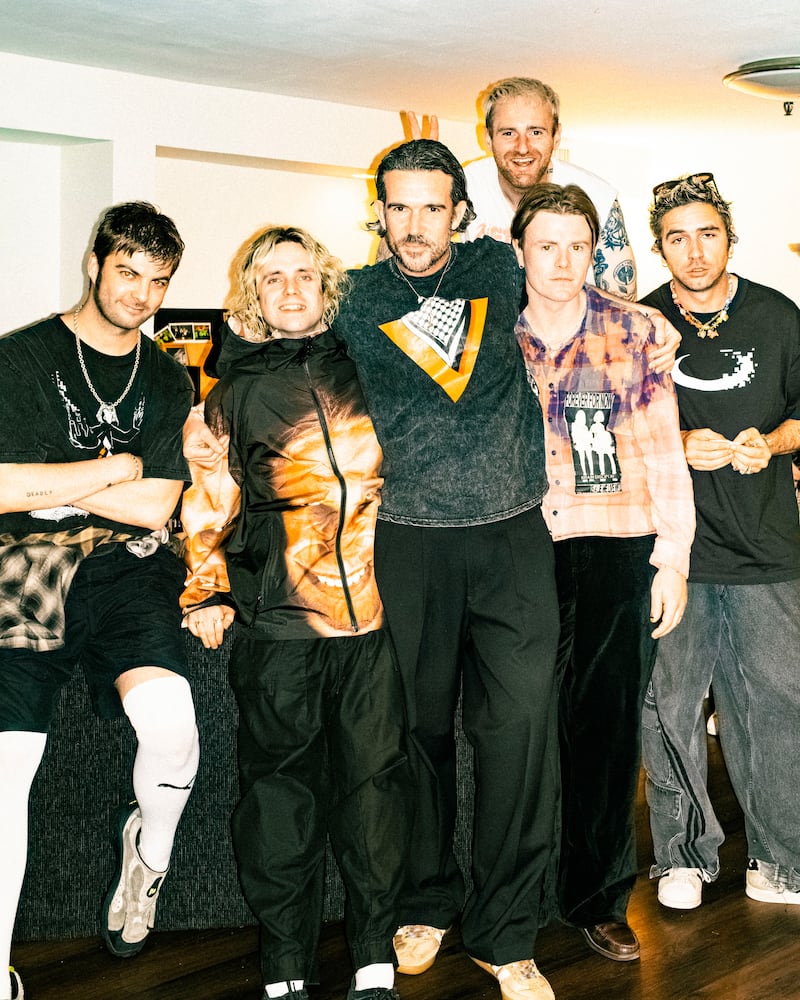 Fontaines DC: the band with Trevor Dietz, their late manager
Later, Coll says, “We’re really awkward to be in social settings as a band, so we just hang out with ourselves and don’t really interact as much with other people. Trev always kept us on the ground, you know? So trying to continue in his spirit, for sure, is a very important thing.”
Trev is Trevor Dietz, the band’s manager and, they say, sixth member. His death, in June, devastated the band. It remains too sad and sensitive a topic to broach.
[ Trevor Dietz and Fontaines DC emerged in a Dublin that seems to be slipping awayOpens in new window ]
Dietz’s early belief in the band set Fontaines DC on their remarkable trajectory. They paid tribute to him in their headline set on the final night of Electric Picnic, in August, during which Chatten brought his fist up to the lens of one of the cameras relaying their performance to the arena’s big screens: each of his knuckles was inked with a letter to spell out Trev.
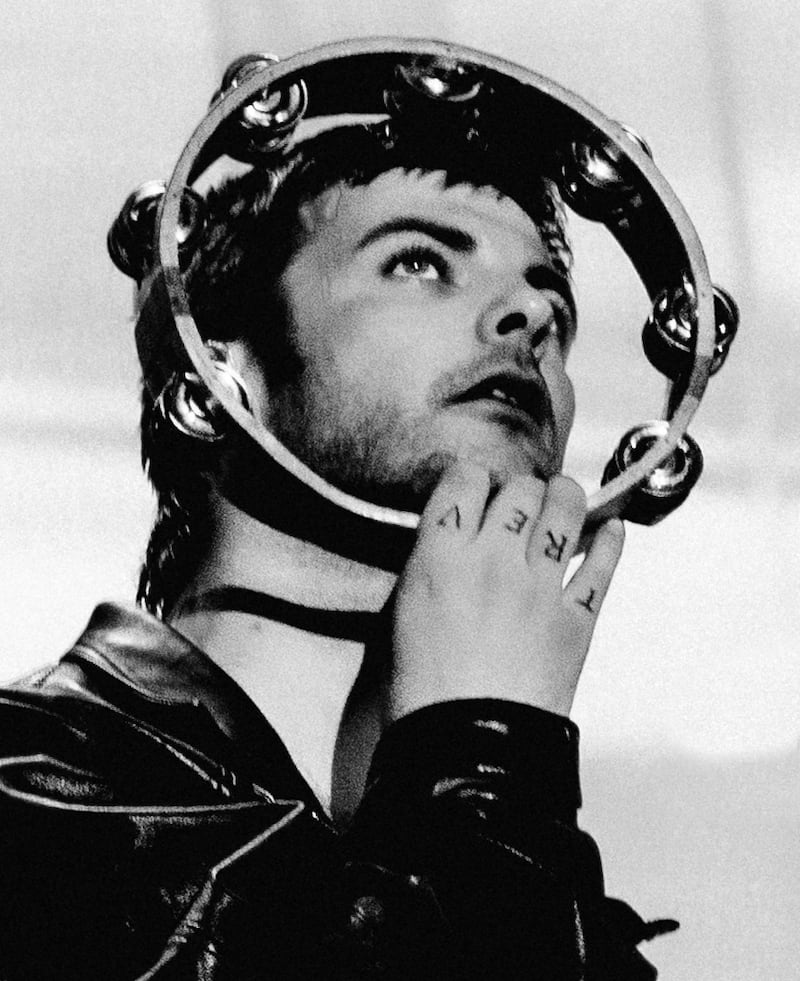 Fontaines DC: Grian Chatten has Trevor Dietz’s name on his knuckles. Photograph: Charlie Barclay Harris
As the set ended, the screens flashed the news that Fontaines will play Slane Castle next year. Was Slane on a vision board at some stage?
Coll laughs and shakes his head.
“To be honest, no. It’s crazy. I’ve actually never been to Slane … I think Curley” – his bandmate Conor Curley – “was at a Kings of Leon show there. In fairness, this wasn’t on the cards when we were starting at all. We were stupidly ambitious, but Slane is a different f**king thing. It’s kind of just mad.”
[ Fontaines DC to play two nights at Slane Castle in June 2027Opens in new window ]
Next summer they will also be playing stadiums in Britain.
“It’s all just a bit overwhelming, but in a great way, you know?” Coll says.
At Electric Picnic this summer, he thought back to his first time at a music festival, watching Arctic Monkeys play the same Sunday night slot, just before the English band released their fifth album, AM. Now he’s in the same position.
“I just feel a bit blown away sometimes that the lads who met each other in Dublin in Bimm” – the music college they went to – “and were in that tiny rehearsal room for years, trying to tune their guitars, ended up rising to it all, and that there wasn’t a moment where any of us went ‘I can’t do this’.”
According to Deegan, part of Dopamine Chamber’s creative process was exploring the kind of band they want to become. What is that band?
“What really excites me still is the philosophy of The Velvet Underground,” he says, “where they were simultaneously pushing boundaries of pop music but, also, it was still pop music.”
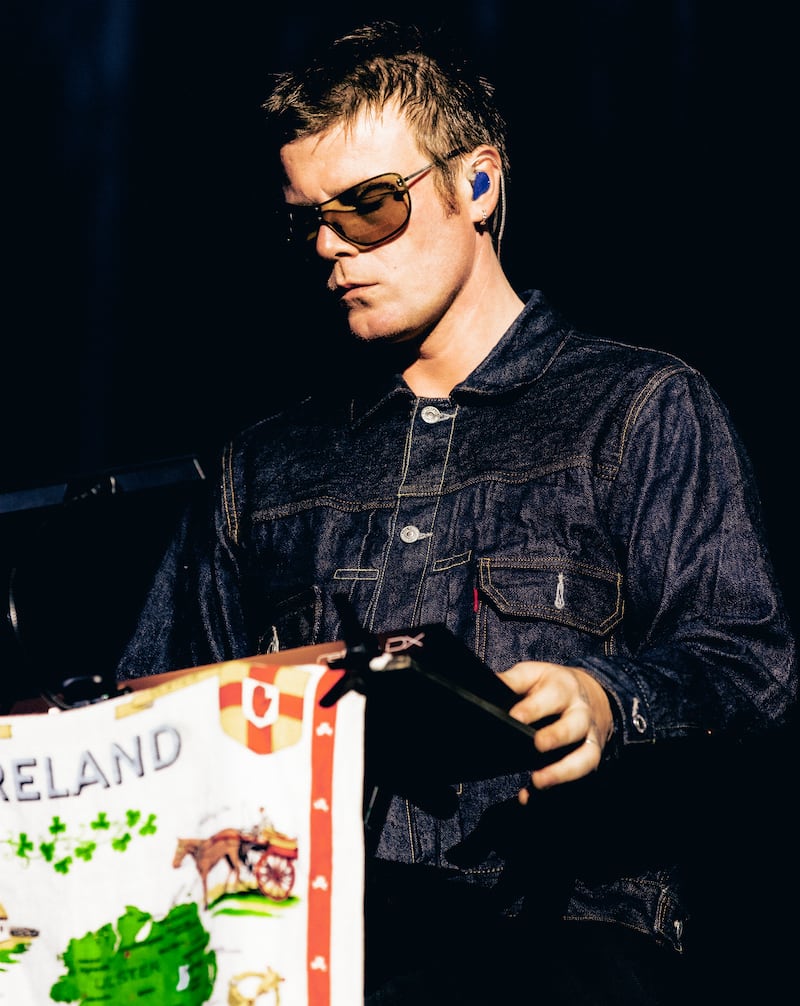 Fontaines DC: Conor Curley at Leeds Festival in August. Photograph: Charlie Barclay Harris
He characterises the blend of John Cale and Lou Reed’s artistry as finding “some really interesting Zen balance”.
“I want us to be able to keep pushing the boundaries more and more, and be more experimental, but never compromise on the fact that it should be a functioning song – that it should be an enjoyable song – even if we do crazy things within it.”
More and more, he believes, Fontaines are capable of being increasingly innovative, making songs that have evolved significantly since those on their debut album “but still feel like Fontaines. We could end up doing things that are very, very diverse and it still feels like us. That’s such an amazing place to be in as an artist.”
Dopamine Chamber is released via XL Recordings on Friday, October 16th