
Analysis: Born in Co Offaly, Mick the Miller was Irish greyhound racing’s all-time greatest star and later even featured on the silver screen
Mick the Miller is probably the most famous greyhound of all time. The smallest and weakest in a litter of 10 pups born at Millbrook House in Killeigh, Co. Offaly, he was bred by the parish curate Fr Brophy and looked after in his early years by local man Michael Greene who exercised him daily and even bottle fed him. Shortly before his first birthday, Mick was struck down by distemper, a highly contagious viral disease which primarily affects dogs. The dog defeated all the odds and survived, thanks to careful convalescence.
Mick made his racing debut in 1928 and proved that he was not just any greyhound. The most successful Irish greyhound in history, he won most of his races in Ireland and was the first greyhound to win the English Derby two years in a row. Mick was the poster dog for greyhound racing and attracted thousands to watch him. He was the first greyhound in the world to win 19 races in a row, a record that remained unequalled for over 40 years.
A 1931 British Pathé film describes Mick as the dog whose “uncanny skill has endeared him to thousands and whom no money can buy”. As it turned out, money could buy him and the price was 800 guineas (around €87,800 today), which was paid by English bookmaker Albert Williams at White City Stadium in London.
From British Pathé, profile of champion greyhound Mick the Miller
Mick the Miller was sold again in 1929 for a world record fee of £2,000 (the equivalent of €195,000 today). The new owner was Phyllis Kempton, whose husband Arundel had purchased the greyhound as a gift for her. Mick’s total prize money was £9,017, the equivalent of nearly half a million euros today. Mick was the poster dog for greyhound racing and attracted thousands to watch him. This in turn gave the sport a huge boost.
His short career is unrivalled and he dominated the sport like no other dog. When he retired from racing, Mick spent eight years at stud and spent much time attending social events, often appearing as guest of honour at important races. He was in great demand with celebrities who were keen to have their photograph taken with him. Mick was even the VIP who opened the new roof garden at Selfridge’s Department Store, London.
In 1934, Mick starred in Wild Boy, a film based on his own life story about the efforts of a corrupt dog owner trying to stop a rival’s dog from running in the Greyhound Derby. Produced by Gainsborough Pictures and directed by Albert de Courville, it also starred Sonnie Hale, Gwyneth Lloyd and comic duo Flanagan and Allen and went on worldwide release.
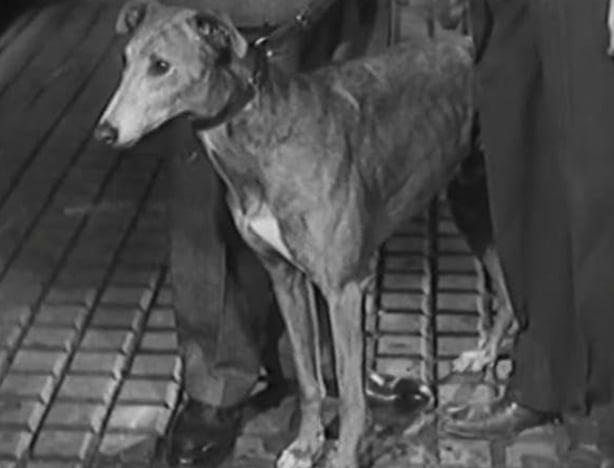
Ready for his close-up: Mick the Miller in Wild Boy (1934)
In his final years, Mick lived with his former trainer Sidney Orton at Burhill Kennels in Hersham, Surrey and died on 5 May 1939. His owners agreed to have Mick taxidermized and displayed in the British Natural History Museum. Postcards of the display were ever sold in the museum gift shop in the 1970s and his body remains in the collection today.
Mick the Miller’s popularity is evident in the abundance of memorabilia created to commemorate him. From cigarette cards to calendars, keyrings to ceramics, the famous greyhound has been merchandised for the masses. He has also been remembered in song with a ballad written by Danny Coughlan in the 1970s called The Ballad of Mick the Miller.
Mick finished first or second 63 times in his 68 track races, a truly remarkable level of consistency
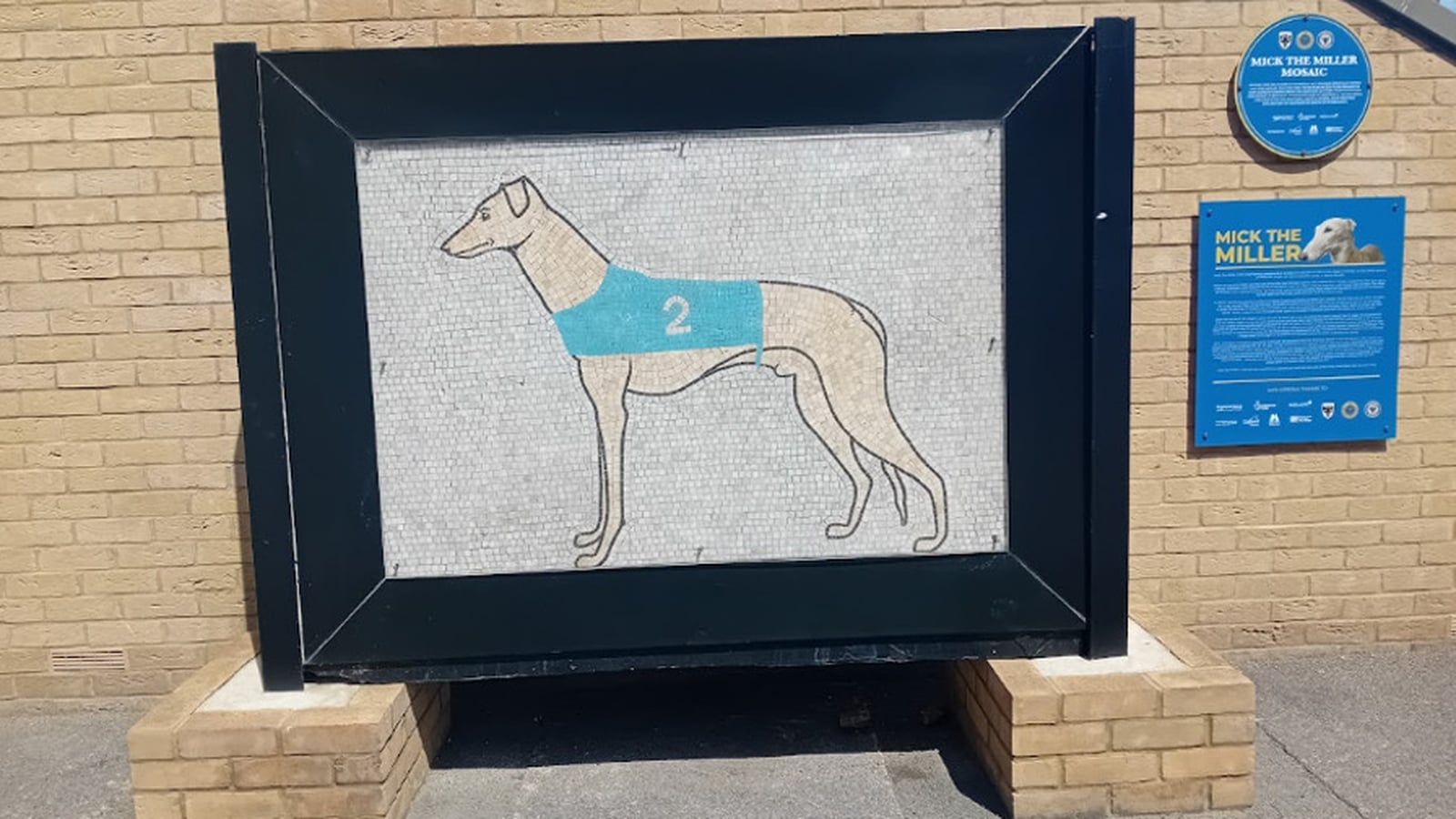
Soon after he died, a mosaic was unveiled in Mick’s honour at Wimbledon Stadium. When the stadium was demolished in 2017, the mosaic was preserved and later unveiled at a new location at AFC Wimbledon’s grounds. In 2011, a statue by Elizabeth O’Kane was unveiled in his birthplace in Killeigh, Co. Offaly. The bronze statue on the village green sits on a stone base, which is made from the ruins of Millbrook House, where he was born.
While the sport of greyhound racing in Ireland hangs in the balance due to avoidable injuries and deaths to dogs, Mick the Miller’s legacy remains unparallelled. Mick finished first or second 63 times in his 68 track races, a truly remarkable level of consistency. Not bad for the runt of the litter from Offaly.
Irish Sport in 100 Objects by Siobhán Doyle is published by Merrion Press
Follow RTÉ Brainstorm on WhatsApp and Instagram for more stories and updates
The views expressed here are those of the author and do not represent or reflect the views of RTÉ