
A necklace of tongues and another of hearts, a tower of hair and a house of thorns: if you wondered how far, or how close, the uncanny might be from the everyday, just take a look at the work of Alice Maher.
Always surprising, and often mesmerising, it can confound those who think of art as something to be tamed within a frame. It is also currently on show at the world’s biggest stage for art, the Venice Biennale.
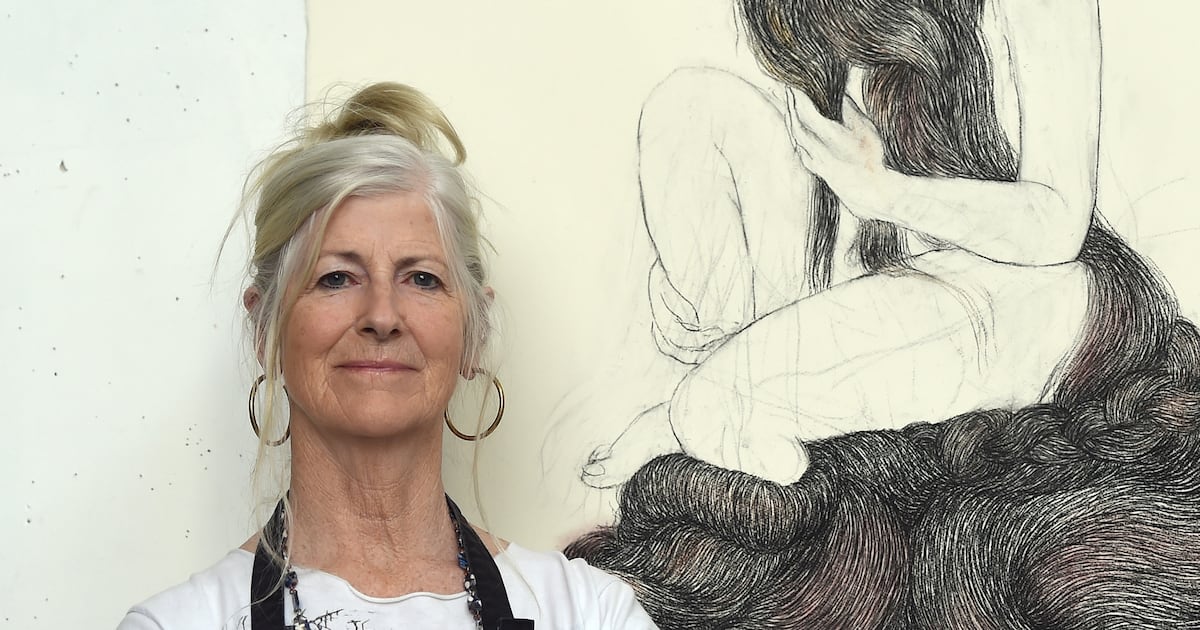
It’s difficult to think of anything tame about Maher, who at 70 continues to conjure wonders from her wild imagination. Yet, on closer inspection, those wonders are grounded in something that might be rather real after all.
Take an object as normal as a thorn, a twist of hair, or a tongue. We all have the latter pair, yet, presented with them in the abstract, we can be torn between being fascinated and repelled. Perhaps that push and pull goes to show how far from home we are with the nature of our bodies.
“I don’t think I knew I always wanted to be an artist,” Maher says. “But it was always there, in my person, as a child.”
Coming from a family of five, she recalls not joining in the games. “I was always a little bit separate.” That, she says, is the artist’s stance: separate from the action, but noticing.
She took European studies at college, going to art classes in the evenings. Then, armed with what she describes as a “portfolio of really bad drawings”, she called into the Crawford art college in Cork (which is now part of Munster Technological University).
“By pure chance I met the principal.”
Barry Maloney took a look and asked if she could start in two weeks.
“The minute I got there, this was exactly where I wanted to be.”
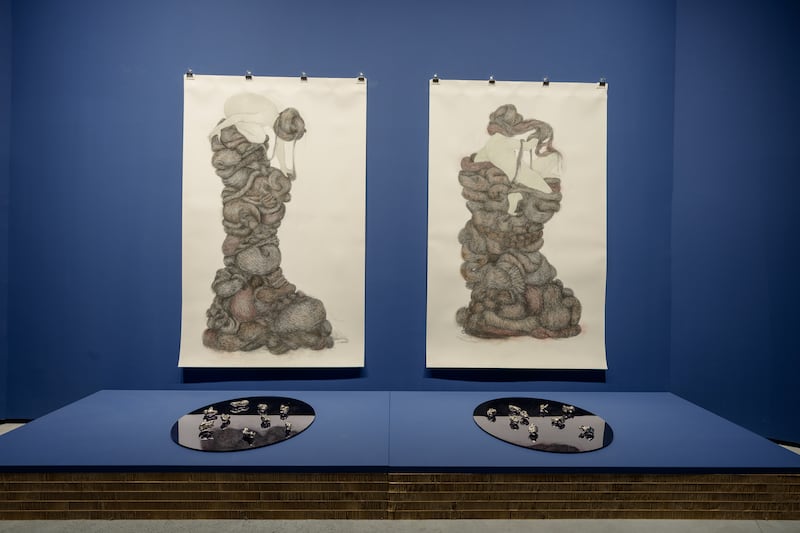 The Sibyls by Alice Maher (2025), on display at the 61st Venice Biennale. Photograph: Andrea Avezzù
Maher works in parallel on a number of projects until one comes to the fore, and to fruition. But, tongues and hearts notwithstanding, her work isn’t about the ick.
In The Sybils, her series of large charcoal drawings installed at Venice (and the subject of a limited-edition book with poetry by Paula Meehan), female figures climb, carry, recline on and perch atop their Rapunzel-like locks of hair.
The form for all is Maher herself. “I don’t look at models,” she says. “I use myself. If I want to make an image of a figure, a human being, I get into that position and stay in it until I understand what it feels like to be in that position.
“Where is the discomfort, where is the weight? My partner” – her husband, and fellow artist, Dermot Seymour – “takes photos of me, very simply with an iPad or something.”
Maher’s work gets to grips with symbolism: her tower of hair, Keep, from the early 1990s, is part castle, part cage. The hair came from the north and south of Ireland, during an intense year of the Troubles. The hair, stored in bags, is now laid out on her studio floor after curator Jelena Sofronijevic asked about exhibiting it.
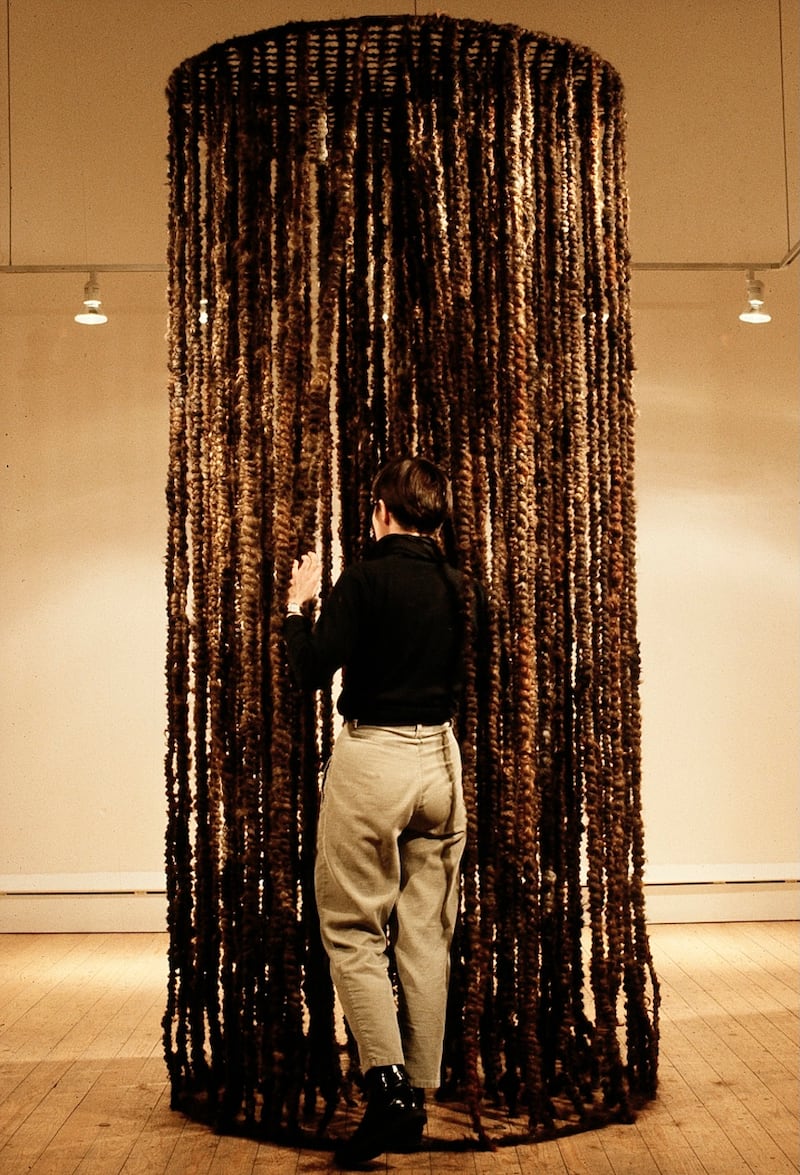 Keep by Alice Maher (1992), installed at Old Museum Arts Centre, Belfast
“She’s doing a show about hope and hate. She read it in a geopolitical way. It gave me the idea to relook. As one gets older, you start to reassess. How does a work from 1992 be relevant in 2026? That has become really interesting.”
The readings may change over time, but a constant is the way Maher’s work allow us under the skin, and under the veneer of what we like to describe as civilised.
That said, is there very much that is civilised about our civilisation today? In this, her Sibyls, Cassandra and other mythic figures are there not to draw our attention to easily decipherable tales but to remind us that deeper forces are at play underpinning the nature of human nature.
As Becoming, the title of Maher’s mid-career retrospective at the Irish Museum of Modern Art (Imma) in 2012, showed, her work is more closely connected to how images and things can be transmuted to make gateways for understanding.
Look closely and you might catch a revelation or two, an awareness of the beat of your blood, as the senses of the subconscious, and possible connections to half-remembered other lives, well up.
Maybe that’s what civilisation is designed deliberately to dull. Most of us tend to mute the possibilities of uncomfortable epiphanies with a glass of wine or a spot of scrolling.
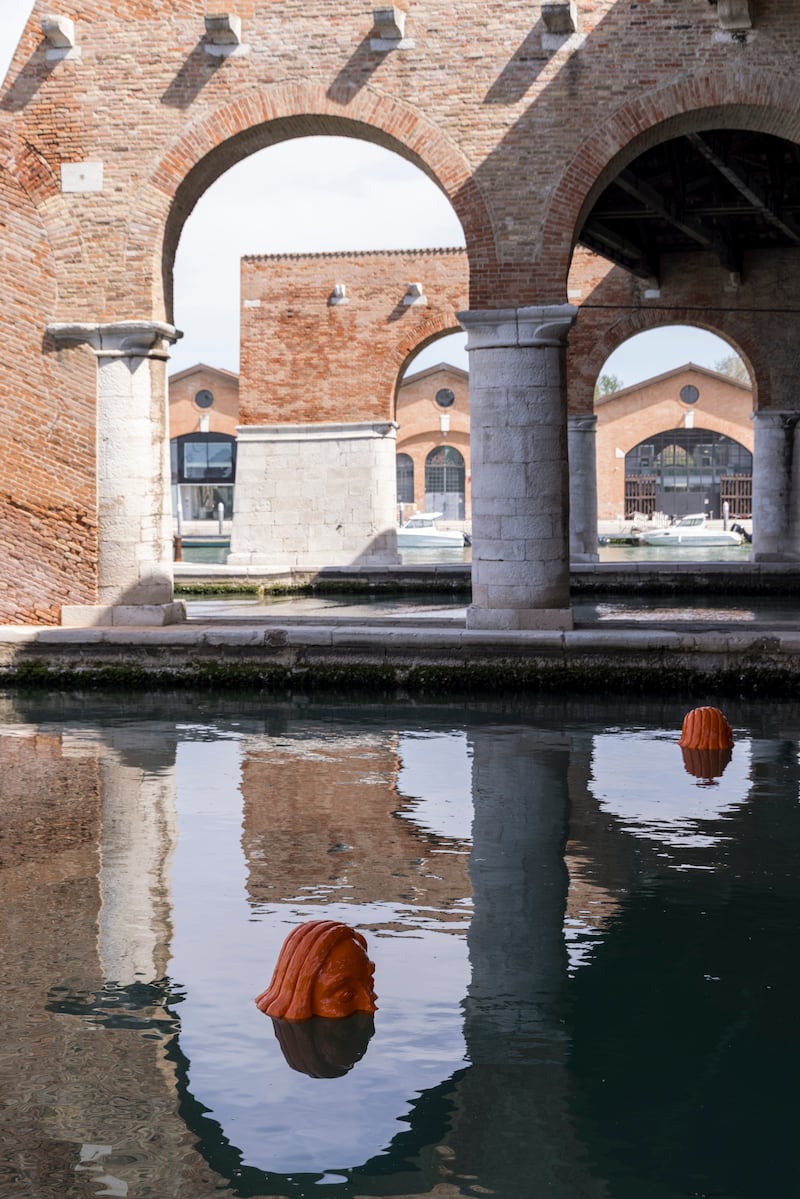 Les Filles d’Ouranos by Alice Maher (1996/2025), on display at the Arsenale during the 61st Venice Biennale. Photograph: Marco Zorzanello
Yet we are closer to those gateways than one might think. It’s there in literature, particularly in WB Yeats, and it positively dances in Eoghan Quinn’s brilliant play Visions, currently on the Peacock stage of the Abbey Theatre.
The land is steeped in it too. Once, driving Maher back to Dublin after I visited her then-new studio in rural Co Mayo, she suggested we stop at Tulsk. “The gateway to the underworld is just over there, a few fields away,” she said. But Oweynagat Cave wasn’t open that day, so we got some coffee and got back on the road.
That was almost 20 years ago. Today, behind her in the Mayo studio is a card – maybe it’s a beer mat – saying “Later Is Now”. There are boxes and folders, jars and bottles. A can of spray paint, rolls of paper.
A fabulous fake fur coat is hanging from a rail, and a silver jacket. She slips into the coat. It is a wonder. “You tend to stick to jeans in the country,” she says, possibly ruefully.
Pinned to the bottom of a shelf is a cut-out, either a dancing figure or a stylised sheela-na-gig. Somewhere will be a box of dead bees, and another of bones.
The bees are for occasional repairs to her Bee Dress. Made in 1994, the child’s dress, covered with dead bees, is now in the collection of the Ulster Museum. A companion piece, Berry Dress, made that same year, is owned by Imma.
Modelled on Irish-dancing dresses, both of them layer ideas of construction of identity, femininity, armour, pain and, again, that collision of myth with the substance of the everyday.
Although Maher says she had always been separate from the action, just over a decade ago she and a group of artist colleagues were right in the thick of it, helping to change Irish society with the Artists’ Campaign to Repeal the Eighth Amendment. She set it up in 2015 with Cecily Brennan, Eithne Jordan and Paula Meehan.
“It was after an Aosdána meeting,” Maher says. “Cecily came to Paula, me and Eithne and said, ‘Do we want to actually do something about this?’ and we just all immediately said yes.” The group called a press conference at Buswells Hotel, opposite Leinster House, and things took off.
Artists began to meet in Maher’s studio, sewing banners for the Repeal marches.
“We were working out the imagery and talking. And I discovered that talking through things as you work is a way of making that clarifies ideas. It was a new way of working for me. A lot of people were just waiting for this to happen. It was very important in my life,” Maher says. “We were seeing the power of art and culture, and the power of collaboration.”
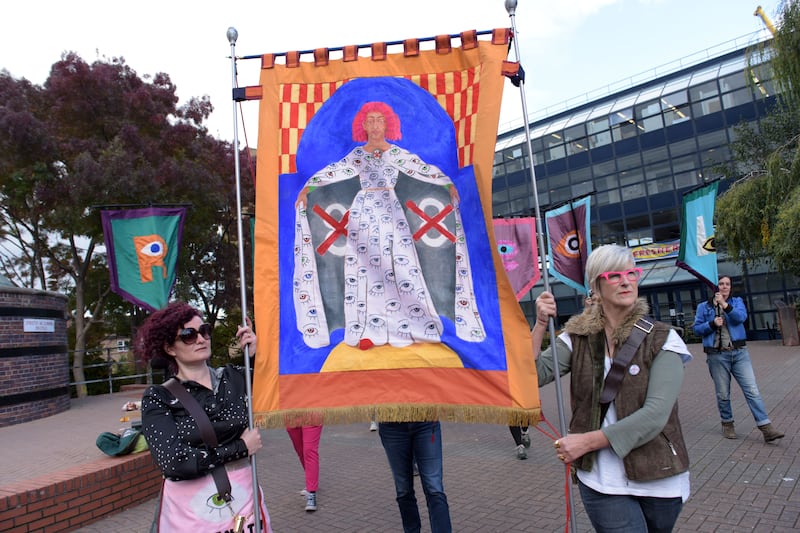 Rachel Fallon and Alice Maher with the banners they created for the Repeal the Eighth campaign. Photograph: Bryan Meade
The banners made by the campaign were deliberately bright and joyful, while also being intensely powerful. They were exhibited in 2016 at EVA International, which was curated by the late Koyo Kouoh, who would go on to invite Maher to participate in this year’s Venice Biennale. The banners have since been acquired by the National Museum of Ireland.
Also shown at EVA, and now at Venice, is an installation of half-submerged heads, Les Filles d’Ouranos. For someone who is utterly serious about her art, Maher is also very funny, with an eye to the self-deprecating, in the sense of puncturing any possible grandiosity rather than actually putting herself down.
It’s a way of being that many of us would love to master. She describes a visit by the team who had taken on the challenge of completing Kouoh’s vision after the curator died mid-project.
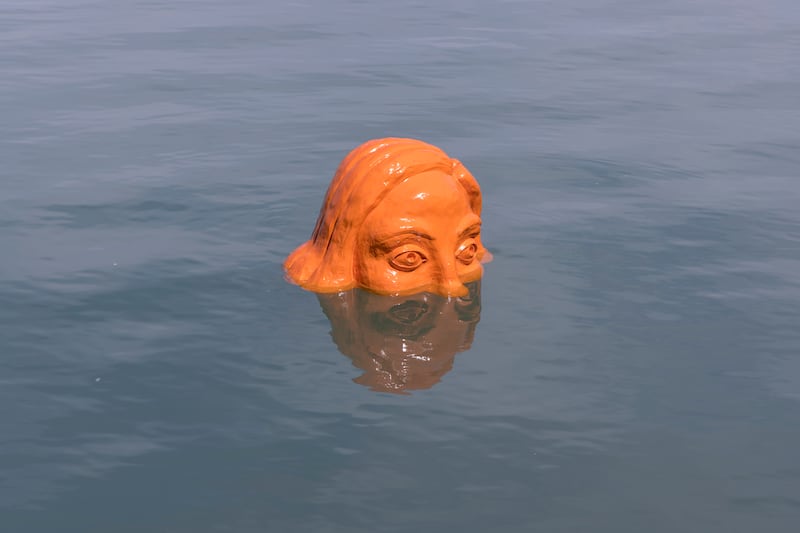 Les Filles d’Ouranos: One of the submerged heads in the Alice Maher installation at the Venice Biennale. Photograph: Marco Zorzanello
Barbara Dawson, the director of the Hugh Lane Gallery, had driven them to Mayo; on their way back to the car, studio visit complete, one had chanced to see a row of orange heads, now holding back the escaping earth and foliage from Seymour’s vegetable garden. They wanted them immediately. “They had weeds coming out of their noses and snails living in them,” Maher says happily.
She remade them for Venice. Also at Venice is The Map, which, made with her fellow artist Rachel Fallon and commissioned by Rua Red in Tallaght, is based on a retelling of the life and legacy of Mary Magdalene.
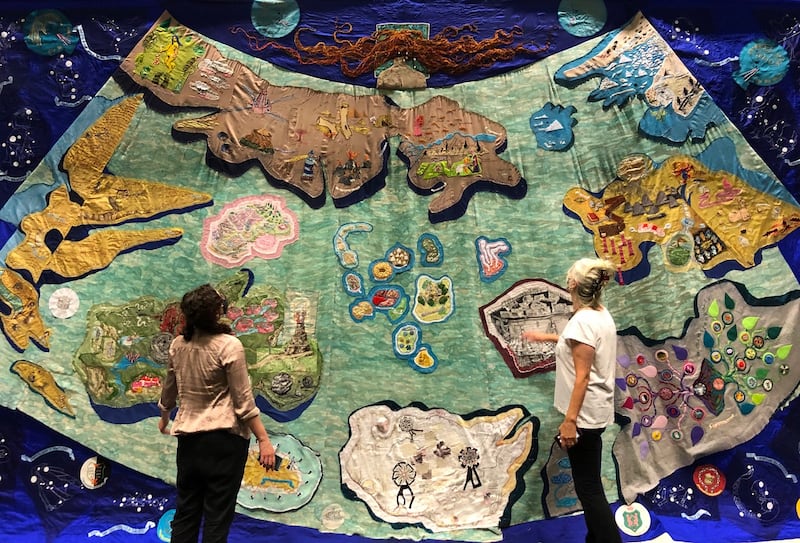 The Map, a collaborative textile work made by Alice Maher and Rachel Fallon based on the life and legacy of Mary Magdalene
So, from myth to Mary Magdalene and through to the social-justice campaigns of recent history, what has changed for women?
“Everything has changed and nothing has changed,” Maher says. “Everything has changed in that the silence and shame that was wielded over us like an axe has been smashed to pieces by feminism and grassroots movements. Yet nothing has changed in that a deep-rooted ancient misogyny still seeps into our lives.”
She describes the institutional imbalances that persist in the art world, and across society, and are so enmeshed that it can be hard to see them or, once seen, to unravel them. “The stories and myths I work with, like that of Cassandra, are very often narratives of silencing and entrapment, intervention and transformation,” Maher says.
Thinking of that transformation, I ask what she’s working on next. What might be in one of those boxes neatly packed and stacked.
“My brother, Paddy, sent me a box of bones,” she says. “He lives in Killarney, and they have some sea eagles there. I’m looking at birds, and it was serendipitous that he sent them. That’s the way it works for me. I thought, ‘Bones that eagles stripped – they might be interesting.’”
Indeed they might. Shortly after our conversation, having been thinking about Maher’s compelling self-possession, I have a follow-up question. “I’m wondering at what point you knew who you were,” I say via email. “Or is that a work in progress, like so many things?”
A day later she emails in reply: “You asked when did you know you were an artist?”
I don’t correct the question. Maher is an artist to her bones. It’s impossible to imagine her, in this life at least, being anything else.
The 61st Venice Biennale, which also included works by Rachel Fallon, Alan Phelan, Mark Francis and Isabel Nolan, runs until Sunday, November 22nd. Alice Maher’s Les Filles d’Ouranos will be installed on the lake at the National Museum of Ireland’s Turlough Park branch in May 2027, where they will remain for a year. Alice Maher’s book The Sybils, with new poetry by Paula Meehan, costs €25 from kevinkavanagh.ie