
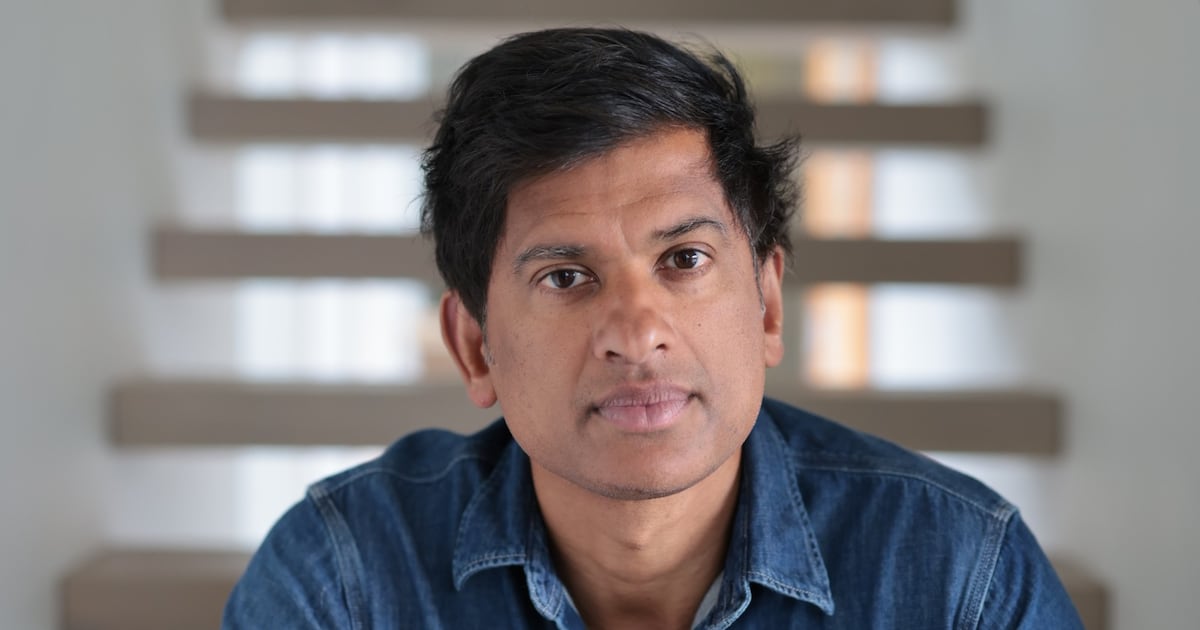
The last time Dr Rangan Chatterjee came to Dublin, it was for a Bon Jovi concert in Croke Park. He’s a superfan of the band, he tells me during a video call from his home in England. He mentions this because he is a proponent of something called “collective effervescence”, a phrase coined by pioneering French sociologist Émile Durkheim to describe “the special energy we feel when we’re in a room with like-minded people”. That energy is something he’ll be channelling at his Thrive Tour event in Dublin next month.
The Thrive Tour, Chatterjee explains, is his attempt to help people reclaim their own innate health expertise with a two-hour, interactive live experience built around “mindset, values and actions”. A journal is included in the price of the ticket, so people can take notes and, he hopes, go home with meaningful tips to improve their lives. It’s the first time he’s bringing the event to Ireland, but he’s played in front of thousands across the UK, Canada and Australia.
We might be drowning in hacks, longevity gurus and health optimisation strategies, but Chatterjee insists people need to stop outsourcing their wellbeing and learn to trust themselves again. His central argument is that “we’ve outsourced our own inner expertise to external experts”. It might sound strange coming from one of those experts, but he insists his goal is to make people like him redundant.
“I want people to not need me,” he says. “The whole theme of the night is: it’s your life. You get to choose what’s important to you, and everything I do is about giving people tools they can use themselves.”
Over the past decade, Chatterjee has managed to cut through the considerable wellness noise with a common-sense approach that blends his medical background with empowering advice for his more than a million Instagram followers. He first came to prominence in 2015, helping families with their health issues in the BBC TV show Doctor in the House. He has written six bestselling books, and his podcast, Feel Better, Live More, is the most popular health show on Apple Podcasts with more than 300 million listens.
Chatterjee’s approach covers sleep, stress, purpose, relationships, technology and happiness, while increasingly questioning whether modern life itself is making people ill. “We have more health and wellness information than ever before,” he points out. “Yet physical health is worsening, mental health is worse now. If all we needed was more knowledge, we’d be thriving.
“My whole message is about empowerment, trying to show people that it doesn’t matter who you are or where you live or what your perceived problems are. That even if you’re in a dark place, there are still some very simple things that you could do that will make a difference.” His aim with the live event is that “people walk away feeling really inspired and feeling that it’s not as hard as they think it is to thrive”.
What he has learned from seeing tens of thousands of patients in his 23-year medical career and reaching millions more online is that in this hyper-connected world, loneliness is an urgent modern malaise. He’s not surprised when I tell him that articles with “lonely” in the headline receive heavy traffic on The Irish Times website. “A lot of the connection we think we’re getting online is what I call junk connection. It’s like junk food. It’s not real, three-dimensional, nourishing connection.” He quotes one study that says “the feeling of being lonely and isolated is as harmful for your health as smoking 15 to 20 cigarettes per day”.
[ How music, or silence, can help with bereavement, dementia and painOpens in new window ]
As the son of two immigrant parents from India who faced challenges coming to a new country, he says they were keen that their son excelled. “I took on the message as a child that I was only loved when I got straight As … but for all my so-called success, I wasn’t actually that happy because a lot of my life had been driven by external achievement and external validation … I’ve since learnt that happiness is an inside job.”
He is a keen follower of Rose Anne Kenny, Trinity College Dublin’s professor of medical gerontology, who has been a guest on his podcast. “She’s been studying this for years and has shown that 80 per cent of how we age is down to how we live, while only 20 per cent is our genes. So I think the ideology of trying to help us to live well and be independent and mobile until the day that we die is awesome.” But he also thinks we have “a problem with death in western society. We don’t want to face it. We don’t want to acknowledge it.”
This philosophy has developed even more since his father died. He had lupus, and Chatterjee cared for him for years. An awareness of death is crucial for a healthy life, he believes. He has a vivid childhood memory of watching the funeral of Indian prime minister Indira Gandhi in the early 1980s. “I remember seeing her body on the funeral pyre. In India, death is not hidden away; it’s part of life. All of us, at some point, we’re going to return to earth. And I think there’s something in that because if I could live forever, I’m not sure how much of my life would have meaning. I’m not sure if there would be an urgency to do anything, because what makes life beautiful is the fact that we are going to die at some point.”
I bring up the biohacking movement where science, technology and lifestyle tweaks are used to “optimise” the human body and mind. He says he doesn’t like to judge anybody, but that caution is needed. “The risk of the biohacking movement is twofold. One is that we’re trying to cheat death, and I don’t think we can cheat death. And even if you could cheat death, do you even want to? Is a big question.
“The other risk is a world where so many of us are struggling with our relationships, where so many of us are feeling lonely. If we keep pursuing our own health habits at the expense of our relationships, we’re setting ourselves up for some really big problems. You can have the perfect level of visceral fat. You can be the perfect weight. Eat the perfect diet. But if you haven’t got meaningful relationships, is there any point? What are you going to do with that perfect six-pack if you haven’t got someone to share your life with?
“I think some people do [biohacking] really well, but some people give it a bad name. I don’t think we all have to do cold plunges and red light therapy. They have value for some people, but I would just say, be careful you’re not optimising your own personal health at the expense of your social relationships.”
He also believes screen use in children may be the most pressing health issue of our current time. He has a 14-year-old daughter and a 16-year-old son. “I was never going to allow my children on social media. Knowing what I know, and seeing what I’ve seen, there was no way.”
We’re living in a world now where there’s noise everywhere. Social media reels, news headlines, podcasts
He started playing a regular padel game with his son recently. “Every week we play two games together on a doubles team. It has dropped my resting heart rate, which is great for my cardiac efficiency. It’s made me sleep better. It’s helped me with multiple aspects of my health, but I don’t play for any of those reasons. I play to hang out with my boy and cultivate our relationship.”
To this end, he hopes people make connections at his upcoming event. “People send me messages saying, ‘I don’t have any friends who want to come with me. Do you think I could come by myself?’ I tell them absolutely, and they often end up meeting or making friends, because it’s like-minded people gathered together.”
The podcasts, the books and the events are about him fulfilling his own evolving purpose in life, he says. The book he is currently writing will explore this topic. “If you’re living a life without purpose, you’re much more likely to engage in problematic behaviours,” he says. “One of the reasons I want to do these live shows is because what drives me is a real desire to help people live better lives. I don’t think it’s as hard as we think it is.”
Before he goes, he tells me he’s heard about doctors who informally prescribe his podcast to their patients. If Chatterjee could prescribe one thing to the population of Ireland for their wellbeing, what would it be? “Ten minutes of silence every day,” he says, without hesitation. “We’re living in a world now where there’s noise everywhere. Social media reels, news headlines, podcasts, right?
“The reason we’re so confused is that we stopped listening to ourselves. Ten minutes of silence, or what I would call solitude, literally helps you to start listening to yourself again. I don’t care if that’s a walk round your block, without your phone, or if it’s meditation or journaling.”
Or perhaps, he says, the most revolutionary act these days is having a cup of tea or a lunch break without checking emails or scrolling social media. “If you spend five to 10 minutes a day with intentional silence, you will start to understand yourself better than you have done for such a long period of time and you will make better decisions throughout the day.” Ten minutes of peace? It’s just what the doctor ordered.
Dr Rangan Chatterjee’s The Thrive Tour event is on at the Bord Gáis Energy Theatre on November 15th