
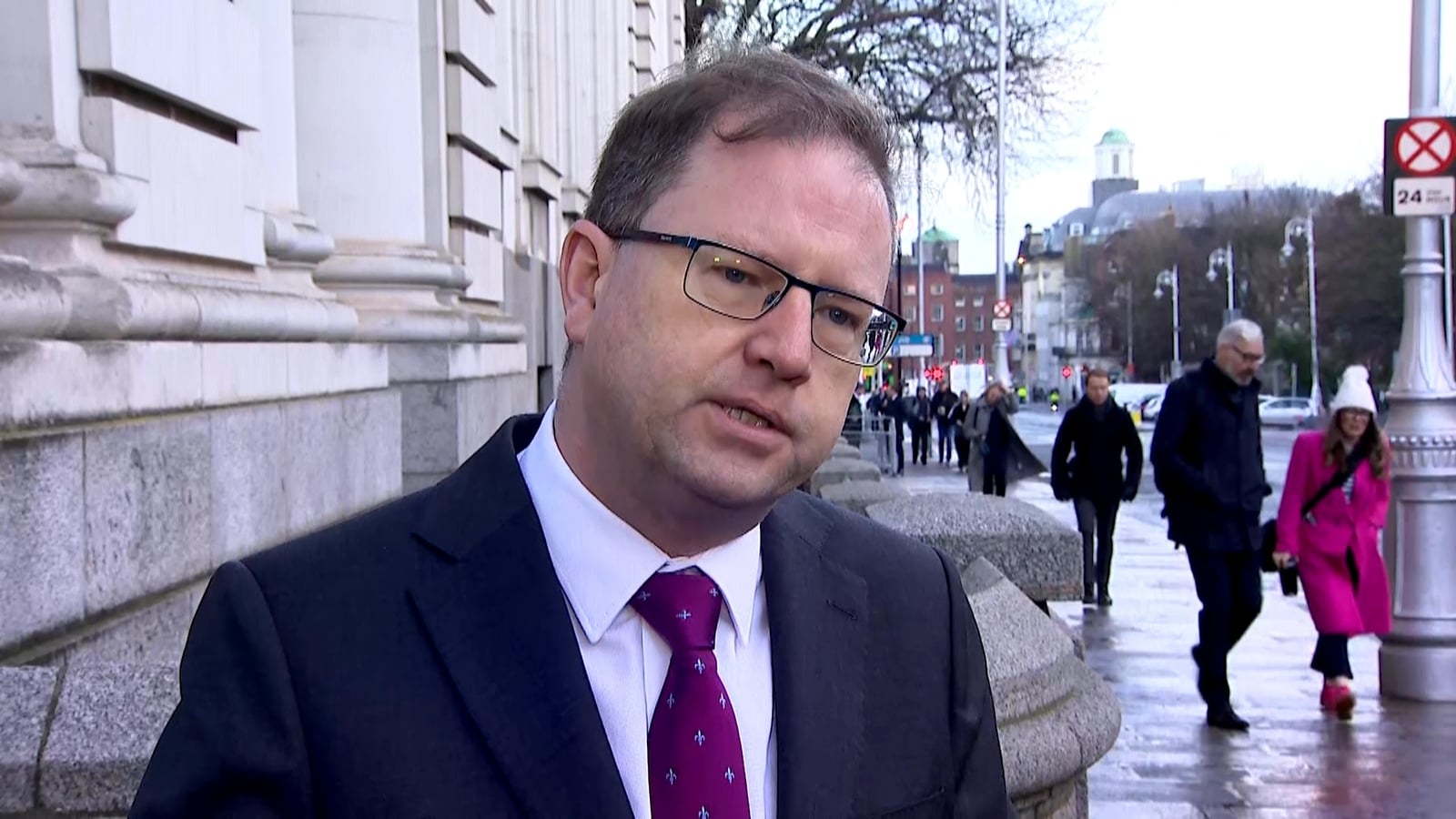
Minister for Higher and Further Education James Lawless has said the demand from Irish universities for €250 million to bridge a core funding gap is “significantly in excess” of the previously agreed figure.
“It’s ten times the previous figure,” the minister said.
Speaking to RTÉ’s This Week, Minister Lawless said: “It’s very difficult two or three weeks before our Budget to come out with this pre-budget submissions, which is magnifying the figure that has previously been agreed ten times from €25 million up to €250 million.”
In 2022, the gap in core funding for Irish universities was identified as €307 million.
The Government agreed to close that gap over successive budgets at a rate of €25 million per year.
Five budgets later, the gap is €130 million, according to the Irish University Association it increases to €250 million if pay and pensions are included.
In Budget 2027, €10 million was awarded to Funding the Future, which will plug some of the universities’ funding gap.
Minister Lawless said, in addition to that: “I gave almost €200 million in things like pay awards in terms of pension deficits being addressed.”
“The €250 million is a new figure,” Minister Lawless said.
He added: “This year, I accept it was only €10 million to €25 million, but there is a big difference from €25 to €250.”
The Minister also said he “entirely intends” to close the funding gap for Irish universities.
At an Oireachtas committee meeting on Thursday, politicians were told that while the number of third-level students in the country has grown by 54% since 2008, State funding per student is down 34% in real terms over the same time period.
We need your consent to load this rte-player contentWe use rte-player to manage extra content that can set cookies on your device and collect data about your activity. Please review their details and accept them to load the content.Manage Preferences
Demand for higher education is projected to grow by 19% over the coming years into the early 2030s.
The committee was told that the higher education sector is not getting a funding increase in line with increased demographic demand from students.
President of the Technological University of the Shannon, Professor Vincent Cunnane, said gaps are already emerging in TUS in terms of facilities, maintenance and equipment.
“There is no significant injection of funds in order to bridge that gap to the necessary amount of money for an expanded higher education sector,” he said.
“We [TUS] at best will have a balanced budget this year, and that means that all the money that we get goes really into our operational activities.
“We’re not getting enough money to cover the necessary expenses.
“We have to cut back on things.”
Prof Cunnane said that the university needed to update its lab and scientific equipment but did not have the money to do so.
Visa refusals costing universities millions of euro
Irish universities will lose millions of euros in student fees this year due to a sudden uptick in student visa refusals by the Irish State.
International students pay higher fees than domestic or European students.
Sean O’Driscoll, chair of the governing authority of University College Cork, estimates that these unexpected visa rejections will cost just UCC €3.7 million in lost student fees for this academic year.
At the Technological University of the Shannon (TUS) several master’s programmes will have to be cut this year due to the sudden large amount of visa refusals meaning certains courses have become financially unviable.
Prof Cunnane said in one master’s programme there were 24 Indian students accepted onto the course and seeking a student visa, 21 were rejected.
There is not right of appeal for student visas meaning that the universities do not know why those students were refused.
“We believe that minor issues with the visa application are being used as an excuse to say, ‘Oh, this wasn’t filled out properly and therefore: Reject. No appeal. Gone,” Prof Cunnane said.
This has meant that some master’s programmes at TUS will have to be cut and some students will be offered a different master’s programme than the one they applied for.
“There will be master’s programmes that will become uneconomic,” Prof Cunnane said.
“The course becomes unviable and it has to be viable given that we don’t have any reserves,” he added.
“I can’t afford to run things at a loss.”
TUS has approximately 17,000 students in both part-time and full-time courses. Prof Cunnane estimates that about 15% of the student body is international.
Public sector pay talks impact
Any increase in pay for the sector will impact the higher education sector, but the pay increases will not be fully funded by the state.
Speaking to RTÉ’s This Week, Sean O’Driscoll, chair of the governing authority of University College Cork, said he believes any public sector pay deals are likely to increase the higher education deficit.
“Only about 60% of the [public sector] pay increase is funded by the state and the universities have to then find the remaining 40% themselves,” he said.
“In the case of UCC, for every 1% increase in pay, there will be cost to UCC of €1.5 million and if that runs up over the 10-to-20-year period, which it has been doing, it results in a very, very significant deficit in the funding for the universities.”
Mr O’Driscoll said the deficit was felt “everywhere”.
“You can’t plan,” he said.
“You’re actually operating with one hand tied behind your back.”
The Minister added he intends to address the gap in core funding for the sector.
“I will be putting together a paper to say what is the current core funding deficit, because we had a figure in 2022.
“The universities have come in recently to say no, that’s not right anymore. It’s a different figure.”
Minister Lawless called on universities to work with Government to find a way to bridge the gap.