
19 October 2026 – Oireachtas Justice Committee has been warned that ageing victims, survivors and families have dwindling time as ICCL, CAJ, Amnesty, Pat Finucance Centre and Bar Council of Ireland criticise the plans over national security veto, government control of information disclosure and lack of independence.
A UK bill to deal with the legacy of the Troubles (the UK Northern Ireland Troubles Bill) is being discussed in the House of Commons today and tomorrow. It will eventually form one piece of the jigsaw in addressing the legacy of the conflict.
The other piece is Ireland’s parallel legislation (the Legacy of the Troubles Bill 2026) which was recently discussed in the Oireachtas Justice Committee. There, ICCL, the Committee on the Administration of Justice (CAJ), Amnesty International, the Pat Finucane Centre and the Bar Council of Ireland warned that this Bill could leave victims, survivors and families facing secrecy and delay, with information potentially withheld from families on vague grounds and key decisions about information disclosure in the hands of the government without adequate independent oversight.
The Irish Bill proposes to create a process (described as a “bespoke mechanism”) that will facilitate the taking of evidence from Irish authorities before a High Court judge for proceedings under the UK Northern Ireland Troubles Bill. Under the scheme, Irish State officials, following consultation with the relevant Minister, would get to control what questions they would, or would not, answer, and who would answer them, if at all. The evidence obtained through these pre-agreed questions would then be provided to the UK Legacy Commission. Victims do not have access to a copy of the record of evidence.
The Bill gives the State several grounds on which it can refuse to provide information, including grounds which are broad, vague and ill-defined, relating to the sovereignty, security or other essential interests of the State (commonly referred to as the “national security veto”); the potential impact on a criminal investigation or criminal proceedings in the State; or that to give this information would be inconsistent with the functions, whether statutory or otherwise, of the designated State body.
There is no independent oversight of refusals. The Bill gives the State significant control over what, if any, assistance it will give. As it is currently written, victims, survivors and families will not receive a notification or explanation as to why information was denied.
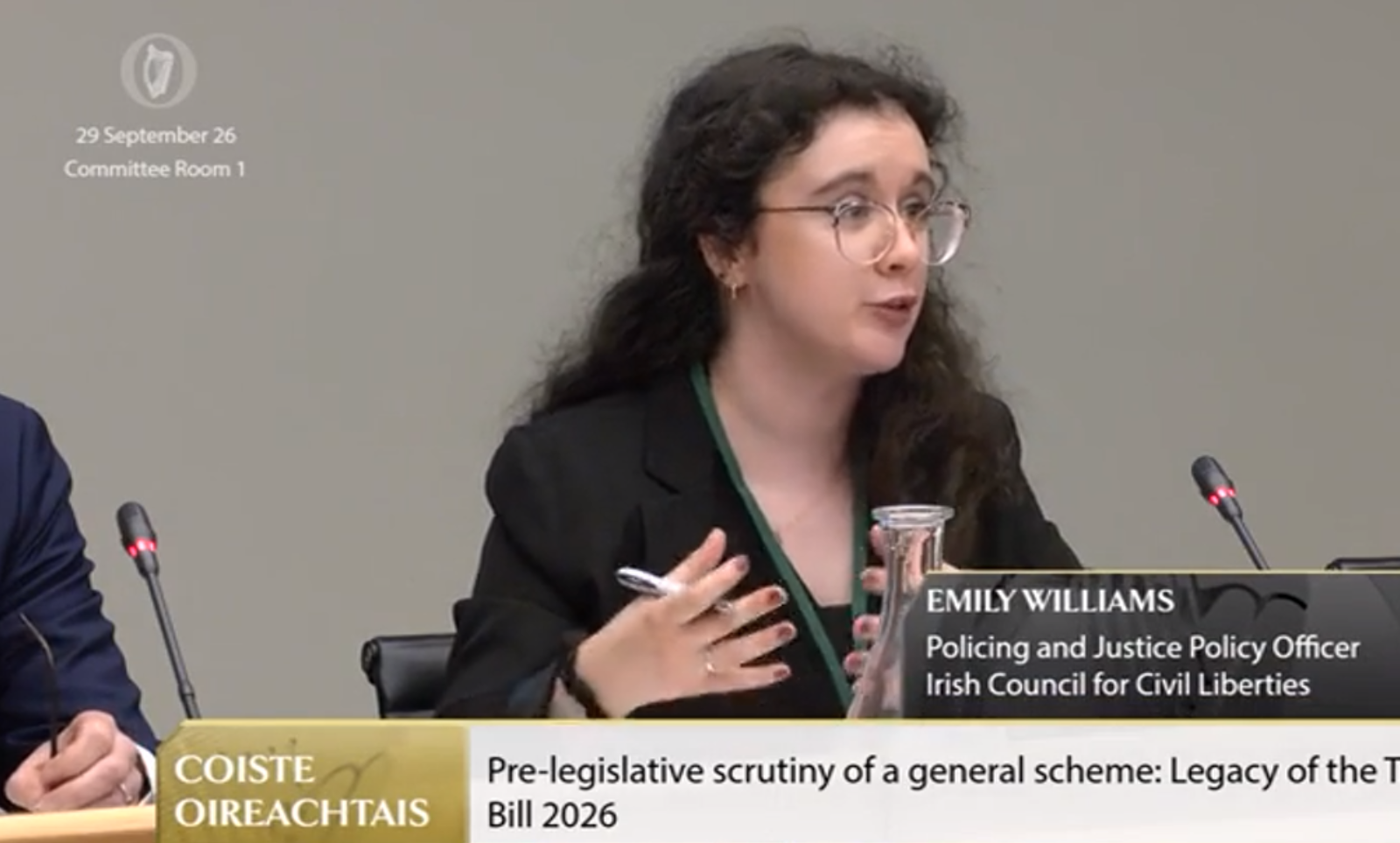
During the Committee hearing, ICCL’s Policing and Justice Policy Officer Emily Williams reiterated ICCL’s call for Ireland to set up an Historical Investigations Unit to ensure there is a mechanism in the South which can pursue independent investigations in legacy cases:
“We see a Historical Investigations Unit as a separate investigatory body which has police powers to conduct independent investigations into certain Troubles-related cases, but it can also be for non-Troubles related cases, for example, the case of the Sallins train robbery. We see this mechanism as necessary as there has been no substantive legacy architecture in the State to date to conduct these types of investigations.”
In respect of the “bespoke mechanism”, Kathleen Leader SC, speaking on behalf of the Bar Council of Ireland, warned the Committee that there is no independent oversight:
“The Bill as presently drafted does not contain any independent oversight mechanisms with regard to information that is not going to be forwarded to the Legacy Commission. It simply does not have any.”
This “bespoke mechanism” is the same process that is currently being used to obtain evidence from, for example, An Garda Síochána in the ongoing Omagh Inquiry. Victims and survivors of the Omagh bombing have already criticised this process, as has the inquiry’s legal team.
But with this Bill, the “bespoke mechanism” would not be confined to just the UK Legacy Commission and the Omagh Inquiry. The proposed legislation would permit the Minister for Justice to apply the same process to any future UK-led inquiries into Troubles-related matters.
The Bill also provides for the establishment of the cross-border Independent Commission on Information Retrieval (ICIR), which will establish an information and truth recovery body where individuals can privately receive information about conflict-related deaths of their next of kin.
However, the Bill creates a process where before an individual can receive this information in a report, the report must first go to the Minister, who can refuse disclosure if “certain information within the report (which the Minister shall identify) would prejudice the national security interests of the State or endanger the safety of a person”.
Gráinne Teggart, Deputy Director of Amnesty International UK – Northern Ireland, raised concerns at the Committee meeting about the compatibility of this with the European Convention on Human Rights:
“We are concerned that these provisions, and in particular the ministerial veto over disclosure, may be misused to prevent disclosure of information regarding State involvement or complicity in serious wrongdoing and that there are no adequate safeguards.”
During the Committee hearing, TDs and Senators heard how the national security veto in the proposed Irish legislation is a replication of a similar national security veto used in current British legacy processes and that it is a model that has already drawn significant criticism from UN experts. Daniel Holder, Director of CAJ, told the Committee that in Northern Ireland the national security veto is used “relentlessly” to restrict disclosure of information:
“In terms of our experience in the North, it is used relentlessly all the time to restrict disclosure of information. […] An amount of information is excluded on all sorts of incidents, including those involving children killed by plastic bullets, where files are sealed”.
Alan Brecknell, Advocacy Support Worker at the Pat Finucane Centre, raised the urgency of providing a rights-respecting legacy and truth recovery process, given the age profile of victims and survivors:
“We have to be honest and say that we coming to the last-chance saloon, given the age profile of the people we are dealing with here. […] More than half of the people were killed before 1976. We have to bear that in mind. We do not have forever to do this. We need to start putting things in place now.”
To uphold the right to truth for victims, survivors and families, ICCL calls on the Minister for Justice to:
Drop the national security veto from the Irish Bill, given the experience in Northern Ireland where it has been used to deny information to families and to cover up possible acts of State collusion;
Tighten the definitions of the other potential reasons for refusal to enhance legal certainty as the current definitions are too vague and ill-defined;
Remove the ministerial role from decisions to withhold information from the UK Legacy Commission and/or to withhold ICIR reports from families, and instead allow a High Court judge to carry out the balancing exercise to ensure independent oversight; and
Set up an Historical Investigation Unit to ensure there is a mechanism available to pursue independent investigations in legacy cases.