
For years, astronomers thought they knew what planet formation looked like.
Powerful images from the Atacama Large Millimeter/submillimeter Array (ALMA) have revealed spectacular disks of gas and dust swirling around young stars. Some were carved into beautiful rings and dark gaps, like cosmic vinyl records. These features quickly became some of the most iconic images in modern astronomy because they appeared to offer a glimpse of planets forming in real time.
But there was a puzzle. Not all stellar nurseries looked so dramatic.
Many smaller disks appeared surprisingly plain. No rings. No gaps. No obvious signs of construction. Just compact, smooth-looking circles of dust surrounding newborn stars.
Had astronomers discovered two fundamentally different types of planet-forming systems? Or were they missing something?
A new study suggests the universe may have been keeping a secret.
Using ALMA’s sharpest vision yet, astronomers have peered deeper into some of the smallest known planet-forming disks and uncovered hidden structures that were previously invisible. Rings, gaps, and even cavities suddenly emerged from what once looked like featureless disks, hinting that the process of building planets may be far more universal than researchers once believed.
The discovery doesn’t just change how astronomers view young planetary systems. It could help bridge one of the biggest gaps in planetary science: connecting the places where planets are born to the mature planetary systems we observe today.
Every star is born in a cloud of gas and dust. During the early stages of a star’s development, there will be some remaining material which will form into a rotating disk around the new star. Over time, particles collide, stick together, and gradually grow into larger bodies. Eventually, some may become planets.
That much is well established. The challenge has always been observing the process itself.
Planet formation unfolds over millions of years, and the earliest stages are hidden inside dusty disks that are difficult to study. Fortunately, ALMA, located high in Chile’s Atacama Desert, can observe the faint glow of cold dust and reveal structures invisible to ordinary telescopes.
Over the last decade, ALMA has transformed our understanding of planet formation.
It showed that many large protoplanetary disks are not smooth at all. Instead, they contain complex rings, gaps, and cavities that appear to sculpt the material from which planets emerge.
These structures matter because they may trap dust and pebbles, creating environments where planets can grow.
Yet a lingering question remained unanswered. Why did many compact disks look so different?
To solve the mystery, a team led by Pietro Curone of CATA (Center for Astrophysics and Associated Technologies) and Universidad de Chile, together with Gijs Mulders, Nienke van der Marel, and Laura Pérez, decided to take a much closer look.
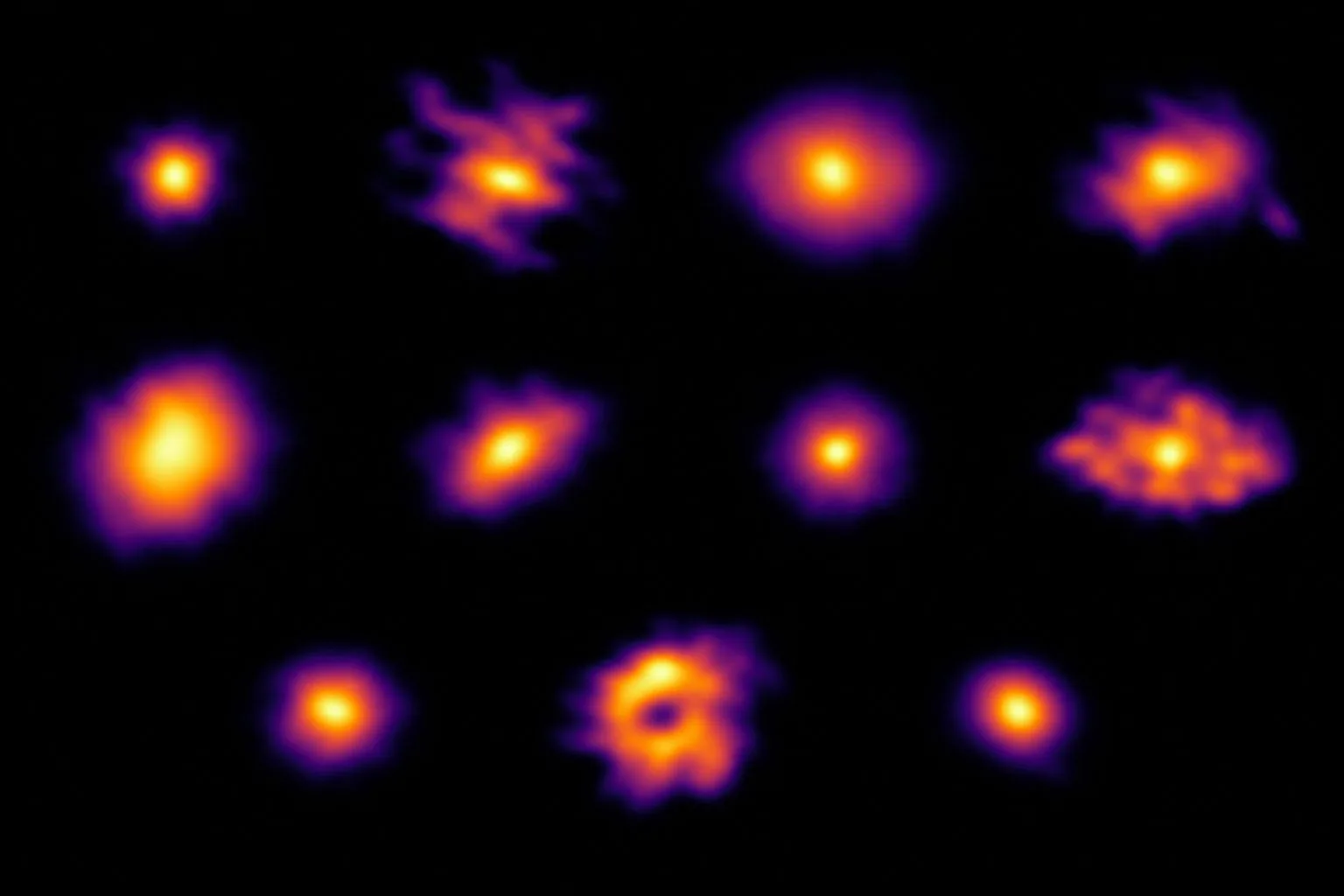
The researchers focused on 11 very small protoplanetary disks within the Lupus star-forming region, which is a nearby area where young stars are actively being formed.
Rather than using ALMA in a standard configuration, the researchers employed its most extended antenna arrangement, effectively transforming the observatory into an extraordinarily high-resolution cosmic camera.
Using a wavelength of approximately 0.9 mm, the team obtained an angular resolution of approximately 0.02 arcseconds. Based on the distance to Lupus, the angular resolution translates into a linear dimension of about 2 AU in size, which is approximately twice the mean separation of Earth from the Sun.
That level of detail represents the highest angular resolution ALMA can achieve at this wavelength.
And what emerged was surprising.
Several disks that had previously appeared simple and smooth suddenly revealed intricate internal architecture.
The researchers detected clear substructures within 10 astronomical units of the central star in four of the eleven disks and found hints of similar structures in three more.
One system, known as Sz 112, contained a central cavity extending just 1.6 AU from its star, placing it squarely within scales comparable to the inner Solar System.
Suddenly, systems once thought to be bland looked far more interesting.
“For a long time, the smallest disks looked much simpler than the large, spectacular disks that ALMA made famous. What we find is that at least part of that difference was an illusion caused by resolution,” explains Curone. “When we zoom in far enough, rings, gaps and cavities begin to appear, even in these tiny systems.”
It’s a bit like looking at a distant city skyline through fog.
At first, the buildings appear as indistinct shapes. But as the fog clears, hidden streets, windows, and details emerge. The city was always there. We couldn’t see it.
The same may be true for many compact protoplanetary disks. The findings challenge the notion that small disks represent a fundamentally different environment for planet formation.
Instead, the evidence suggests many compact systems may contain the same kinds of structures seen in larger disks. The difference may be one of scale.
Large disks spread these features across vast regions. Compact disks squeeze them into areas only a few AU wide.
That distinction matters because many known exoplanets orbit much closer to their stars than the regions traditionally examined in protoplanetary disks.
Previous ALMA surveys often resolved structures located several to tens of astronomical units from young stars. Yet countless planetary systems host worlds packed much closer in.
Compact disks therefore provide a rare opportunity to study conditions in regions that more closely resemble where many planets eventually end up.
“The central question for us was whether small disks truly lack structure, or whether their features were simply beyond our resolution limit,” explains co-author Mulders. “To answer that, we compared the new observations of compact disks with previous ALMA studies of planet-forming disks.”
The results strongly point to the latter explanation. When the team compared compact disks with larger ones, an interesting pattern emerged.
The likelihood of detecting rings and gaps depended heavily on how well a disk had been resolved.
Among extremely compact disks with radii between 3 and 10 AU, structures were detected in about 44% of cases where observations could reveal them.
For disks between 10 and 30 astronomical units, the detection rate reached about 55%. In disks larger than 30 AU, the detection rate exceeded 90%.
Rather than indicating that small disks are fundamentally different, the trend suggests many structures may have gone unnoticed because they were hidden below previous resolution limits.
In other words, the universe wasn’t necessarily giving astronomers a different answer. It was giving them an incomplete picture.
“This is a good example of how the picture changes when we gain resolution. A disk that looks smooth from farther away can show rich internal structure once we can separate features only a few astronomical units apart,” says Pérez, a co-author of the study.
At first glance, a dusty ring around a young star might not seem particularly exciting.
But to planetary scientists, these structures could represent some of the most important real estate in a planetary system.
Dust inside a protoplanetary disk is constantly moving. Tiny particles gradually lose angular momentum and spiral inward toward the star. Left unchecked, much of the material needed to build planets could disappear long before planets have a chance to form.
Rings and gaps may help solve that problem. These structures can create regions of altered gas pressure that trap drifting particles, acting like cosmic traffic jams.
Instead of plunging into the star, dust grains collect and accumulate, increasing the chances that larger bodies can form.
Such “pressure traps” are considered among the leading mechanisms that may enable efficient planet growth.
The new observations suggest these traps can operate surprisingly close to young stars.
“Our new ALMA observations suggest that such traps can exist only a few astronomical units from young stars, even in extremely compact disks,” says co-author of the study Nienke van der Marel. “One possible explanation for some of the newly detected gaps is that young planets created them.”
That possibility makes the findings especially exciting. Whenever astronomers find gaps inside a young disk, one question quickly follows:
Did a planet make it?
A growing planet can gravitationally disturb surrounding material, carving out gaps as it sweeps through the disk. Because of this, rings and gaps are often viewed as potential fingerprints of unseen worlds.
The researchers estimated what kind of planets might create the features observed in these compact systems.
If a single planet is responsible for a gap, the calculations suggest that planets within five astronomical units of the star could fall into the mass range of super-Earths and mini-Neptunes.
These are among the most common types of planets discovered in the galaxy.
What’s particularly intriguing is that these potential planets would occupy a region of mass and orbital distance that is notoriously difficult to study directly. They sit in a sweet spot that often lies beyond the reach of current exoplanet searches while also remaining challenging to observe in disks.
“If planets are responsible for some of these gaps, we may be seeing the signatures of relatively low-mass planets while they are still forming, at orbital distances that have been very difficult to access before,” adds Curone.
Still, the researchers urge caution. The observed structures are not direct detections of planets.
Several other physical processes can create rings, gaps, and cavities within disks. While a planetary explanation remains consistent with the observations, additional studies will be needed to determine exactly what produced the features.
That’s the hallmark of good science: excitement tempered by evidence. Just when the mystery seemed solved, another clue emerged.
The previous classification of Sz 73 and Sz 130 as compact systems was supported by the presence of faint, extended outer rings surrounding the central bright disk in each system.
Four additional systems showed tentative hints of similar extended material. That raises an intriguing possibility. Some disks considered “small” may not actually be small at all.
Instead, they may possess larger, faint outer regions that escaped detection because they are much dimmer than the bright central disk.
If confirmed, this would further blur the distinction between compact and large disks, reinforcing the idea that many protoplanetary systems share a common underlying architecture.
This discovery may seem distant from everyday life. After all, these disks are located light-years away and represent planetary systems that are only beginning their journey.
But the questions they address are profoundly human. Every atom in Earth’s rocks, oceans, and living things was once part of a disk around a young star.
Understanding how those disks create planets is ultimately about understanding our own origins.
The newly discovered structures bring astronomers closer to observing the environments where worlds like those throughout our galaxy begin to take shape.
Perhaps even more importantly, they help connect two different eras of planetary evolution: the birth of planets and the mature planetary systems we observe billions of years later.
By finally resolving features only a few astronomical units across, ALMA is beginning to bridge that gap.
The telescope is revealing that complex planet-forming structures may be common even in places that once appeared empty and unremarkable.
A strong lesson is found within this discovery: some of nature’s best-kept secrets may be overlooked simply because we haven’t taken the time to observe them more carefully, rather than due to their rarity.
Future observations will allow us to see more detail and observe these systems in other types of light (wavelengths). Astronomers will likely find out that many disks we thought were very simple are actually “factories” producing planets.
The rings were there all along. Now, for the first time, we can finally see them.
Journal Reference:
Pietro Curone, Gijs D. Mulders, Nienke van der Marel, and Laura M. Pérez. Probing Planet Formation within 10 au: Dust Substructures in Extremely Compact Protoplanetary Disks. The Astrophysical Journal Letters. DOI 10.3847 /2041-8213/aeaa3c