
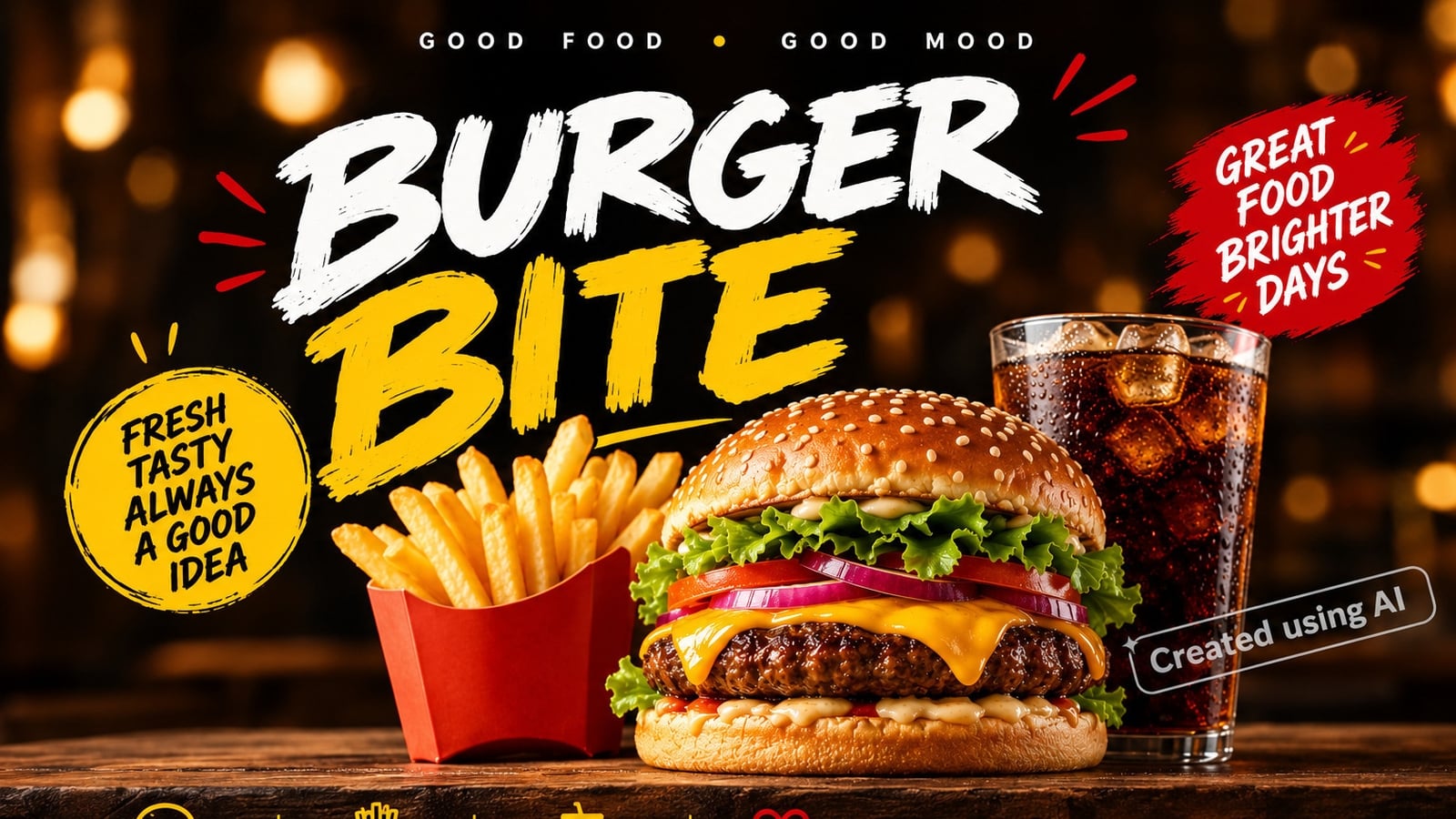
Analysis: Concerns about AI art touch on issues of authenticity, connection, design and creativity – and the fact that the output just looks awful
If you feel like you’ve noticed more AI posters lately, you’re not alone. Several factors make them stand out, such as uniform design, information-heavy pages, and an overall blandness that makes everything feel similar.
Yet while businesses and organisations see them as a way to save time and money (33% of SMEs in Ireland use generative AI in some form), the public views them differently. For posters alone, there has been pushback from the public, with concerns surrounding lack of support for artists and creatives, the environment and the overall sameness of each poster. These concerns touch on the main issue of AI content: authenticity and connection, the very things design and creativity focus on.
Shaping Ireland’s design culture
The general public’s understanding of design, where they see an AI poster and can clock that something isn’t quite right, comes from our constant exposure to design principles found everywhere. Good design principles are all around us, and Ireland has developed its own sensibilities while incorporating modern principles.
Ireland was deemed behind the curve until 1962,, when a landmark report called Design in Ireland (also known as the Scandinavian Report) called for a total reimagining of design education in Ireland, Dr Nina Holmes, assistant lecturer in the Department of Design and Visual Arts at IDAT, explained.
“The report was quite scathing of Irish design,” she said. “They recommended taking into account traditional Irish craft and design and embracing a more modernistic design as they did in Scandinavia. That was seen as a catalyst for establishing a more up-to-date design culture in Ireland and also in design education.”
We need your consent to load this rte-player contentWe use rte-player to manage extra content that can set cookies on your device and collect data about your activity. Please review their details and accept them to load the content.Manage Preferences
From RTÉ Radio 1’s Liveline, listeners share their thoughts on using AI to make art
This eventually led to the Kilkenny Design Workshops being set up in 1963. It was a state-sponsored design initiative to bring Irish craft and design up to speed with modern practices, with Dr Holmes adding, “The legacy of the Kilkenny Design Workshops and that overall moment of design reform was that it brought a greater professionalism of design”
This tradition has continued to the modern day and across all creative disciplines; Ireland punches above its weight, said Bob Gray, lecturer in visual communications at NCAD. “Culturally, Ireland has been standing out quite a bit with music, authors, film and television. There’s a great belief in our cultural and creative community, but in design, we’re still relatively young.”
The creative process
The problem with understanding creativity is that it’s all around us, but we don’t register it. Recently, Ireland’s basic income for the arts pilot found that society received €1.39 in return for every €1 invested, showing it has economic value as well as cultural and personal value.
From RTÉ Archives, Norris Davidson profiles the Kilkenny Design Workshops, which were created to promote good design in Ireland, in a 1969 episode of Anthology
Yet evidence for creativity, and the growing prominence of tools that make design a thoughtless process, makes that point harder to establish. When videos, images, and more are prevalent across social media, and a three-minute video gets the same prominence as a 15-second AI video, it’s harder to place value on them.
“There tends to be a literacy problem around the value of creativity,” said Peter Evers, lecturer in Graphic Design at IADT. “The return on investment is great when you do it properly, but people generally don’t realise that.”
“Where the real danger lies with AI is that there’s a gap between our understanding of design and what it can do for you, and then this quick and easy fix. If you undercut the service of creativity or make it free, you take the value of it away.”
From YouTube channel BBC News, can artists protect their work from AI?
Evers mentions that book purchases and reading increased globally, as did consumption of streaming and video services, when Covid-19 forced much of the public to stay at home. People value creativity, but the danger is thinking AI shares that same creativity and can produce similar results on its own.
“There’s a great line by John Moriarty, the Irish philosopher, who says that there can be no wildness inside us if there’s no wildness outside,” said Gray. “There’s a misunderstanding of the tool because AI isn’t a collaborator. It’s not a person; it’s trained on our data, so it doesn’t have empathy, warmth, anxiety, or fear.
Authenticity is key
The general public may not be able to articulate that producing these images creates a lack of authenticity. Generative AI lacks the social and cultural context to design a poster, which is why you will get similar, nondescript results whether you’re promoting an event in Galway or in Sydney, Australia. Ultimately, watching or viewing generative AI content can leave people feeling deceived.
“You feel like you’re being lied to when you’re looking at these things, because they’re taking the language of authenticity,” said Evers. “If you’re 15 seconds into a video and you realise this isn’t real but generated, you just grow resentful. It’s like someone dipping their hand into your pocket and taking your time.”
It’s like a simulation of a time gone past with, for example, the old-style pubs that aren’t actually old at all but brand new.
A tool can create a picture or video, but it doesn’t understand the small choices or the philosophy that lead to it. IADT’s Nina Holmes likens it to modern pubs designed to evoke the feel of an old rural pub; the aesthetic may be there, but the overall result doesn’t match up.
“The irony is that in this search for authenticity, you get people almost capitalising on this search and simulating it,” said Holmes. “It’s like a simulation of a time gone past with, for example, the old-style pubs that aren’t actually old at all but brand new.”
“What I find fascinating is this idea that design is communicating a simulated friendliness or that it’s trying to look like something from the past, but it’s actually not.”
Follow RTÉ Brainstorm on WhatsApp and Instagram for more stories and updates
The views expressed here are those of the author and do not represent or reflect the views of RTÉ