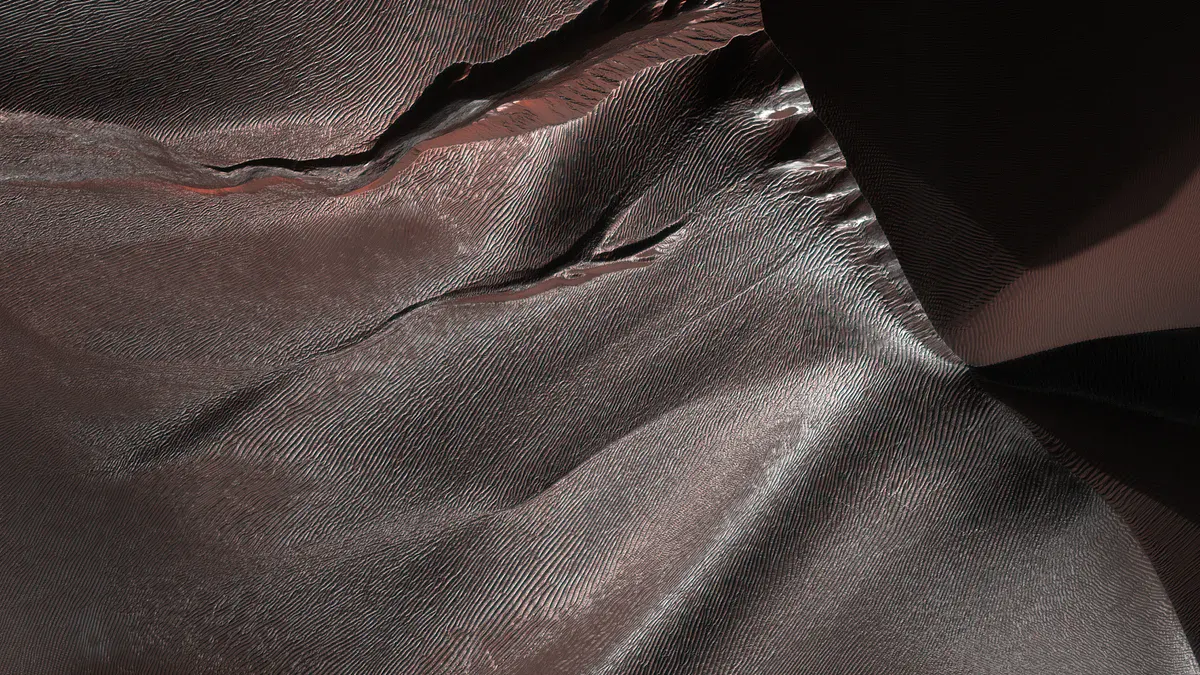
 Some of the “frosted” gullies as seen on Mars. Credit: NASA/JPL-Caltech/University of Arizona
When scientists discovered young-looking gullies on Mars more than 25 years ago, the explanation seemed obvious. On Earth, flowing water produces gullies with eroded hollows, downhill channels and fan-shaped deposits. The Martian features looked as though the same process had shaped them.
You can see why someone would get excited by this. It meant liquid water had flowed across Mars in the relatively recent past, geologically speaking (like millions of years ago). Yet Mars often produces familiar scenery through thoroughly unfamiliar means.
A new study, posted as a preprint on arXiv, suggests that at least one collection of active Martian gullies is being modified without liquid water. Instead, seasonal carbon dioxide frost, better known on Earth as dry ice, may loosen Martian soil and send it sliding downhill in fluid-like avalanches.
The research focused on Sisyphi Cavi, a system of steep-sided depressions near Mars’ south pole. The paper has not yet completed peer review, and its conclusions apply specifically to present-day changes at this location—not necessarily to the original formation of every gully on Mars.
Catching the gullies in the act
 Gullies in Mars’s Matara Crater, imaged by the HiRISE camera on the Mars Reconnaissance Orbiter, with frost visible in the channels./ Photo: NASA/JPL-Caltech/University of Arizona
Mars Global Surveyor first photographed the gullies in images reported in 2000. Scientists proposed that groundwater, melting snow or thawing buried ice had carved them during a time when Mars was warmer or changes in its orbit placed more sunlight on icy slopes.
Then NASA’s Mars Reconnaissance Orbiter (MRO) began repeatedly photographing the same locations. New channels appeared, old channels lengthened and fresh material accumulated at the bottoms of slopes. Some of the gullies were not merely geological leftovers. They were still changing.
As researchers gathered more observations, however, the timing presented a problem. Much of the activity occurred during cold seasons when liquid water would have been extremely difficult to maintain. A 2014 NASA study examined gullies at 356 locations and identified active changes at 38 of them. The activity coincided with seasonal carbon dioxide frost and temperatures too low for liquid water, directing scientific attention toward dry ice.
This was the smoking gun.
×
Thank you! One more thing…
Please check your inbox and confirm your subscription.
Mars’ thin atmosphere is composed mostly of carbon dioxide. During the frigid polar winter, some of that gas freezes directly onto the surface. When spring arrives, the ice does not melt into a liquid. Under Mars’ low atmospheric pressure, it sublimates, changing directly from solid ice into gas.
That seasonal transformation can make the Martian surface unexpectedly active.

The new study, led by Université Paris-Saclay, examined infrared observations from NASA’s MRO and the European Space Agency’s Mars Express. The researchers used data from the CRISM and OMEGA spectrometers, instruments that identify materials by measuring the wavelengths of light they absorb.
The team found abundant carbon dioxide ice at Sisyphi Cavi but no independent deposits of water ice during late spring, when the gullies were changing. Small amounts of water ice might have been trapped inside the carbon dioxide frost, but the observations provided no evidence that it melted or drove the flows.
The researchers also detected faint signs of sulfate salts and clay minerals. Salts can lower water’s freezing point, making them important in the search for possible Martian brines. In this case, however, the minerals were found mainly on surrounding plateaus and near the rims of depressions rather than beside the active gullies. And their distribution suggests that erosion may have exposed older mineral-bearing layers.
The geysers that arrived too early

With water looking increasingly unlikely, the researchers considered carbon dioxide geysers. During spring, sunlight can pass through translucent slabs of dry ice and warm the darker soil underneath. Carbon dioxide at the bottom of the slab turns into gas, building pressure until it erupts through a crack and carries dust onto the surface.
Sisyphi Cavi contains dark spots commonly associated with these eruptions. The new analysis also indicates that its carbon dioxide ice remains translucent through much of the season, providing suitable conditions for geysers.

Yet the geysers and gullies do not keep the same schedule. Dark spots begin forming in late winter and early spring, while most lasting erosion and deposition occurs later, as the seasonal ice thins or disappears. Geysers may contribute to some movement, but the mismatch makes them an unlikely primary cause of the gully changes.
Those involved in the study actually favor a quieter but potentially more effective explanation. As carbon dioxide frost sublimates, the emerging gas may infiltrate the soil, separate its grains and reduce friction. Dust, rock and dry ice could then rush downhill almost like a liquid.
The effect is loosely comparable to an air-hockey puck gliding on a cushion of air. On Mars, that cushion could help an avalanche excavate a channel and spread debris into a fan-shaped deposit without requiring a drop of water.
The result does not erase the abundant evidence that ancient Mars possessed rivers and lakes. Some gullies may have been carved initially by water and modified later by carbon dioxide frost. Other gullies, particularly those with different shapes or locations, may have entirely different histories.
At Sisyphi Cavi, though, Mars appears capable of producing a convincing imitation of water erosion using little more than frozen atmosphere, sunlight and gravity. It is a useful reminder that other worlds do not have to follow Earth’s rules of science.