
Large-amplitude coherent lattice motion provides a powerful route to controlling functionality in quantum materials1,2,3,4,5,6,7. Femtosecond light pulses can drive solids far from equilibrium, creating transient structural configurations with emergent ferroic8,9 or electronic properties10,11,12,13. Displacive excitation of coherent phonons (DECP)14,15 harnesses photo-excited carriers to launch Raman-active modes and thereby steer atomic motion. Van der Waals sliding ferroelectrics16,17,18,19,20,21 are particularly promising for such vibrational control, as their polarization arises from the relative displacement of adjacent layers and remains robust down to the few-layer limit20,21. Driving this sliding motion to extreme amplitudes may even enable ferroelectric switching on ultrafast timescales17,18,22,23,24. Yet, achieving such large displacements within DECP remains challenging, as electronic excitation, damage thresholds and anharmonic decay at high fluence often limit the attainable vibrational amplitude25.
Here, we show that splitting an optical pulse into two time-separated excitations overcomes amplitude saturation of the key phonon mode in a van der Waals sliding ferroelectric, enhancing control over ferroelectric polarization and enabling access to nonlinear lattice phenomena. Using time-resolved second-harmonic generation (trSHG)26,27 and ab initio calculations, we investigate the coupling between interlayer-sliding motion and ferroelectric polarization, and trace the nonlinear amplitude limit to the occupation of high-lying electronic states counteracting sliding phonon generation. Staggered sliding-mode stimulation avoids this compensation, restores linearity and thus amplifies sliding motion beyond the single-pulse limit. By exploiting the enhanced lattice response, we achieve greater control over the ferroelectric polarization and uncover a strong correlation between sliding-mode amplitude, damping and frequency, revealing a form of anharmonic coupling mediated by coherent nuclear motion.
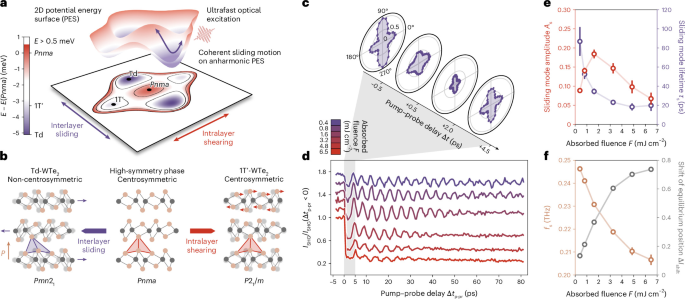
As a model system, we investigate WTe2, a ferroelectric van der Waals semimetal that has recently attracted attention for its giant, non-saturating magnetoresistance and ultrafast optical switching between topologically distinct states28,29,30,31,32,33,34. In its thermodynamically stable ground state, the Td polymorph of WTe2 (stable for temperatures T < 565 K) adopts a trilayer structure that breaks inversion symmetry perpendicular to the van der Waals planes (see calculated potential energy surface in Fig. 1a and lattice structure in Fig. 1b). An uncompensated interlayer vertical charge transfer gives rise to a ferroelectric polarization oriented along the crystallographic c-axis, that is, normal to the layers16,17,18,19. Ultrafast optical excitation across a broad spectral range (from terahertz to visible) depopulates antibonding orbitals between neighbouring layers29,32,33,35. This launches an interlayer-sliding mode at fs = 0.24 THz, which pushes the system towards a high-symmetry configuration on the potential energy surface, eventually restoring inversion symmetry29,33,36,37,38,39 (see Fig. 1a and displacement pattern in Fig. 1b). Such interlayer-sliding motion is expected to strongly influence ferroelectric properties on ultrafast timescales, a feature shared broadly among van der Waals sliding ferroelectrics18,20. Owing to antiparallel interlayer sliding between adjacent layers and electronic screening, the effective polarization in bulk Td-WTe2 is dominated by near-surface contributions19, for which a robust ferroelectric hysteresis and domains have been observed experimentally28. We point out that, although the sliding mode is often referred to in the literature as a ‘shear mode’, it does not break the symmetry of the elastic tensor and is therefore not a shear mode in the strict sense. Thus, it is essential to carefully distinguish between the two terms.
Fig. 1: Ultrafast structural dynamics in ferroelectric Td-WTe2.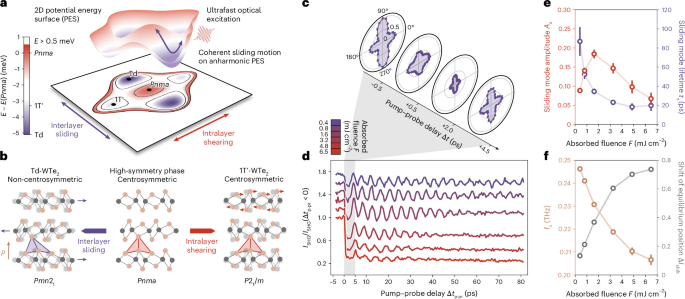
a, Calculated two-dimensional potential energy surface of WTe2 spanned by interlayer sliding and intralayer shear displacements. b, Structural configurations of WTe2 and lattice modes connecting the Td and 1T’ polymorphs to the paraelectric high-symmetry phase. Dark-grey circles, tungsten atoms; light-brown circles, tellurium atoms; grey background structures denote the atomic configuration of the high-symmetry paraelectric phase, included for comparison. c, Polarization-dependent SHG intensity at selected pump–probe delays Δtp-pr. The polarization of the incident fundamental is varied, with the analyser fixed in the horizontal orientation. d, Normalized, delay-dependent SHG efficiency (polarizer: vertical; analyser: horizontal) as a function of absorbed laser fluence F. Traces are vertically offset for clarity. e, Sliding-mode amplitude As and lifetime τs as a function of absorbed fluence F. f, Sliding-mode frequency (brown) and shift of the equilibrium position of the sliding oscillation (grey) extracted from fits to the delay-dependent SHG intensity as functions of the absorbed fluence F. Error bars in e and f, 69% confidence intervals (CI) of the fitted parameters; details on the model function are given in the Supplementary Information.
In a first step, we use symmetry considerations to investigate how structural distortions connect the ferroelectric and paraelectric configurations of WTe2 (Fig. 1b). The polar Td phase belongs to the space group Pmn21, whereas the nonpolar, ferroelastic 1T′ phase crystallizes in the P21/m structure. While the interlayer-sliding mode is often discussed in the context of the Td → 1T′ transition, it should be noted that the 1T′ and Td phases are not related by a group–subgroup relationship40. Therefore, the sliding mode does not, by itself, provide a symmetry-allowed pathway between them. Instead, we identify the centrosymmetric Pnma structure as the true high-symmetry reference phase, from which both the 1T′ and Td polymorphs emerge as symmetry-lowering instabilities. The two relevant distortions are the interlayer-sliding mode (\({\Gamma }_{2}^{-}\) irreducible representation), leading to the Td phase, and an intralayer-shear mode (\({\Gamma }_{4}^{+}\) irreducible representation), giving rise to the 1T′ phase. Consequently, the structural pathway connecting the Td and 1T′ phases requires not only interlayer sliding but also intralayer shearing—contrary to the common assumption that sliding alone governs the transition. This lowest-energy route on the potential energy surface bypasses the energetically unfavourable Pnma structure through the simultaneous excitation of both modes (Fig. 1a; see the Methods and Supplementary Note 8 for details on the underlying density functional theory calculations).
To relate the free-energy landscape F to the vibrational spectrum, we perform an anharmonic phonon expansion around the minimum energy structure (Td phase), yielding
$$F={F}_{{\rm{Td}}}+{\omega }_{{A}_{1}}^{2}{Q}_{{A}_{1}}^{2}+{\omega }_{{B}_{1}}^{2}{Q}_{{B}_{1}}^{2}+\gamma {Q}_{{A}_{1}}{Q}_{{B}_{1}}^{2},$$
(1)
where \({Q}_{{A}_{1}} \propto \sqrt{(P-{P}_{z})^2}\) represents the amplitude of the interlayer-sliding phonon corresponding to fluctuations of the ferroelectric polarization P around the minimum Pz, while \({Q}_{{B}_{1}}\) represents the intralayer-shear phonon. The corresponding mode frequencies are \({\omega }_{{A}_{1}}/2{\rm\pi }:={f}_{{\rm{s}}}=0.24\,\,\mathrm{THz}\) and \({\omega }_{{B}_{1}}/2{\rm\pi }=2.7\,\,\mathrm{THz}\). Thus, interlayer sliding couples directly to the ferroelectric polarization Pz, whereas intralayer shearing couples only indirectly to Pz through nonlinear phonon–phonon interactions, parametrized by the last term in equation (1).
Sliding mode amplitude limitation
SHG, owing to its inherent sensitivity to inversion-symmetry breaking, is an ideal probe of structural dynamics governing ferroelectric order41. In our trSHG experiments, we use 130-fs pump pulses (ℏωp = 0.82 eV) to trigger structural dynamics, and detect the SHG response to the probe pulses (ℏωpr = 1.55 eV) at variable time delays Δtp-pr and optical polarizations (Methods; Supplementary Fig. 5). Tracking the transient symmetry changes in Td-WTe2 following single-pulse optical excitation reveals an initial drop in SHG intensity within 500 fs, concomitant with prominent oscillations at the interlayer-sliding-mode frequency fs (Fig. 1c,d and Supplementary Fig. 2).
Maximizing the sliding-mode amplitude provides greater leverage over the ferroelectric polarization. To explore the limits of the linear coupling between electronic excitation and the sliding-mode amplitude, we perform fluence-dependent trSHG measurements (Fig. 1c,d). Increasing the absorbed fluence from 0.4 to 6.5 mJ cm−2 progressively shifts the equilibrium position Q0 towards the centrosymmetric Pnma configuration (compare Fig. 1a) and leads to a pronounced softening of the sliding mode. This is reflected in a long-lived shift of the equilibrium position and fluence-dependent frequency shifts, respectively (Fig. 1f; for details on data analysis, see Supplementary Notes 1 and 2). Most notably, the sliding-mode amplitude initially increases with fluence, then reaches a maximum around an absorbed fluence of Fsat ≈ 1.6 mJ cm−2, and even declines at higher excitation levels (Fig. 1e, red trace). This counterintuitive reduction imposes a fundamental limit on the extent to which displacively excited coherent lattice motion can manipulate ferroelectricity. Together with transient reflectivity and time-resolved X-ray diffraction measurements on WTe2 (ref. 39) and MoTe2 (ref. 42), our results suggest that such saturation behaviour is a general characteristic of sliding ferroelectrics.
Understanding the fluence-dependent behaviour of the sliding-mode amplitude requires going beyond the conventional, linear DECP model, which assumes a linear relationship between excited-carrier density and coherent-phonon amplitude14. Instead, we account for the contributions of individual electronic states at different energies to the effective electron–phonon coupling at the sliding-mode frequency. To this end, we perform ab initio calculations43,44 to determine the driving force on the sliding mode as a function of the optically induced transient electronic temperature (see the Methods and Supplementary Note 7 for details).
Figure 2 a displays the state-resolved driving forces for the sliding mode at electronic temperatures Telec = 2,000 K and Telec = 4,000 K, that is, above and below the amplitude-limiting threshold. The contributions of individual states are weighted by their occupation, governed by changes Δfelec in the Fermi–Dirac distribution at the transient electronic temperature following optical excitation. At low excitation laser fluence, that is, low electronic temperature, changes in occupation of electron- and hole-like states near the Fermi energy EF generate net positive sliding forces. With increasing fluence, higher-energy states become populated, which instead counteract the excitation of directed sliding motion. This response is not captured by linear DECP theory and requires the state-specific ab initio approach introduced here. Recent theoretical work indicates that selective population of higher-lying electronic states can launch the sliding mode in the opposite direction32. In this picture, the effective lattice response in our measurements is governed by a competition between two opposing contributions: coupling to low-energy electronic states drives the lattice towards the high-symmetry Pnma configuration, whereas coupling to higher-lying states favours motion in the opposite direction. As the fluence and, consequently, the electronic temperature increase, the transient population of higher-energy states becomes more significant. This reduces the net driving force towards the high-symmetry phase and, in turn, the observed sliding amplitude (Fig. 2b).
Fig. 2: Ab initio modelling of sliding-amplitude saturation.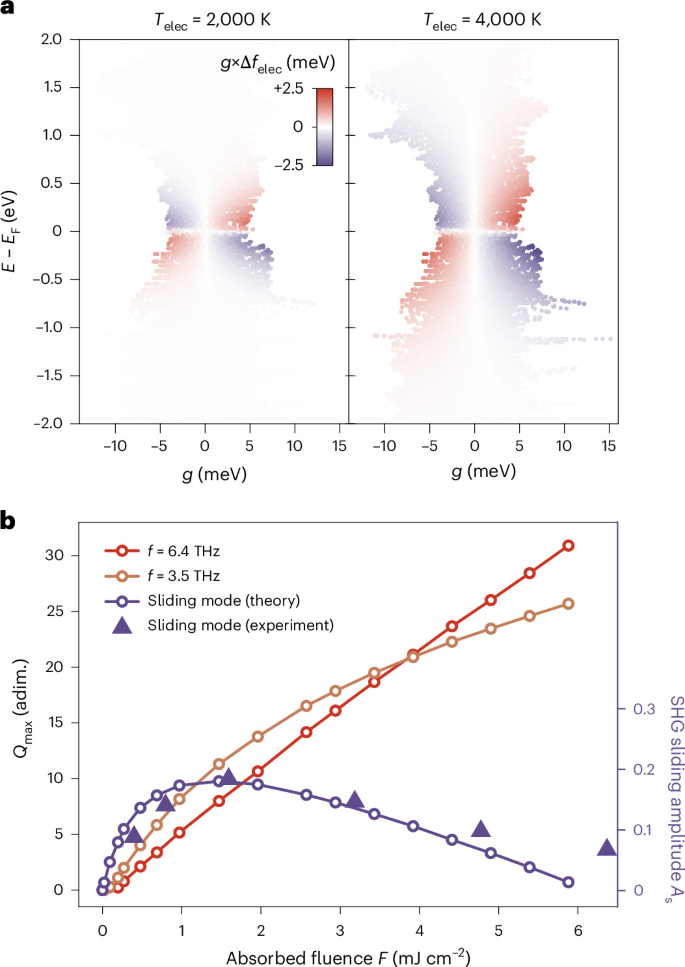
a, State-resolved electron–phonon coupling strength g at the sliding-mode frequency at two electronic temperatures Telec = 2,000 K and Telec = 4,000 K. Red (blue) indicates positive (negative) contributions to the sliding mode excitation, with more saturated colours corresponding to stronger coupling. Along the energy axis, the coupling strength g is weighted by the change in the Fermi–Dirac distribution Δfelec at the respective temperature. b, Calculated maximum amplitudes Qmax of the sliding mode and of two higher-frequency modes of Td-WTe2 as a function of absorbed fluence F. Triangular data points represent the sliding-mode amplitudes determined in our experiments as presented in Fig. 1e.
The saturation behaviour is specific to the sliding mode, whereas higher-frequency modes exhibit a continuous, monotonic increase in amplitude. Comparison between experimental data and the ab initio model reveals close agreement in the fluence-dependence of the sliding-mode amplitude (Fig. 2b). More specifically, our calculations predict a saturation of the sliding-mode amplitude at an electronic temperature of Tsat = 3,100 K. In the experiment, this corresponds to an absorbed fluence of Fsat = 1.6 mJ cm−2, consistent with the experimental value. Beyond this fluence, both experiment and theory show a decline in sliding-mode amplitude. Our observations are further supported by recent theoretical work on the prototype sliding ferroelectric MoS2, revealing nonlinear ionic and electronic contributions to the ferroelectric polarization under ultrafast excitation as a function of excited-carrier density22.
Coherent control and amplification of sliding motion
The sliding-amplitude limitation restricts coherent vibrational manipulation of the material’s ferroelectric16,18,28 and topological29,32 properties to low fluences. This motivates the search for control schemes that beat the limit posed by electronic excitation and reach hitherto inaccessible phonon amplitudes. Specifically, we aim to overcome the sliding-mode amplitude limitation by a double-pulse excitation scheme12,13,45,46,47,48. Repeated in-phase excitation of coherent phonons by optical pulse trains has been shown to selectively amplify targeted vibrational modes to high amplitudes49,50,51. Such ‘cold’ driving schemes rely on vibrational coherence persisting beyond the electronic excitation. Our single-pulse excitation experiments confirm that the sliding mode in WTe2 satisfies this condition, supported by earlier studies29,33,36,37,38,39.
We therefore split the pump pulses in two and record trSHG traces as a function of the mutual delay Δtp1-p2 between the two pump pulses and the double-pump–probe delay Δtp-pr (see Fig. 3a). Strong modulations of the vibrational amplitude for different double-pulse delays Δtp1-p2 demonstrate coherent control over the sliding-mode amplitude As in the excited state (see selected SHG traces in Fig. 3b), corroborated by ab initio calculations (Fig. 3c; see Supplementary Note 3 for a detailed discussion of Fig. 3a). Comparing double-pulse SHG traces for Δtp1-p2 = 0, where both pump pulses act as a single excitation, and Δtp1-p2 = 2Ts (Ts = 2π/fs), we find that, for equal total optical energy, sequential optical excitation yields up to 50% higher sliding amplitudes (Fig. 3d). This key result is visualized in Fig. 3f, which directly compares the yields of single- and double-pulse excitation and shows that sequential excitation extends the linear relation between optical energy and sliding amplitude in the targeted non-equilibrium state. This behaviour most likely arises because double-pulse excitation—unlike a single strong pulse—avoids electronic temperatures above Tsat and thus minimizes the population of higher-lying electronic states that drive the sliding mode in the opposite direction (Fig. 3g). For in-phase excitation, the two vibrational wave packets launched by the double-pulse sequence interfere constructively, yielding a larger amplitude than in the single-pulse case.
Fig. 3: Coherent control and amplification of sliding motion.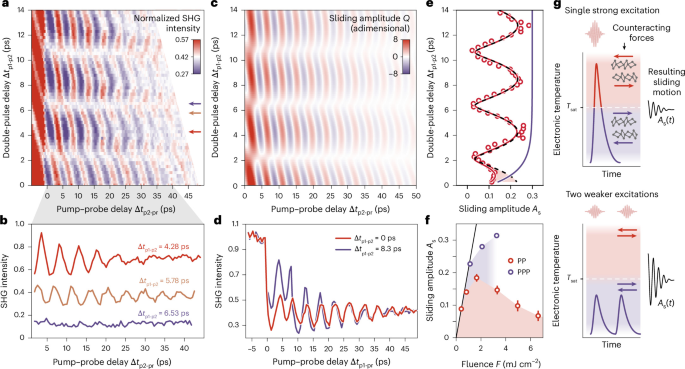
a, Normalized SHG intensity as a function of pump–probe delay Δtp-pr and double-pulse delay Δtp1-p2 for a combined absorbed fluence of 2.1 mJ cm−2. Red, brown and violet arrows indicate double-pulse delays corresponding to pump–probe traces shown in c. b, Pump–probe SHG traces at selected double-pulse delays Δtp1-p2, demonstrating coherent control of the sliding-mode amplitude. c, Simulated sliding-mode amplitude Q as a function of Δtp-pr and Δtp1-p2, assuming an amplitude-dependent sliding frequency. d, Comparison of pump–probe SHG traces for Δtp1-p2 = 0 ps and Δtp1-p2 = 8.3 ps. e, Sliding-mode amplitude after the second optical excitation as a function of Δtp1-p2. Dashed black line, expected behaviour in coherent control experiments without amplitude saturation (Methods); red line, fitted model incorporating amplitude suppression at short double-pulse delays; violet line, transient suppression of the sliding mode extracted from fits to the experimental data (see the Methods for details). f, Comparison of vibrational amplitudes extracted from pump–probe (PP) and pump–pump–probe (PPP) measurements. Black line, estimated vibrational amplitude assuming a linear dependence of As on the excited-carrier density. Error bars, 69% CIs of the fitted sliding amplitudes As. g, Schematic illustration of sliding-mode enhancement induced by double-pulse excitation. Red (violet) shading denotes higher-lying (lower-lying) electronic states that initiate sliding motion away from (towards) the Pnma structure.
In this respect, analysing the sliding-mode amplitude after the second excitation as a function of Δtp1-p2 reveals a strong suppression for overlapping pump pulses compared to the delay-dependent amplitude expected in coherent control experiments (see red-shaded area near Δtp1-p2 = 0 in Fig. 3e). The suppression persists for inter-pulse delays up to ~2 ps (compare violet trace in Fig. 3e). This timescale agrees with the carrier lifetimes determined by time- and angle-resolved photoemission spectroscopy34, supporting our hypothesis that excitation of charge carriers to high energies above the Fermi level counteracts sliding-mode generation. We note that saturable absorption in WTe2 on a few-picosecond timescale52 cannot account for this behaviour as the magnitude of that effect appears insufficient to explain the pronounced sliding mode saturation and, in particular, its subsequent decline.
Large-amplitude coherent vibrational spectroscopy
In a next step, we exploit the fact that we can beat amplitude saturation by well-timed sequential excitation to enable large-amplitude coherent vibrational spectroscopy in the excited state. In particular, double-pulse excitation not only facilitates enhanced vibrational amplitudes but also allows precise control over the amplitude while keeping other key degrees of freedom, such as electronic excitation and temperature, constant53,54,55. This makes it possible to isolate correlations between the coherent sliding-mode amplitude on the one hand, and its damping and frequency on the other hand55 (Fig. 4a).
Fig. 4: Large-amplitude vibrational spectroscopy in targeted excited states.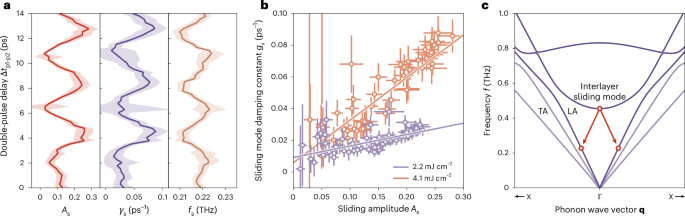
a, Sliding-mode amplitude As in the SHG signal, damping \({\gamma }_{{\rm{s}}}={\tau }_{\text{s}\,}^{-1}\), and frequency fs as a function of the double-pulse delay Δtp1-p2 for a combined absorbed fluence of 2.1 mJ cm−2. The sliding-mode amplitude As has been normalized to the SHG signal measured at Δtp-pr < 0. Red/violet/brown traces, Δtp1-p2-dependent parameters extracted from fits to the two-dimensional dataset shown in Fig. 3a. Light-coloured error bands, 69% CI of the fitted parameters, centred around the respective parameter value. b, Sliding-mode damping constant γs as a function of the sliding-mode amplitude As for two different combined fluences in double-pulse experiments. Solid red and violet lines, linear models fitted to the data to determine (Δγ/ΔA)s. Horizontal and vertical error bars represent 69% CIs of the parameters As or γs, respectively, extracted from fits to the data in Fig. 3a. c, Low-energy phonon band structure of WTe2. Red arrows indicate an exemplary pathway for the Klemens-like decay of the sliding phonon into two acoustic phonons of opposite momentum. TA and LA, transverse acoustic and longitudinal acoustic phonon branches.
Applying this scheme, we observe a strong correlation between the sliding mode’s initial amplitude As and its damping constant \({\gamma }_{{\rm{s}}}={\tau }_{\text{s}\,}^{-1}\) across the full amplitude range (Fig. 4a,b). This behaviour indicates that damping is mediated by the coherent vibrational amplitude. Crucially, this is not observable under equilibrium conditions, where nuclear wave packets remain centred at their equilibrium positions irrespective of temperature. Amplitude-dependent damping traces recorded at different combined fluences reveal a strikingly linear relation, characterized by the slope (Δγ/ΔA)s, with larger coherent amplitudes producing proportionally stronger damping (Fig. 4b). Notably, (Δγ/ΔA)s itself increases with combined fluence, such that for a given initial sliding amplitude, higher overall excitation enhances the damping.
To identify the microscopic origin of this amplitude- and fluence-dependent damping, we consider a Klemens process56,57,58 as the most probable decay mechanism for the sliding mode. As the lowest-energy optical phonon, the sliding mode can decay into two lower-energy acoustic phonons with opposite momentum (Fig. 4c). Stimulated phonon decay has been predicted to strongly enhance optical-phonon damping under non-equilibrium conditions, with the decay rate of the optical phonon governed by the populations of the optical and acoustic modes59.
Consistent with this picture, the two experimental trends established above naturally emerge from stimulated decay of the sliding mode into acoustic modes. First, the damping increases with increasing excitation of the sliding mode. Second, the damping grows with combined fluence, as higher overall excitation enhances the population of low-energy acoustic branches and thus scattering into them. Therefore, stimulated phonon decay provides a microscopic rationale for the observed amplitude- and fluence-dependent damping.
The sliding-mode frequency, on the other hand, exhibits a clear anticorrelation with the sliding amplitude (compare red and brown traces in Fig. 4a): as the amplitude increases, the frequency softens. Because both the lattice temperature and the level of electronic excitation are fixed in double-pulse experiments, a significant contribution from electronic softening, as reported in other semimetals60, can be excluded. We therefore attribute the observed amplitude-dependent frequency shift to intrinsic lattice anharmonicity, explored by large-amplitude coherent nuclear motion.
In pump–probe experiments, even such clear linear relations between coherent-phonon amplitude, damping and frequency are difficult to extract unambiguously, as variations in phonon amplitude are intertwined with electronic excitation (compare pump–probe and pump–pump–probe data in Supplementary Fig. 6). Double-pulse excitation overcomes this limitation by enabling independent control of the phonon amplitude within a targeted excited state.
Discussion and summary
In summary, we have demonstrated that redistributing the energy of a single ultrafast excitation into two pulses overcomes the amplitude limitations of key vibrational modes, enhancing control over ferroic order and revealing non-equilibrium lattice dynamics. Our results show that the linear relationship between excited-carrier density and coherent vibrational amplitude assumed in DECP14 is an oversimplification, highlighting the potential of sequential excitation to surpass the resulting nonlinear limits and access large-amplitude dynamics. Such strategies are particularly advantageous in materials where decisive modes are exclusively Raman-active and coupled infrared-active modes possess only weak dipole moments, rendering nonlinear phononic driving3,8,9 ineffective. More broadly, our results point towards a dynamical extension of the DECP picture, where the photo-induced driving force evolves with the time- and energy-dependent carrier distribution rather than arising from an instantaneous displacement of the equilibrium nuclear positions, consistent with recent observations of delayed coherent-phonon motion in semimetallic Sb (ref. 61).
Owing to the shared structural motifs of van der Waals materials and the universality of DECP, we expect the sequential excitation scheme demonstrated here for WTe2 to be broadly applicable to other systems and their vibrational degrees of freedom, particularly other sliding ferroelectrics. Having established this more efficient driving mechanism in a bulk system, a natural next step is to extend it to ferroelectric bi- or trilayers. In these technologically promising systems, sliding motion is predicted to be governed by modified interlayer interactions62. In this context, large-amplitude vibrational spectroscopy enabled by multipulse excitation provides a powerful means to investigate and tailor phonon–electron and phonon–phonon interactions far from equilibrium54,55. We envision that leveraging vibrational coherences near topologically trivial and paraelectric configurations opens new avenues for coherent control of both topology and ferroelectricity in functional materials.