
October 22, 2026
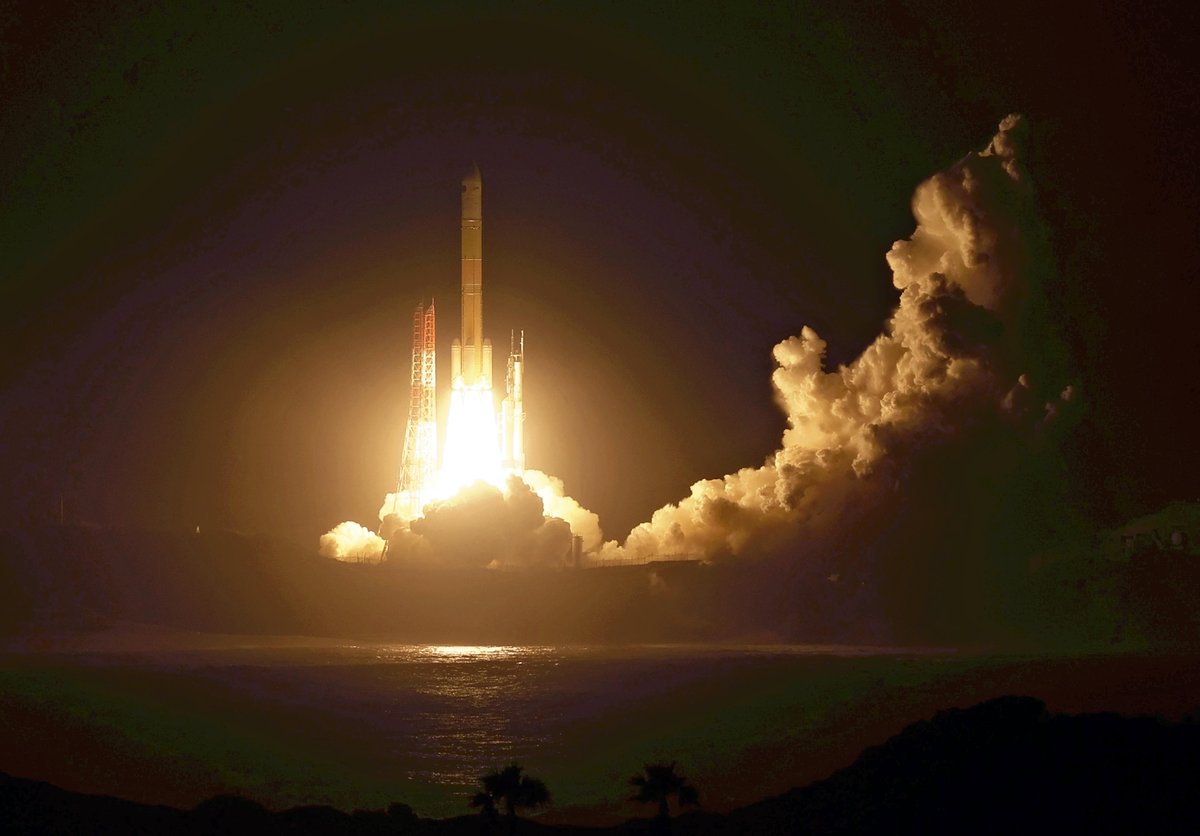
TOKYO – Japan’s Martian Moons eXploration (MMX) probe began a long journey on Tuesday, with its outbound trip to exceed 500 million kilometers. Will the mission, which aims to deliver samples from the Martian moon Phobos to Earth, shed light on how the solar system was formed? The next five years will put Japanese technology to the test.
2 hypotheses
The ambitious MMX project will take about two years for the trips to the neighborhood of Mars and back, and about three years for exploration. “The long journey toward humanity’s first sample returned from near Mars has begun,” Hiroshi Yamakawa, president of the Japan Aerospace Exploration Agency (JAXA), said at a press conference on Tuesday.
Phobos, which is one of two moons that orbit Mars and has an altitude of about 6,000 kilometers, is a small celestial body with a diameter of 20 to 30 kilometers. MMX will land on this moon to collect samples that will be analyzed to investigate how Phobos was formed.
There are two leading hypotheses for the origin of Phobos. One is the “asteroid capture hypothesis.” According to this hypothesis, an asteroid that was flying by Mars was captured by the planet’s gravity and became a moon. The second hypothesis is the “giant impact hypothesis,” in which a celestial body collided with Mars, and the scattered debris gathered to form the moon.
Hokkaido University Prof. Kiyoshi Kuramoto, an expert on planetary science who oversees MMX’s scientific research, said: “The chemical and mineral compositions implied by the two hypotheses are completely different. Analyzing the samples will definitively settle the question of its origin.”
If the samples are rich in water-bearing minerals and organic matter, as with the samples from the Ryugu asteroid that were brought back to Earth in 2020 by Japan’s Hayabusa2 probe, then the asteroid capture hypothesis becomes the leading candidate. On the other hand, since the main components of Mars’ crust have been identified through past missions, if the same substances are found in the samples from Phobos, the likelihood increases that the giant impact hypothesis is correct.
Moons like Phobos are believed to have formed in large numbers during the early stages of the solar system’s formation, and Phobos’ origin could offer a valuable clue for understanding that formation.
“We may be able to understand the mechanisms behind the formation of the solar system,” said Yasuhiro Kawakatsu, the MMX project manager at JAXA.
A fraction of Earth’s gravity
The mission’s greatest challenge is the landing on Phobos, which is scheduled to take place around early 2029. Since the gravity of Phobos is only about one-2,000th that of Earth’s, there is a risk the probe could bounce off the surface due to the impact of the landing and tip over. To reduce this risk, Japanese technology — which was successfully used to bring back a sample from Ryugu and conduct a lunar landing with the Smart Lander for Investigating Moon (SLIM) in 2024 — was fully mobilized for the development of MMX.
The spacecraft is equipped with four landing legs designed to absorb the impact of the landing. It also uses image-based navigation, which estimates the probe’s location using images of Phobos taken during flight and automatically corrects its flight course. This technology was tested in the SLIM probe’s landing on the Earth’s moon.
High-precision course control is essential for this mission. Nagoya University Prof. Seiichiro Watanabe, an expert on planetary science, said, “It is extremely difficult, even compared to the Hayabusa2.” In fact, the Nozomi Martian probe, launched by Japan in 1998, failed to reach the planet’s orbit.
Discovery of the century?
Experts around the world are focused on the Martian dust believed to have accumulated on Phobos. If it contains any traces of life, it could be the discovery of the century.
Organic molecules and water — the essential ingredients of life — have already been confirmed on Mars. Evidence from surface features strongly suggests that large quantities of liquid water once existed there, and it is believed that ice still exists both underground and on the surface.
If the MMX mission succeeds, humans will be able to directly examine samples brought back from the Martian environment for the first time. “The likelihood of finding traces [of life] is higher than for any other sample,” said University of Tokyo Prof. Seiji Sugita, an expert on planetary science.
In recent years, there have been a series of reports suggesting the possibility that life once existed on Mars. Last year, NASA announced that rock data transmitted to Earth by the Perseverance Mars rover indicated a substance that can be produced by microbial metabolism. Samples from Phobos may also provide clues as to how a planet capable of supporting life was formed.“The MMX project might yield unexpected discoveries,” said Junichi Watanabe, a visiting professor at Kyoto Sangyo University and an expert on planetary science.