
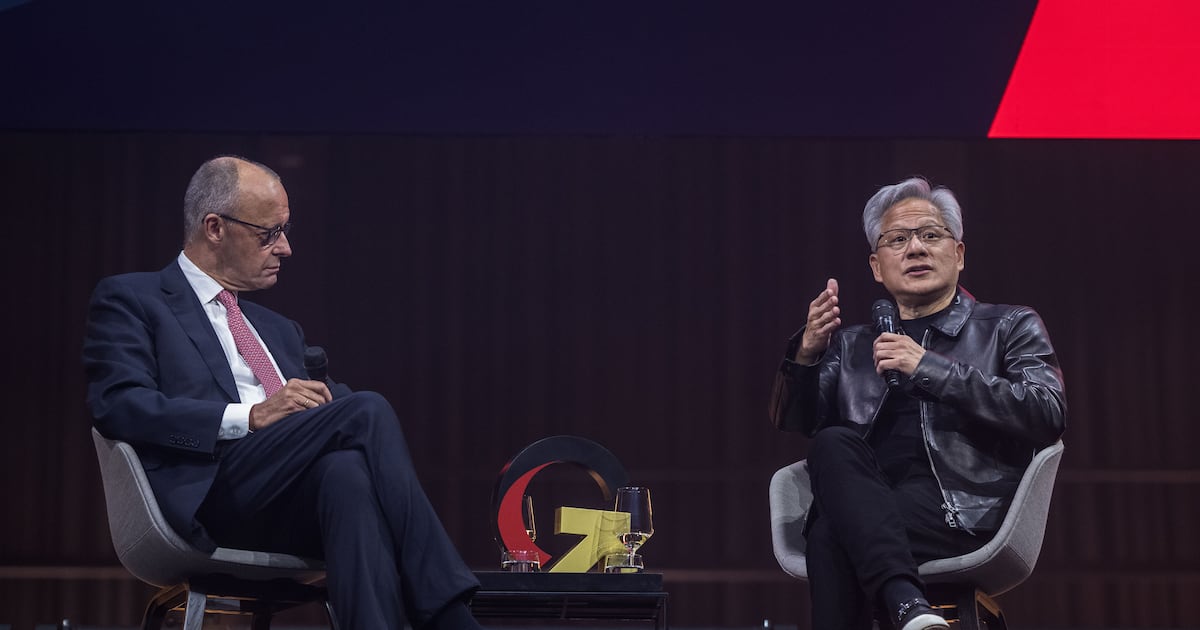
Nvidia chief executive Jensen Huang is not just the king of the chips driving AI, he is also a pro at generating headlines.
In London, days before flying to Berlin, the Taipei-born American engineer-executive was broken-hearted over the sorry state of Germany.
“Nothing hurts me more than to see one of the world’s most technologically advanced countries lagging so far behind,” he said.
On Monday evening and Tuesday, managing his hurt bravely, Huang found himself the target of a very public wooing by chancellor Friedrich Merz.
Huang was guest of honour at the inaugural Invest in Germany event, a humbling sign of the times when Germany has to hustle for business.
But Huang was the ultimate get, smiling and nodding in Berlin on Tuesday as Merz insisted – despite ample headlines and economic data to the contrary – that Germany is open for business.
For Merz, lagging in polls with Europe’s largest sclerotic economy, his pitch was plain: in Europe, only Germany has the industrial AI data that Nvidia needs.
“This is a real secret,” he said, “and a real advantage for Germany to make use of all the data which is already available in our companies.”
For its part the chipmaker has promised to back four German start-ups, part of a commitment of almost $10 billion (€8.9 billion) in Europe-wide spend on companies, universities and research institutions.
Though the German firm names are known, Nvidia did not disclose the size of its respective planned investments. Agile Robots develops AI-powered robots for manufacturing, logistics and healthcare; Avelios Medical programmes AI-powered hospital management software; Mirelo is behind AI models that generate audio for video; and Reflex Aerospace designs and builds satellites.
Merz and his business minister Katherina Reiche were both tight-lipped about the scale of Germany’s investment in the Nvidia partnership, but informed guesstimates are several hundred million euro.
Germany has some cash spare since last year, when Nvidia rival Intel officially cancelled its $30 billion planned investment in eastern Germany, with about a third in state subsidies.
One year on, Germany’s unpopular chancellor can only hope his chips are down, but not out.