

Whatever happens over the final two games, I think this League of Ireland season deserves a closer look than simply asking whether Shamrock Rovers have won another title.
They remain the benchmark. Their consistency over several seasons has earned them that status. But beneath them, something is changing.
Clubs are becoming better equipped to compete, talent is spreading around the division, and the numbers suggest that challenging Rovers is becoming a more realistic ambition.
If you’re a maths head – you may enjoy some of the figures below that back the above sentence up.
Bohemians are the clearest example.
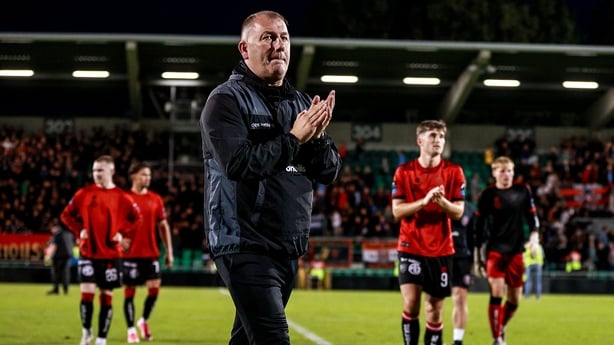
Another season of progress in the league for Bohemians under Alan Reynolds
With two games remaining, they have 62 points. That already exceeds every total they recorded across the previous five seasons. Last year they finished with 54. In 2024 it was 42. Even their strongest return during that period, 58 in 2023, has been surpassed.
They have also scored 60 goals, 12 more than last season, with two matches still to play. Whatever disappointment might accompany finishing second, that is substantial progress.
Continuing this progress over the coming years will be their biggest challenge with the stadium rebuild and all the juggling to come their way.
There is a similar argument at St Patrick’s Athletic, although their biggest improvement has come at the other end.
Pat’s have conceded 28 goals in 34 matches. Across the previous five seasons, they conceded an average of just over a goal per game. This year that figure is down to 0.82, a huge improvement.
They also have the best goal difference in the division, plus 25, yet sit third. Rovers and Bohs are both on plus 19. Pat’s have already matched their 2024 points total and beaten last year’s.
Win their remaining two games and they would finish with 65, their strongest return across the last six seasons.
Another interesting stat from Inchicore is that they have created the most chances in the league, however they are seventh in the league at converting chances.
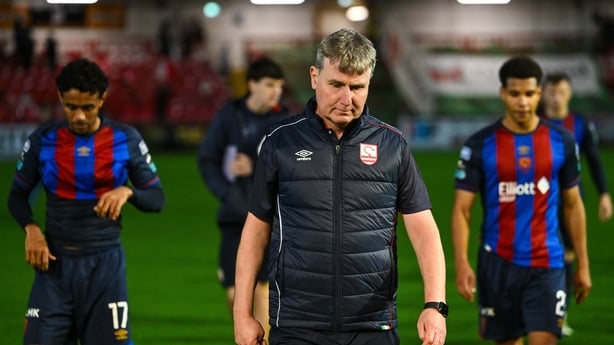
A case of what might have been for Stephen Kenny and St Pat’s
That will not remove the frustration of missed opportunities.
It does, however, provide evidence that something is being built.
I would include Derry City and Shelbourne in that conversation for the future, even if neither has delivered what they would have wanted this season.
Derry’s financial backing and spending have been substantial. Shelbourne, also, have increased investment into the club considerably. Money guarantees nothing, as both clubs know, but it gives them the opportunity to recruit, retain players and build stronger squads. Their current positions should not mean dismissing their potential to challenge.
My feeling now is that good players increasingly have credible options beyond the established champions. That matters a lot.
The obvious being that now, more clubs are capable of assembling strong teams, making it harder for one side to keep everyone at arm’s length.
The foundation underneath all of this is hugely important: we now have ten full-time clubs in the Premier Division. Part-time football at this level is no longer part of the picture.
As a former player, I can’t overstate the value of having time to train, recover and prepare properly. Managers get more opportunities to work on shape and detail.
Players can devote more attention to their football. That doesn’t eliminate differences in budgets or quality, but it has to contribute to greater competitiveness.
For Rovers, the response must include tightening up defensively.
Their scoring has not fallen away dramatically. They are averaging 1.59 goals per match, against 1.63 across the previous five seasons.
Defensively, however, they are conceding 1.03 per game compared with 0.81 across the 2021-2025 seasons, a dramatic increase.
They can and most likely will still win the league, but staying dominant requires addressing that vulnerability.
When the challengers improve, those margins become less forgiving.
Meanwhile, and this is probably my favourite stat, is that us supporters are seeing more goals. The league has produced 474 in 170 matches, already exceeding the completed totals of each of the previous five campaigns.
At 2.79 per match, scoring is approximately 12% above last season and 23% above 2024.
More goals do not automatically mean better football, and a close title race doesn’t mean everybody is equally strong: but let’s be honest, we tune in to watch the back of the net being hit.
Coming across these stats and putting them on paper makes me believe I can see stronger foundations for competition.
Rovers have raised expectations. Other clubs are investing, improving and trying to meet them.
If those clubs turn their resources into consistent performances, winning this league should demand more every year.
That is exactly the direction we should want it to travel.