

Analysis: When it comes a pint of plain, two questions dominate debate: what makes a perfect pint and does Guinness taste best in Ireland?
On a recent architectural walking tour of Dublin pubs with historian Donal Fallon, he pointed out that both The Flowing Tide and The Confession Box pubs on Marlborough Street do a really good pint. A Canadian visitor on the tour turned to me and asked ‘do all Irish pubs not do a good pint?’ His palate was freshly coated from a glass of Guinness in Cleary’s on Amiens Street which tasted like nectar.
If you are a Guinness drinker, you probably have a handful of pubs that you particularly rate for the quality of their pint. My own favourites include Kavanagh’s Gravediggers in Glasnevin, Mulligan’s on Poolbeg Street, Kehoe’s on South Anne Street and the Palace Bar on Fleet Street. Yet one of my most memorable pints was consumed on Inis Mór (one of the Aran islands) having watched the last evening boat pull away from the pier, knowing that we were now there for the night. Does the ambience, company and the context matter? Should it? What role does advertising play in all of this?
We need your consent to load this rte-player contentWe use rte-player to manage extra content that can set cookies on your device and collect data about your activity. Please review their details and accept them to load the content.Manage Preferences
From RTÉ Brainstorm, why are pints so pricey in Ireland?
Guinness has a long history of iconic advertisements, explored by Patricia Medcalf for her PhD in TU Dublin several years ago, and published in 2020 as Advertising the Black Stuff in Ireland 1959-1999: Increments of change, part of the Reimagining Ireland series. The Guinness Storehouse has a separate floor dedicated to this advertising heritage. Early advertisements included the Toucan and messages that Guinness gives you strength.
In 1977, ARKS advertising agency made a Guinness television commercial titled ‘The Island’ which is widely regarded as one of the greatest Irish advertisements of all time. Known famously by its Irish-language line ‘tá siad ag teacht’, this ad depicting Aran islanders waiting patiently for a currach to arrive with a fresh keg of Guinness won the Silver Lion at the Cannes Film Festival. The 1994 ad titled ‘Anticipation’ but more commonly known as ‘The Dancing Man’ is another iconic example.
Tá siad ag teacht: 1977 Guinness ad
Most people do not enjoy their first taste of Guinness. Its bitter flavour takes getting used to. As a teenager, I felt that ordering a Guinness would make me appear more grown-up, but the fact that I asked the barman to put a splash of blackcurrant into it clearly revealed my naivety and early-Guinness-drinking apprenticeship status. Perhaps Mark Zuckerberg should have been offered a dash of blackcurrant by John Collison during his recent ‘Cheeky Pint’ podcast, where the images of our newest Irish castle-owner grimacing at his pint went viral?
So, what makes a good pint? Does Guinness travel well? And how come one of my most memorable pints was on an island off the west coast, nearly as far as possible from the St James’s Gate Brewery as one can travel while still being in Ireland?
what Zuckerberg brought to the Cheeky Pint ▫️ a keg of Guinness ▫️ sourced from Dublin that is the gift Zuckerberg arrived with https://t.co/6gTFRgraXL
— Ruben (@rdominguezibar) October 13, 2026
Let’s start with the first question – what’s the secret to a perfect pint? Keith McGovern and David Beirne run a successful tourism business in Dublin called The Perfect Pint Tour. Last month I was asked by Fáilte Ireland to share my knowledge of Irish food history with some Canadian tour operators and journalists over dinner in Library Street and I joined them on the first stop of their Perfect Pint Tour in Kavanagh’s Gravediggers Pub.
On the journey to the pub in the bespoke minivan, McGovern outlined some of the secrets of the perfect pint, including serving temperature, cleanliness of the glass, short draw of the line –which had been regularly cleaned – and the fact that the keg needs to be rested for several days before being tapped.
In the snug of the Gravediggers, he dismissed the ‘splitting the G’ fad as marketing hype and showed how the perfect pint can be consumed ideally in seven sups—leaving seven lines (or lacing) on the inside of the glass. For this to happen, the glass needs to be perfectly clean. Another insider secret he shared with us is to never let milk or dairy fat into a glass washer. Serious pubs will have a separate washer machine for the cups from their coffee or cappuccino operations.
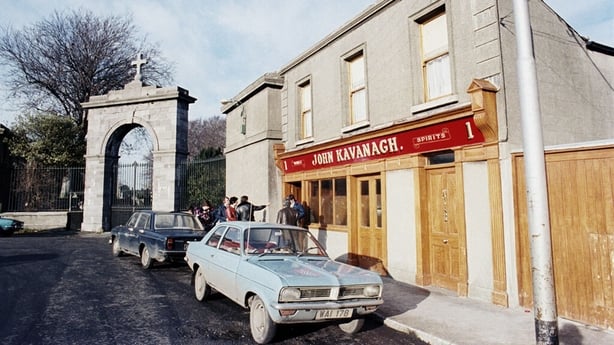
Kavanagh’s Gravediggers pub back in the day. Photo: RTÉ
Then, there’s the second question: does Guinness travel well? A peer-reviewed article in the Journal of Food Science published in 2011 provides some answers. Between October 2008 and September 2009, four researchers, Daniel Kotz, Liam G. Glynn, Christian D. Mallen, and Jochen W.L. Cals, from Ireland, England, Germany and the Netherlands, travelled to 14 countries, visiting 71 different Guinness-serving establishments in 33 cities to try and scientifically evaluate the quality of Guinness both inside (42 tastings) and outside of Ireland (61 tastings).
All four researchers visited the Guinness Storehouse to learn about pouring the perfect pint before they began their field work. They measured the pints on a Visual Analogue Scale (VAS) from one to 100 and adjusted their findings for such factors as pub ambience, Guinness appearance, sensory mouthfeel, flavour, and aftertaste, and both temperature and timing of the pour. The researchers concluded that Guinness does not travel well, as is reflected in their awarding a higher average mark of 74 VAS in Ireland as opposed to the 57 VAS recorded elsewhere.
We need your consent to load this rte-player contentWe use rte-player to manage extra content that can set cookies on your device and collect data about your activity. Please review their details and accept them to load the content.Manage Preferences
From RTÉ Archives, Mary Fanning reports for RTÉ News in 1984 about a campaign by Dublin’s Lord Mayor Michael O’Halloran to save the pint of Guinness
Like all good scientific papers, they highlighted that theirs was the first empirical study to prove that Guinness does not travel well. However, their limitations section was particularly long, noting some potential bias, and many possible other variables that could be tested by any subsequent studies.
Several hypotheses were suggested to explain their results. One conspiracy theory suggested that Diageo produced three different batches of Guinness: the finest, which was served to its own employees, the second best, that was sold to the people of Ireland, and the worst, which was exported. Other explanations included the ‘craic theory’ and the ‘line theory’. The former involves the unique ‘craic’ (fun-loving atmosphere) that one experiences in Irish pubs; the latter reminds us of the earlier mention of having a short and well-cleaned line.
We need your consent to load this rte-player contentWe use rte-player to manage extra content that can set cookies on your device and collect data about your activity. Please review their details and accept them to load the content.Manage Preferences
From RTÉ News, the infamous #PintBaby is tracked down
So why my island pint so nice? There are many factors which may have led to that memorable pint in The American Bar on Inis Mór. I had spent the day walking this beautiful island and there was a taste of sea salt on my lips from the Atlantic breeze. I was on holidays and carefree knowing that the last ferry had just departed. These details might laterally explain why the memory of a bottle of wine you may have enjoyed watching the sunset on summer holidays in Italy with your wife seemed to have been far nicer than the same bottle consumed a month later on a Thursday night at home following a tense dinner because the dishwasher was not emptied. Context clearly matters. Was I subliminally influenced by the ‘tá siad ag teacht!’ ad?
Some of the Perfect Pint Tour explanations may also come into play. The American Bar served lots of Guinness and the kegs were stored directly under the taps (line theory). Moreover, the deliveries would be made weekly, resulting in time for the kegs to have rested for a few days by the time the beer was poured—negating the possible disadvantage that distant travel might wreak on kegs. Furthermore, Keith assured us that the temperature at which the beer is stored and poured is also key, along with the cleanliness of the glass. Most good pubs like the American Bar will ensure these two factors. Finally, the ‘craic theory’ must also come into play as a footloose spirit is almost synonymous with holidaying on the Aran Island, where a good seisiún ceoil can often develop organically.
We need your consent to load this rte-player contentWe use rte-player to manage extra content that can set cookies on your device and collect data about your activity. Please review their details and accept them to load the content.Manage Preferences
From RTÉ Radio 1’s History Show, the social and cultural history of the Irish pub with Donal Fallon, author of The Dublin Pub, and Perry Share and MoonYoung Hong, editors of The Irish Pub
Whether you find yourself in Dublin, Dún Chaoin, Dusseldorf, Delhi or Durban, several factors discussed may influence your enjoyment of the pint of plain. If we are to honestly recall our own first reaction to tasting Guinness, we might be a little kinder to Zuckerberg’s facial gymnastics. Keith McGovern had a bottle of blackcurrant ready to smooth the first experience of some of our guests who were finding the bitterness challenging.
Similar to many other classic foods (olives, dark chocolate, coffee and indeed red wine), I would suggest that Guinness is worth becoming accustomed to. Wherever you reside globally, and in spite of how well your local Guinness has travelled, I would recommend a regular pilgrimage to the home of the black stuff. Donal Fallon’s The Dublin Pub: A Social and Cultural History will be your guide.
Follow RTÉ Brainstorm on WhatsApp and Instagram for more stories and updates
The views expressed here are those of the author and do not represent or reflect the views of RTÉ. Drink responsibly