
We need your consent to load this EBU contentWe use EBU to manage extra content that can set cookies on your device and collect data about your activity. Please review their details and accept them to load the content.Manage Preferences
Species detection dogs – these are dogs that can sniff out endangered species. According to scientists, the potential for this is huge. However, the method is still new and there are currently few trained dogs. BR24 has accompanied one of them.
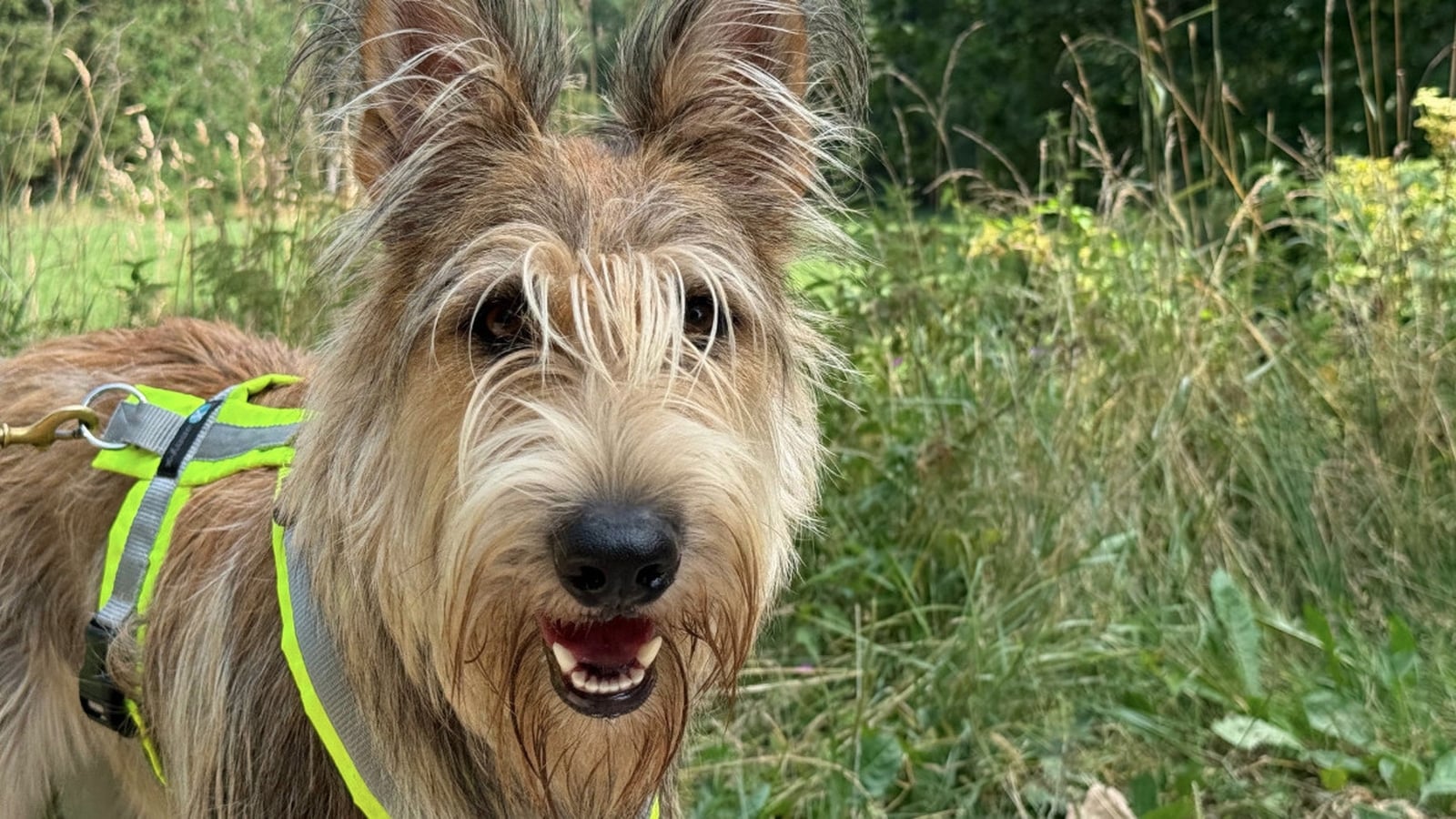
Arnie has an important task today: The species detection dog is to find the endangered freshwater mussel in a stream near Landshut (Bavaria). His owner Irene Wagensonner has a scent sample in a plastic bag. Then Arnie sniffs along the water’s edge. Wagensonner knows what to watch for: If Arnie sits down, it’s a sign that he has found the mussels.
And it works: The dog of the Berger de Picardie breed eventually discovers a whole series of bivalves. Without Arnie, Wagensonner would have had to walk through the streambed to find mussels. The danger of accidentally stepping on some would have been great.
The challenge: Sniffing out species – without disturbing them
Independently, Wagensonner has trained her dog to be a species detection dog. Wagensonner is a biologist. The challenge: Arnie should not only sniff out endangered species but also indicate to his human handler – without disturbing the animals.
Wagensonner has trained her animal not to bark or scratch once it detects the desired scent, but simply to sit. “Of course, I have to make sure the dog doesn’t get too close, but I’ve already practiced that with him. Normally, he should now keep a distance of one and a half to two meters,” says Wagensonner.
Thanks to Arnie, many animals have already been found and protected. He particularly helps with beetles, which are often nocturnal and need to be trapped for mapping, or with reptiles, which are only active in nice weather and usually sunbathe hidden. For biologists, they are hard to find.
The same goes for nocturnal amphibians like fire salamanders, which only appear briefly in streams in spring to lay their larvae and otherwise live hidden in the forest.
Studies: Dogs can detect species better than humans.
In Germany, the process of using dogs to detect species is still relatively new, while it is already widespread in North America. Studies show that the method has enormous potential. Leading in German-speaking research is Annegret Grimm-Seyfarth, a professor for biodiversity and conservation at the Dresden University of Applied Sciences. In an evaluation of studies, she has shown that in 90 percent of the cases examined, dogs can detect endangered species better than humans through classic methods.
Deutsche Bahn already uses detection dogs
The potential of detection dogs is already being utilized today in mapping dead specimens under wind turbines. For instance, dogs reliably track down bats that have been killed by rotor blades.
According to Grimm-Seyfarth, the largest practical example is Deutsche Bahn (German train services). They regularly commission new mappings of land along railway lines to check the presence of species before new laying or cleaning. They employ their own detection dog team for this purpose.
There is a lack of standardized training
Aside from that, the method is still hardly used in Germany – as there is a lack of standardized training and thus a lack of dog examination and certification. “Because dog owners usually train their animals themselves, errors can occur during training,” says Grimm-Seyfarth. She also researches at the Helmholtz Centre for Environmental Research in Leipzig.
The result: Authorities are hesitant regarding the recognition of species detection dogs. To change this, there first needs to be an examination regulation and trained trainers.
UN discusses species protection
Detecting and recording species is of great importance for nature and species conservation. The Earth is currently experiencing a mass extinction of species. There is also an overall decline in biomass. The loss of habitats, such as through deforestation for agricultural land, but also through climate change, environmental pollution, and overexploitation of wild animal stocks, such as in fishing, is the main driver of species extinction. The 17th UN Biodiversity Conference in Yerevan, Armenia, is currently discussing how to stop species extinction in the coming years.
An article written by Rebecca Reinhard (BR), initially published on 26 October 2026, 09:08 (CET)