
The Trump administration is moving to weaken federal rules designed to force oil and gas companies to cut their emissions of methane, a gas considered a “super pollutant” because it traps so much heat in the atmosphere.
President Trump announced the plan at a campaign rally on Tuesday evening in Lubbock, Tex., for Republican Senate candidate Ken Paxton. Mr. Trump said the Biden-era rules were “expensive and unnecessary.”
The move marks one of the most significant steps by the Trump administration to scale back federal policies designed to tackle climate change.
Methane, the main component of natural gas, traps about 80 times more heat in the atmosphere in the short term than carbon dioxide does. It is responsible for nearly one-third of the rise in global temperatures since the start of the Industrial Revolution, and experts have said that reducing methane leaks is one of the fastest ways to slow global warming.
The Biden administration issued rules in 2023 that would have required oil and gas facilities to monitor their operations and prevent methane from leaking into the atmosphere. The Trump administration had already delayed those rules from taking effect.
Now the Environmental Protection Agency is proposing to relax requirements to curb methane emissions from hundreds of thousands of “marginal” oil and gas wells that are nearing the end of their useful lives and have relatively low output. These wells account for around 7 percent of U.S. oil and gas production but produce roughly half of the industry’s methane emissions, the agency has previously said.
Trump administration officials have cast the move as an effort to bolster U.S. oil and gas production and ease prices for consumers. High fuel prices, driven up by the U.S.-led war with Iran, are weighing on Republican candidates ahead of next week’s midterm elections. In Texas, the nation’s top oil-producing state, polls show Mr. Paxton trailing Democrat James Talarico, and Mr. Trump is aiming to boost his campaign.
Lee Zeldin, the E.P.A. administrator, said that the Biden-era rules would have shut down a number of smaller wells and estimated that easing the requirements would save the industry $45 billion through 2050.
“Behind every barrel of oil and every cubic foot of natural gas produced in the U.S. are millions of workers, businesses, and the heartbeat of this nation’s economy,” Mr. Zeldin said in a statement. “The Biden E.P.A. destructively targeted all this. President Trump promised to end the war on oil and natural gas.”
Oil and gas production is the largest industrial source of methane emissions in the United States. Methane can leak from wells, pipelines, storage tanks and other fossil fuel infrastructure. The gas can also come from natural sources such as cows, rice fields and wetlands.
Environmental groups criticized the rollbacks, saying that methane leaks from oil and gas operations were a form of waste that it made sense to curb. They also pointed out that the Biden-era methane rules had been expected to cut other harmful pollutants such as volatile organic compounds, which can form smog, and benzene, which has been linked to cancer.
“Methane leaks are the dumbest kind of pollution because the industry is losing the very product it is selling,” said David Doniger, senior strategist at the Natural Resources Defense Council.
Many large oil and gas companies have said they support at least some limits on methane emissions, noting that they have already invested in expensive technologies to monitor and capture the gas.
But a number of small and independent operators have opposed many of the regulations as costly and overly restrictive. They have said that requiring marginal wells that don’t produce very much oil to cut emissions would force producers to simply shut many of them down.
Mr. Zeldin indicated that the agency would rework regulations for marginal wells, typically classified as those that produce 15 barrels of oil equivalent per day or less. In 2024, those wells accounted for roughly three-fourths of the more than 900,000 oil and gas wells in the United States. While they account for a small fraction of total production, multiple studies have found that these wells yield an outsized proportion of methane emissions.
The E.P.A. is also planning to end its Methane Super Emitter Program, which would have empowered third-party monitors to use satellites and other sensors to quickly identify and report significant methane leaks. Some gas producers had complained that the program would have handed too much regulatory power to environmental groups.
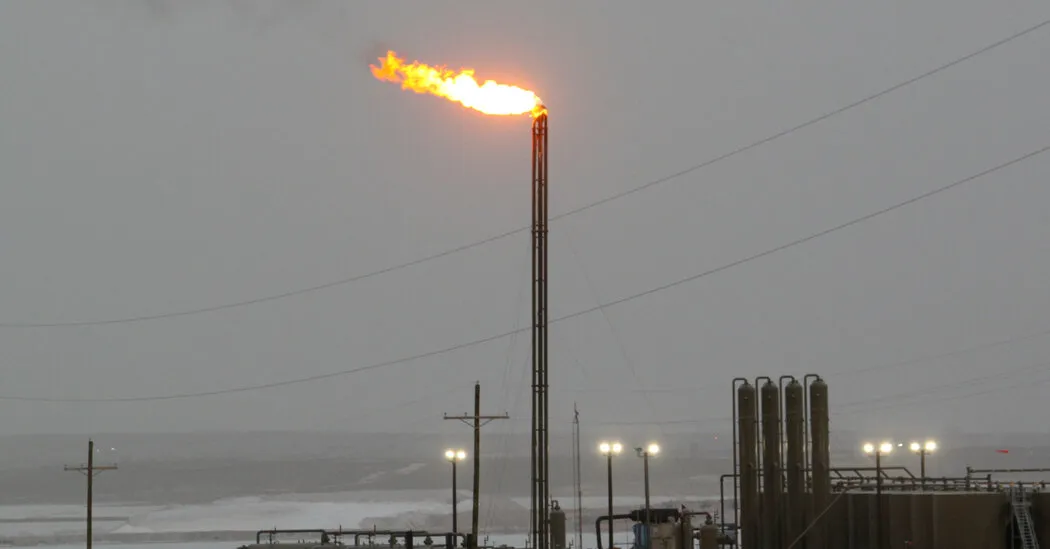
And the agency is proposing to reverse a Biden-era rule that would have required operators to capture associated gas that comes out of oil wells and sell it. The agency said that doing so was not always practical, and that companies would be allowed to burn off the gas, a practice known as flaring, which produces carbon dioxide emissions.
The E.P.A. will solicit public comments on the proposed changes for 45 days before finalizing the rule.
The Trump administration has separately disavowed a Biden-era pledge to cut U.S. emissions roughly in half by 2035. And last year, Republicans in Congress passed a bill that would delay for 10 years a steep fee that Democrats and the Biden administration had imposed on oil and gas firms for larger methane leaks.
Some oil- and gas-producing states are nonetheless moving forward with their own methane regulations. Last month, Colorado adopted rules that would essentially replicate the Biden-era standards. New Mexico, the second-largest producer of crude oil after Texas, is also considering new methane rules.
Shortly after Mr. Zeldin previewed the E.P.A.’s proposal, New Mexico Gov. Michelle Lujan Grisham, a Democrat, highlighted satellite data that showed that the state’s existing rules had already cut methane emissions in half compared with neighboring Texas.
“Rolling back federal standards means more pollution drifting into the lungs of families living next to wells and flares, and a hotter planet for all of us,” Ms. Lujan Grisham said. “In New Mexico, we won’t stand for that. Our methane rules will remain firmly in place, and we’re planning to strengthen them while collaborating with other states to share our nation-leading best practices.”
Maxine Joselow contributed reporting from Washington.