
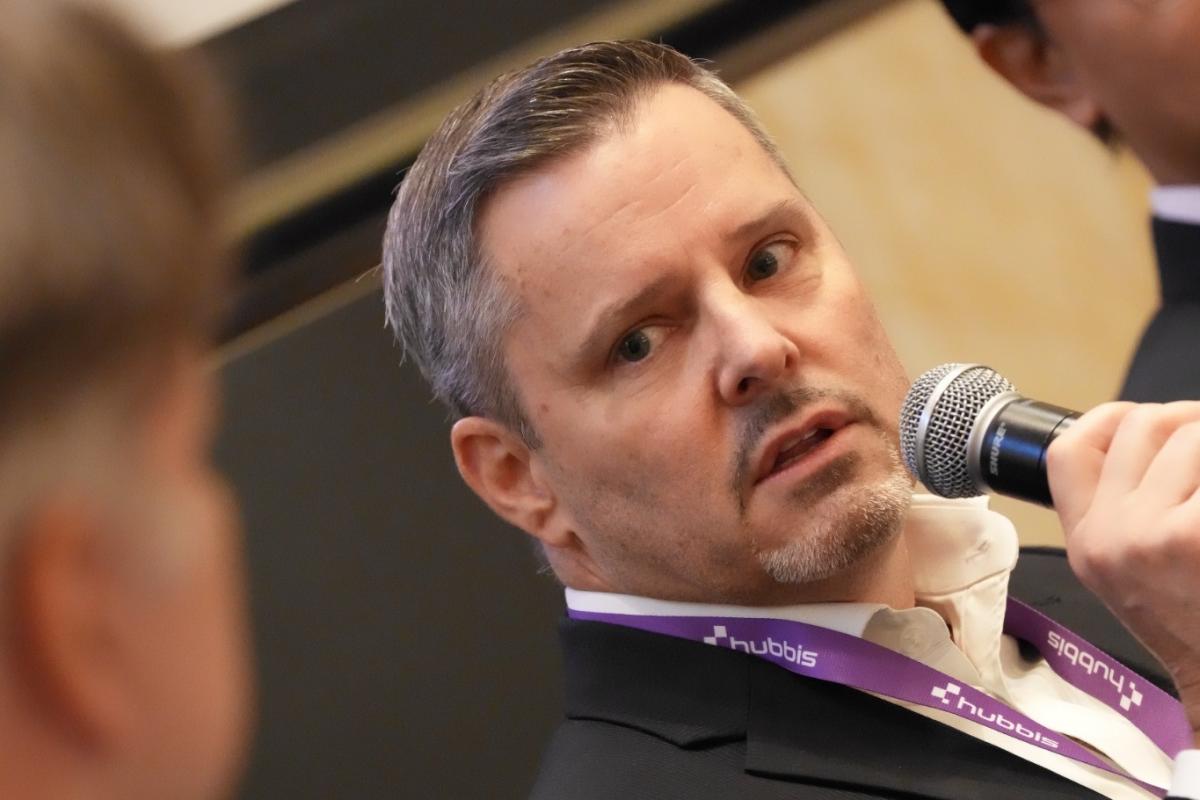
Tokenisation should be understood as an evolution of financial infrastructure, with traditional investments and digital assets increasingly coexisting. Reto Marx argued that the opportunity is substantial, but the industry still needs to advance interoperability, distribution and the underlying economics of operating on digital infrastructure.
Speaking on the final panel at the Hubbis Digital Wealth Forum Singapore 2026, Marx, Chief Executive Officer, Singapore at Sygnum, discussed the work required to bridge those traditional and digital markets. He emphasised education and a holistic wealth management proposition, alongside the technical capabilities associated with digital assets.
Key Takeaways
Tokenisation changes the infrastructure through which financial assets are issued, held, administered and transferred; it does not replace the financial system itself.
Digital and traditional assets still need to be managed within a coherent portfolio and risk framework.
Lower costs are not guaranteed today, particularly where distribution remains limited.
Interoperability and the ability to use digital assets as collateral are critical to unlocking deeper liquidity and broader adoption.
Understanding What Tokenisation Changes
Marx described Sygnum’s role as a digital asset banking group, bringing together expertise across regulated banking, institutional-grade custody, trading, tokenization, security, risk management and regulatory compliance. He noted that investors still require considerable education around what is accessible and how digital assets can be integrated within a broader portfolio.
He sees the proposition as complementary to traditional securities. “Tokenisation is not replacing finance. Tokenisation is re-engineering the underlying financial services infrastructure,” he said.
Tokenised debt, equities and deposits illustrate that distinction. The technology changes how existing financial activities are conducted, rather than necessarily creating a different asset class. Marx distinguishes cryptocurrencies and certain protocols separately from that discussion.
He also cited a recently launched tokenised money market offering from Fidelity as an example of bridging access between the traditional and digital financial markets.
The Limits of the Cost Argument
Marx emphasized that portfolio construction does not cease to matter when assets are digital. The same principle of risk management, diversification and performance expectations still apply, with traditional securities and digital assets increasingly needing to coexist within a coherent investor’s framework.
The operational promise of tokenisation is greater efficiency, faster processes with less friction, but he cautioned against treating lower cost as a benefit already achieved across the board.
“We are not there yet,” he said. “Depending on what you do, you may even have a slightly higher cost still today compared to traditional securities.”
Issuance and distribution illustrate the challenge. Depending on the nature and size of a transaction, conventional methods may still be faster or cheaper. For digital debt markets in particular, Marx said, distribution has yet to reach the scale required to fully realise the efficiency and liquidity benefits of tokenization.
Making Separate Systems Work Together
Many providers still operate within relatively closed ecosystems, according to Marx, limiting the ability of assets to move seamlessly between them, constraining the broader utility of digital financial infrastructure.
He linked further development to greater interoperability and the ability to use digital assets as collateral across different platforms and financial applications. These capabilities can support liquidity and broaden investment opportunities, which in turn can encourage greater adoption and further tokenisation of real-world assets.
Marx expects the financial services industry to continue building out digital infrastructure, even when market attention is dominated by cryptocurrency price cycles. He also acknowledged that parts of the regulatory framework need to further evolve alongside the development of technology and its use cases.
The opportunity, he argues, lies in bridging these different systems, assets and investor needs into a coherent and usable financial ecosystem. “Putting everything in overall context and connecting it, that’s the added value,” he said.
Building a Wealth Management Service
Marx distinguished a comprehensive digital asset wealth management offering from a fintech built around a single product or an exchange platform. He noted the regulatory compliance and risk management demands of the business can be underestimated, particularly by providers focused narrowly on one product or service.
He sees Sygnum as rather advanced in bringing a comprehensive wealth management proposition to digital assets, while recognising that its own product and service range continues to evolve.
His emphasis was on the combination of institutional-grade access, robust governance and the investment expertise required to guide clients and integrate digital assets into a broader portfolio. Connecting those elements is where he expects a specialist provider to earn its place in the wider wealth management relationship.